3 months ago
6
3 months ago
6
Opinion
November 19, 2025 — 5.01am
November 19, 2025 — 5.01am
You recently commented on the tax implications when a super fund has to be disposed of. In our case, on the death of the survivor, the funds go into a trust where the trustee disposes of them to nominated charities. Is there any tax relief from the death tax of 17 per cent payable to a non-dependent which in this case would be the charities?
Leigh Mansell, technical director of Heffron says when it comes to the tax treatment of the super received by a deceased’s estate, the tax law includes look-through provisions.
This means a super death benefit paid to the deceased’s executor is taxed in the same way it would be taxed if it had been paid directly to the beneficiary – the taxable component of the death benefit payment is subject to tax to the extent the estate beneficiaries are tax dependants or non-tax dependants of the deceased.
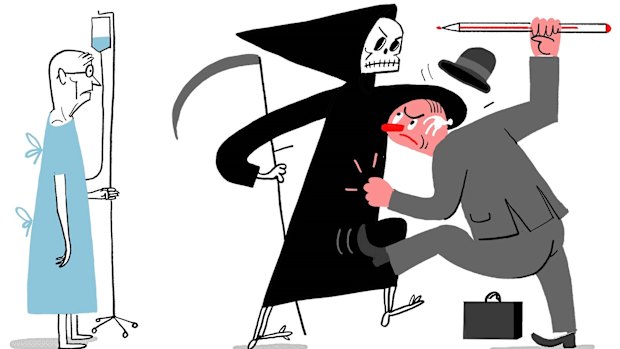
Even death won’t save you from the tax man.Credit: Simon Letch
The tax law prescribes who a deceased’s tax dependants are, and it’s a short list comprised of the surviving spouse and minor children of the deceased, and anyone who was financially dependent on or in an interdependency relationship with the deceased at the time of death.
Charities do not appear on this list – so a charity would be a non-tax dependant beneficiary – which means the taxable component of any super death benefit received by the estate will be subject to tax to the extent the funds ultimately pass to the charity.
Mechanically this means the executor includes the relevant portion of the taxable component of the super death in the estate’s tax return where it’s taxed at marginal rates, but the estate is entitled to a tax offset to ensure a maximum tax rate of 15 per cent applies to the “taxed” part of the taxable component, and a maximum tax rate of 30 per cent applies to the “untaxed” part.
My wife and I have an ANZ home loan with a balance of about $370,000 and an offset account that usually holds about $80,000, though it varies from week to week. The interest rate is 5.54 per cent. Given the recent issues some banks have had, should we be checking that the bank is correctly calculating the interest reduction from our offset account, or can we safely assume they’re getting it right? And if we should check, is there a straightforward way to do so?
It’s simple to check. Multiply your loan balance ($370,000) by 5.54 per cent and divide by 365 to get the daily interest – about $56.15 a day. Then do the same calculation for the $80,000 in your offset account, which gives $12.15 a day.
That means your offset should be saving you roughly $12 a day in interest, leaving a net daily cost of about $44 to $45. Compare that figure with the interest actually charged on your statement, and it should match closely. If there’s a big discrepancy, contact your lender for an explanation.
Loading
My husband and I receive the full age pension and own our home. We’re considering a house-and-land package as our next residence. The land costs $300,000, which we can pay upfront from assets and family help. The house will cost $400,000, payable when it’s built. At that stage, we’ll sell our current home to fund the build, and the new property will become our residence.
While the house is under construction, and we continue to own our present home, will Centrelink assess only the $300,000 land value for assets, or will it also count the $400,000 house cost even though it hasn’t been built or paid for?
Your current home will continue to be exempt from Centrelink means testing, and you’ll be assessed under the home owner assets test. The land you buy will be counted as an asset until you move into the new property.
While you’re still living in your current home, only the amounts you’ve actually paid towards the new build will be included in the assets test. Once you’ve moved in, your new home becomes exempt from the assets test.
Any other assets – including any surplus funds from downsizing – will be counted and may affect your pension. You must also tell Centrelink about any change in your circumstances within 14 days.
It would appear you are both retired and, having passed the age of 60, can access your superannuation at will.
My wife and I are retired – I’m 64, and she’s 60. I receive about $100,000 a year from a defined benefit pension, while my wife has no regular income. Between us, we have about $1.3 million in superannuation in accumulation mode and about $1 million in other cash investments. We own our home outright, which is worth about $1.3 million.
We’d like to move to another area and buy a more expensive home. To avoid the stress of selling and buying at the same time, can we use money from our superannuation funds (and our other investments) to buy the new home, and then repay those amounts to our super funds once we sell our current home?
It would appear you are both retired and, having passed the age of 60, can access your superannuation at will. In addition, your wife may be able to make non-concessional contributions of up to $360,000 under the bring-forward rules, as her total superannuation balance is well below the $2 million limit.
Your non-concessional contributions cap will depend on how much of the super accumulation balance is in your name, in addition to the value attributed to your defined benefit pension for total super balance purposes. The timing of withdrawals and contributions will also be important, so best to take financial advice before proceeding.
Noel Whittaker is author of Retirement Made Simple and other books on personal finance. Questions to: [email protected]
- Advice given in this article is general in nature and is not intended to influence readers’ decisions about investing or financial products. They should always seek their own professional advice that takes into account their own personal circumstances before making any financial decisions.
Expert tips on how to save, invest and make the most of your money delivered to your inbox every Sunday. Sign up for our Real Money newsletter.
Most Viewed in Money
Loading