3 months ago
17
3 months ago
17
Straight out of a sandstone university, Ibrahim Helmy was at the start of his career. Aged 25, the son of Egyptian migrants was two years into a graduate program at NSW’s roads agency in late 2012 when he got to know the owners of a small firm working on Sydney’s M4 motorway. Within months, the University of Sydney civil engineering graduate was helping inflate Complete Linemarking’s invoices in return for taking a cut of the increased amount.
At an Oporto fast-food outlet in Wetherill Park in July 2013, Helmy allegedly picked up his first cash kickback totalling $9288 from one of the firm’s directors, Peco Jankulovski. Five weeks later, they met at the same spot, where Helmy was handed two cash bundles totalling almost $16,000.
It was a harbinger of what was to come. Over the next 12 years, Helmy is accused of masterminding a corruption racket that has rocked Transport for NSW, which absorbed the roads agency in 2019. The alleged wrongdoing involved nine companies receiving at least $343 million worth of contracts, in return for Helmy pocketing $11.5 million in kickbacks.
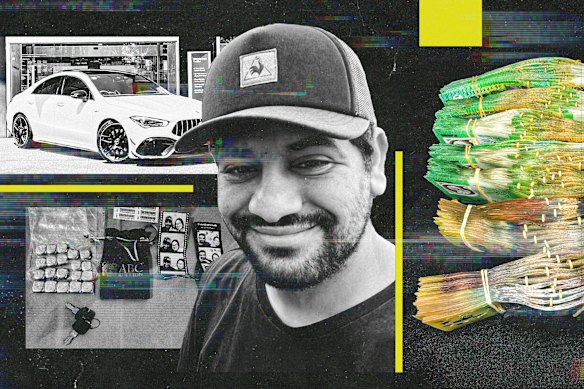
Ibrahim Helmy is alleged to have pocketed $11.5 million in kickbacks, including gold bullion and bundles of cash.Credit: Aresna Villanueva
A 54-day public inquiry at the Independent Commission Against Corruption’s head office in central Sydney has chronicled a web of improper deals, including Helmy’s meticulous recording of contracts and kickbacks in spreadsheets on his laptops. Five other Transport for NSW officials are accused of having roles in the kickback scandal.
After Helmy failed to appear at the ICAC in May, a family member told investigators that he had taken the rubbish out on a Sunday night from his Merrylands home and had not returned. It triggered a four-month search that ended at a 1970s-style red brick apartment block Lakemba in September. Detectives took him into custody after finding him hiding in a cupboard in a rented unit.
Less than two weeks later, in handcuffs and prison greens, the former public servant was escorted into the ICAC inquiry to begin 19 days in the witness box. Helmy said he had watched part of the first day of hearings almost three months earlier via a livestream from ICAC’s website while in hiding. He also told the inquiry he was “getting something from the cupboard” when police found him.
In evidence to the marathon hearings, there were thousands of WhatsApp messages, texts and emails, as well as tracking of mobile phone locations, intercepted phone calls and covert surveillance of meetings. These helped piece together the extent of corruption in Transport for NSW over a decade or more. Taxpayers had picked up the tab for millions in inflated work orders, which the inquiry heard was enriching Helmy, his alleged co-conspirators and road contractors.
Alarmingly, it is the fourth ICAC inquiry in the past six years into procurement practices at Transport for NSW, which spends almost half the government’s capital budget each year. The latest probe heard of agency investigators’ failure to act on red flags raised by an official who had become suspicious of Helmy’s activities in 2023.
By 2015, Helmy began receiving large cash kickbacks from Complete Linemarking in his first venture into improper dealings. After the then project engineer met one of the company’s directors at the back of an Oporto restaurant in Wetherill Park on July 24 that year, he messaged his close friend and developer, Adam Taki: “I got all the money off the guy. Got about 84k with me now haha.”
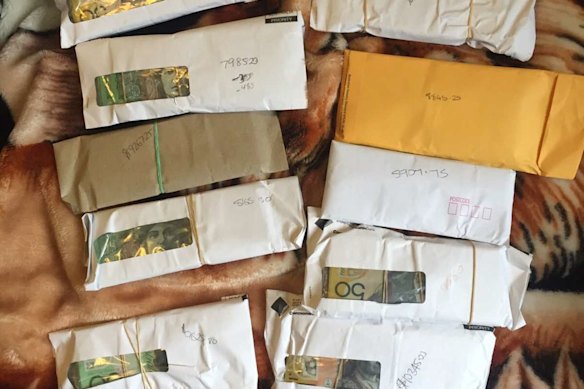
A photo of the envelopes containing bundles of cash Ibrahim Helmy sent to Adam Taki in 2015.Credit: ICAC
Taki said: “How much he give you?”
“He gave me about 61k. Need to count them lol,” Helmy replied, adding that he had “23 from them before”, referring to previous payments.
Four months later, he messaged his friend a photo of 10 envelopes containing cash lying on a bedspread featuring tiger images at his Merrylands home. The amount in each envelope was scrawled on the front. The total: more than $86,000.
The American-born Helmy told the inquiry that by 2020 he had wanted to end his dealings with Complete Linemarking, which had become a hassle and was not paying him what he believed he was owed. By then, he had started kickback arrangements with contractors Direct Traffic and Capital Lines & Signs.
Over the next four years, his allegedly corrupt dealings expanded to six further contractors, resulting in work worth hundreds of millions of dollars for them. The inquiry heard accounts of Helmy meeting contractors at service stations, cafes, McDonald’s restaurants, Bunnings car parks, secluded spots in parkland areas, and even an aquarium.
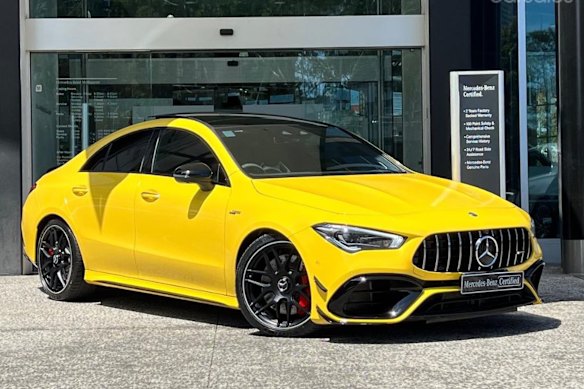
A photo of the yellow Mercedes-Benz tendered to the ICAC inquiry.Credit: ICAC
Capital Lines & Signs director Andrew Stewart told the inquiry that Helmy hassled him relentlessly to pay bundles of cash of up to $120,000 for inflating work contracts, and pressed him to buy a $130,000 yellow Mercedes-Benz. The now-sacked Transport official has denied pressuring the company over the luxury car purchase, yet text messages showed he sent Stewart photos of the car and a link to a dealership.
Loading
He is also alleged to have received $8.97 million in cryptocurrency payments from Grafton company Protection Barriers between 2021 and 2024, as well as $227,000 in cash in 2020 and 2021 and $60,000 in gold bullion in 2023. Protection Barriers founder Jason Chellew described the one ounce gold bullion nuggets he gave Helmy as like little bits of Cadbury chocolate.
In return, Protection Barriers received about $100 million of work from Transport for NSW, making it by far the largest beneficiary of the nine companies involved in the improper dealings.
The inquiry heard Helmy’s modus operandi was to target small family-owned businesses, preying on their owners’ anxieties about whether they would win work on the state’s roads. His alleged co-conspirator, Peter Le, told a hearing that smaller firms were attractive to Helmy because “there were less layers of management” than larger companies, which meant “you need to go to the top”. Le said Helmy groomed contractors as well as colleagues at TfNSW to become part of the improper deals.
As his right-hand man, Le allegedly manipulated the tender process by “fudge[ing] the numbers” and raising prices of competitor companies so the preferred contractors were more likely to win work.
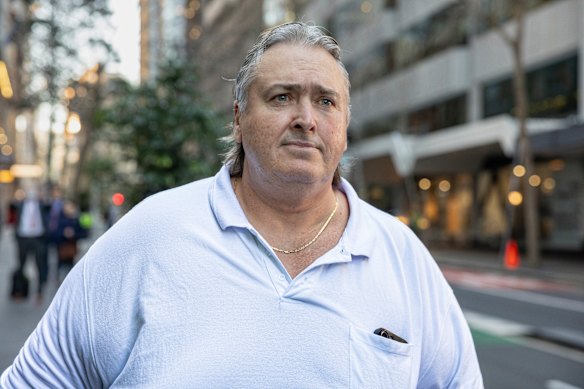
Protection Barriers founder Jason Chellew appears as a witness in July at the ICAC inquiry.Credit: Sitthixay Ditthavong
Their exchanges via WhatsApp messages shown to the inquiry are strewn with vulgar, disparaging and sexualised language. Helmy’s nickname for Le was “penis”. Despite their arrangements, the inquiry heard that on occasions Helmy underrepresented to his alleged co-conspirator how much he was pocketing in bribes.
Amid this, the two were eager to expand. In a text exchange with Le on November 8, 2018, Helmy said: “We need a bigger scheme. One that will make us back everything.”
Le replied: “Yeah that’s good. But we need more. More schemes. That was a lot of work for nothing.”
The pair considered using a colleague’s death to their advantage by faking emails to sign off on work orders with contractors from which they received cash benefits – six days after he died. “I was considering signing them and saying that he signed it before dying haha,” Helmy wrote in a message to Le on September 1, 2020. “Like they can’t check or anything lol … We’ll make use of him, dead or alive.”
Helmy’s web of influence extended beyond dealings with contractors and colleagues. He drew in people from his personal life. Helmy set up a Binance account in his sister’s name, into which contractors allegedly paid him the equivalent of $8 million in cryptocurrency. Younger brother Mohamed Helmy is accused of having knowledge of the corrupt relationships and assisting him in trading cryptocurrency, both of which he denied this week.
The inquiry heard that Helmy transferred $257,200 to Mohamed in the three months to March 2018. In a WhatsApp exchange between the pair in May 2018, Helmy asked whether they should put “more $$ into crypto over next few months after I get $$“. His brother replied: “Haha maaate 1 mill will change life. It will get a house at least.”
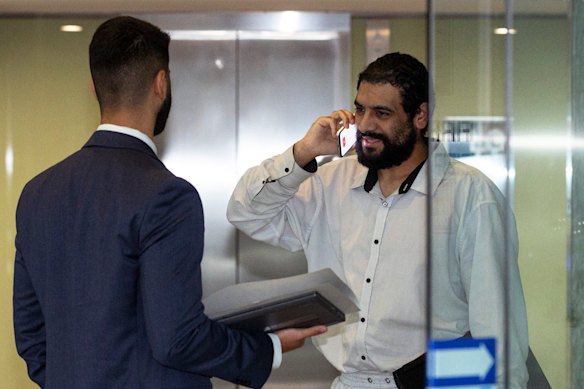
Sacked Transport official Ibrahim Helmy is released from custody on November 7 after his 17th day in the witness box at ICAC.Credit: Dominic Lorrimer
In another WhatsApp exchange in June 2019, Helmy told his younger brother that more cash would come from deals. Moments later, he said: “Mate I enjoy workin and scamming people. I don’t work for work. You gota take advantage of whatever job or position you’re doin. For personal gains lol.”
Loading
Helmy also met his ex-girlfriend Katya Wang at TfNSW, revealing his schemes while bushwalking on a first date. Wang told the inquiry she assisted Helmy, outside of work hours and off work premises, with legitimate “straightforward” tasks he was expected to perform at work, so it would free up time for him to work on arrangements with contractors. She also recounted helping him count up to $20,000 in cash at her apartment in Parramatta.
He gave her $6000 in cash benefits throughout their six-year relationship, which she kept at home in a red envelope. Wang made numerous attempts to return the money, but Helmy always gave it back. The inquiry heard Helmy offered to help with a down payment for a home, and wanted to buy her luxury Chanel bags worth thousands of dollars, all of which she rejected.
In September last year, the net closed on Helmy, his alleged workplace accomplices and contractors when detectives and ICAC officers conducted raids. Cash, gold bullion bars and items including a cash counter were seized from Helmy’s Merrylands home, as well as computers on which he saved spreadsheets recording his dealings with contractors. The NSW Crime Commission also seized $413,000 worth of cryptocurrency held by Helmy, and the $8 million in the crypto account in his sister’s name.
Assets worth an estimated $41 million were also seized from the owners of Protection Barriers, including two luxury Bentley cars each worth half a million dollars and properties with a total value of $15 million.
The inquiry is another blow to the transport agency’s credibility in preventing potential corruption in its ranks. The ICAC public hearings have played out within metres of the department’s headquarters overlooking Hyde Park.
In his opening address, ICAC counsel assisting Rob Ranken, SC, remarked that in each of the previous three inquiries into Transport for NSW since 2019, the department had failed to detect favouritism or poor value for money in its contracted work. Ranken said it was of “notable concern” that the referral to ICAC, which ultimately led to the investigation named Operation Wyvern, came via an external party.
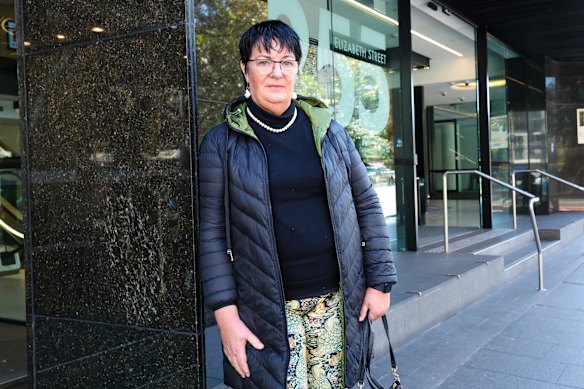
Adele Graham attempted to blow the whistle on corruption within Transport for NSW.Credit: Edwina Pickles
Port Macquarie woman Adele Graham joined as a safety quality officer in 2022 to discover a “tick and flick” culture in her part of the agency. By the following year, Helmy’s dealing with Protection Barriers and a related company raised red flags for Graham, who had decades of audit experience.
“I was suspicious of his activities by this stage because I could tell that he wasn’t telling the truth,” she told the inquiry. “I believe that he was communicating with the contractors behind my back.”
She reported Helmy to the agency’s “speak up hotline” in July 2023 but she became frustrated by the person who answered her anonymous call. She had expected the names on emails and documents that she had provided to later prompt the agency’s fraud and investigation unit to contact her. That failed to happen.
In fact, Transport for NSW investigator David Faust, who was assigned to assess the anonymous complaint, concluded in August 2023 that the concern raised about Helmy “does not indicate corrupt conduct and is therefore not required to be reported to the ICAC”.
Senior investigations manager Paul Grech, who signed off on the report, sad they had relied too heavily on information from Helmy’s supervisor, Tahira Basir. However, the investigators pinned some of the blame on workload pressures and a department that was regularly restructured.
Questioned about why Graham’s complaint did not set off alarms, Grech told the inquiry that on many occasions procedures or processes – “with procurement especially” – were not followed within the department, which was why they had relied heavily on the response from Helmy’s supervisor.
Loading
As the hearings wind up, the question is what the transport department, which is cutting 950 jobs, will do to stamp out the potential for corruption arising again. In a worrying sign, nearly half of those polled in a recent survey of its 17,500-strong workforce revealed they were reluctant to speak up about “tough issues”, which could range from alleged corruption or malpractice to workplace matters.
Transport Minister John Graham says the alleged corruption detailed in the latest inquiry reflects as much a “culture issue” as a “workplace issue”. He says some of the alleged schemes were able to develop because of the department’s decentralised procurement system. “A lot has to change – a lot is changing in Transport,” he says, citing a move to centralise procurement. “I’m absolutely convinced we can change this culture.”
Taxpayer dollars to pay for roads and public transport will depend on it.
Start the day with a summary of the day’s most important and interesting stories, analysis and insights. Sign up for our Morning Edition newsletter.