2 months ago
14
2 months ago
14
Bondi shooters Naveed and Sajid Akram acted alone and were not part of a broader terrorist cell, Australian Federal Police commissioner Krissy Barrett has said, providing a limited public update as the surviving shooter faces dozens of criminal charges.
Offering additional information emerging from a joint investigation with the Philippine National Police, Barrett said it was their assessment that there was “no evidence to suggest these alleged offenders were part of a broader terrorist cell or were directed by others to carry out an attack”.
Barrett said the father and son shooters did not receive any training or “logistical preparation” during their month in the Philippines shortly before the December 14 attack, but cautioned this did not mean they were in the country for tourism.
The pair were in the Philippines for almost a month, with local police assessing the pair “rarely left their hotel”.
Sajid Akram was shot dead by police at the site of the attack, while his son Naveed is facing 59 charges.
“I want to underscore that the update I give today is our initial assessment. It’s a point in time the AFP and our partners still have significant investigative work to undertake, and it is possible that new information or evidence may be forthcoming as part of that,” Barrett said.
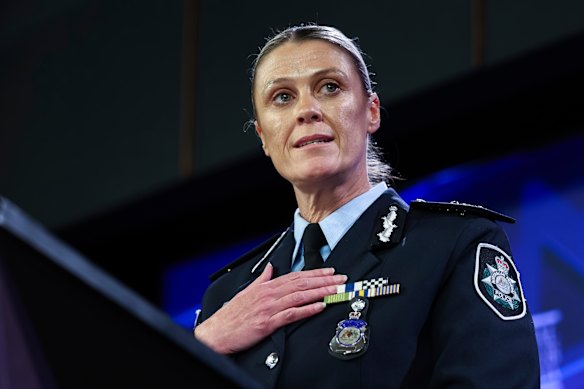
AFP commissioner Krissy Barrett.Credit: Alex Ellinghausen
The shooters travelled from Sydney to Manila on 1 November of this year, continuing to Davao City on the same day. They returned to Sydney from the Philippines on 29 November, two weeks before the Bondi shooting.
Barrett thanked the Phillipine police, saying: “much of the CCTV footage that is now under review by our investigators would not have been available.”
“The AFP welcomes the federal government’s plans to strengthen hate speech laws, I remain concerned about vulnerable adults and youth who are susceptible or open to manipulation by religious and other extremists who encourage violence or desensitise violence,” Barrett said.
“Radicalisation and extremism can provide a pipeline of recruits to terror groups who are willing to use violence to advance their cause. The AFP will be visible and vocal on those we charge and importantly, the work of the national security investigations teams to disrupt early and to deter and prevent violence. We won’t put a time limit on our vigilance. We will be here every day to help keep Australians safe.“
Loading
Home Affairs Minister Tony Burke, who appeared alongside Barrett, said a review into law enforcement and intelligence agencies by former diplomat Dennis Richardson would look at how agencies are notified of the travel arrangements of individuals of concern.
“There are some countries where there is almost no valid tourism industry there at all, and it raises a very high level of alarm … there are other countries where an alert might come up, but it wouldn’t necessarily raise the eye that then has to get measured against the risk profile that’s being done on individuals,” he said.
“That work is complex. It is best done by the experts, and that’s why to review that sort of work, you don’t get anyone better than Dennis Richardson.“
Barrett declined to answer when asked if a royal commission would compromise national safety and said she could not provide further detail on the investigation into the attack while Naveed Akram faces multiple murder charges in NSW court.
more to come...
Cut through the noise of federal politics with news, views and expert analysis. Subscribers can sign up to our weekly Inside Politics newsletter.
Most Viewed in Politics
Loading