3 months ago
5
3 months ago
5
The NSW environmental watchdog will door-knock residents in Medlow Bath on Wednesday after new testing revealed high levels of toxic forever chemicals in the middle of the township.
The results suggest that Medlow Bath itself is ground zero for the PFAS contamination in the Blue Mountains that led to the disconnection of two dams from the drinking water supply for 78,000 residents in August 2024.
“The numbers are ridiculous – really alarming,” said Professor Ian Wright, the water scientist at Western Sydney University who led the research.
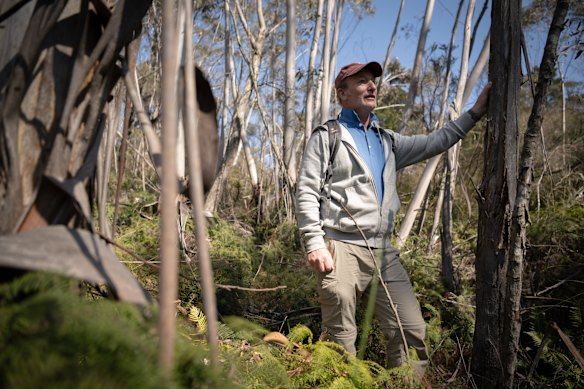
Water scientist Professor Ian Wright in a swamp about 20 metres from houses in Medlow Bath taking samples last year. Credit: Wolter Peeters
PFAS – or per- and polyfluoroalkyl chemicals – are a family of synthetic chemicals that persist for long periods in the natural environment and have been linked to cancer, infertility and other health problems, even at low doses.
A spokesperson for the NSW Environment Protection Authority said staff would survey 15 properties at Medlow Bath in response to community concern. They will ask residents whether they use a particular drainage line to water their vegetable gardens or fruit trees or if they keep backyard chickens.
Loading
“Discovering PFAS in the environment does not necessarily mean there is a risk to human health, but it is important to assess if there are exposure pathways through which people might ingest PFAS,” the spokesperson said in a statement. “Town (tap) water is safe to use.”
The responses will inform if further sampling is required, and the EPA would offer precautionary advice based on results. Any data from sampling would also inform a broader investigation of the site planned for 2026.
In other PFAS contamination sites such as near the air base in Richmond and Williamtown, residents have been advised not to eat home-grown eggs or fruit or vegetables. Chickens eat PFAS-laden invertebrates in the soil and the chemicals wind up in their eggs, Wright said.
STOP PFAS convenor Jon Dee said Wright’s research showed the PFAS problem had not been solved by shutting off dams and adding filtration to the drinking water.
“All the focus so far has quite rightly been on the dams and the drinking water, but the actual contamination ground zero is in Medlow Bath itself, right next to the highway,” Dee said. “Every time the rain is touching that sediment, it’s going to pick up that PFAS and push it down towards the creek through people’s backyards.”
Dee has been campaigning for Blue Mountains residents to receive free blood tests to check their PFAS levels. NSW Health said the advice of the expert panel recommending against this still held.

STOP PFAS convener Jon Dee in Leura.Credit: Sitthixay Ditthavong
After first testing with this masthead in September last year, Wright has repeated his research with more samples and also tested in the national park for the first time. Wright is writing a paper for peer review, but is discussing the results early because of the high public interest.
The contamination was worst in the water and sediment of a swamp just 20 metres from homes. Wright found the level of two PFAS chemicals – PFOS and PFHxS – in the water was 8000 times the ecosystem guidelines set by National Environment Protection Council. It was also about 30 per cent above the National Health and Medical Research Council guidelines for safe recreational water usage, which are currently under review.
Loading
“There should be signs up saying “Contamination! Keep out!,” said Wright, noting that children play in natural waterways.
The sediment under the water also had PFOS and PFHxS 100 times higher than the safe level for a residential garden, based on the limit outlined in the PFAS national environmental management plan written by a working group of Australian and New Zealand EPAs.
“Because it’s in swamp water, I suspect that it’s spread into the local aquifer and it could be underlying a lot of private land because it’s within 20 metres of private land,” Wright said.
This means that backyard fruit trees and vegetable gardens with deep roots could be drawing contaminated water even if they did not draw directly from the drainage line, Wright said.
The exact location of the PFAS hotspot provides further evidence that the contamination was caused by firefighting foam used to put out a blaze from a tanker crash in 1992, rather than one of two other sites hypothesised by WaterNSW. This implies residents have been exposed to the cancer-causing chemicals for more than three decades.
Wright retested in Greaves Creek and went into the national park for the first time down the Grand Canyon track, below the two reservoirs.
Even at this furthest point, water contamination was a hundred times the guidelines for ecosystem protection, which could trigger Commonwealth involvement given the area’s World Heritage listing.
Most Viewed in Environment
Loading