3 months ago
8
3 months ago
8
Australians took to the streets because they were scared by numbers that don’t exist
Opinion
September 2, 2025 — 3.33pm
September 2, 2025 — 3.33pm
Sunday’s anti-immigration marches, held in cities from Sydney to Perth, were large, noisy, and deeply revealing. Thousands of Australians took to the streets chanting slogans and waving placards about “mass migration”.
For many, the tempting reaction is to dismiss the demonstrators as racists. Some certainly were, and shadow federal attorney-general Julian Leeser was right to warn that those who attended should “be careful of the company they keep”. But we cannot and should not write off everyone who marched. Many protesters were drawn out of their homes because they genuinely believe immigration has reached record-breaking, unsustainable levels.
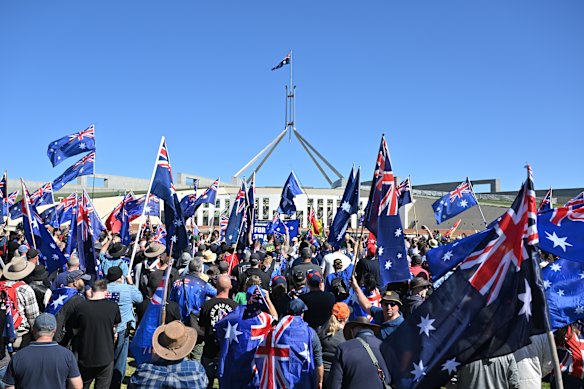
Protesters during the March for Australia anti-immigration rally outside Parliament House in Canberra on Sunday.Credit: AAP
And here lies the real problem: most of them are misinformed. Australia’s immigration crisis isn’t about numbers – it’s about misinformation.
Australians took to the streets because they were told to be afraid of numbers that don’t exist. A press release from the Institute of Public Affairs issued two weeks before the rallies claimed 457,560 net migrants had arrived in the 2024-25 financial year alone.
But that number is wrong. In fact, it’s off by more than 30 per cent. The release misused Australian Bureau of Statistics data on tourist movements rather than net overseas migration data, despite the ABS explicitly warning that the data should not be used that way.
Loading
Another claim, this time appearing on a flyer promoting the marches, was that more Indians had migrated to Australia in the past five years than Greeks and Italians in the past century. That’s simply false. ABS historical data from the Australian Demography Bulletin shows that between 1916 and 1971, far more Greeks and Italians arrived in Australia than Indians have in the past five years.
Yet these misleading statistics were quickly picked up and run with by some sections of the media, and made their way into slogans, speeches and signs seen at the weekend. If I believed those numbers, I’d be worried too.
So, let’s look at the facts. The Australian government currently issues about 185,000 permanent migration visas each year. That figure has been fairly steady for years. When we talk about net overseas migration – the balance of arrivals and departures – the most recent confirmed figure is about 341,000.
That sounds big, but it came after years of pandemic disruption, when borders were closed, arrivals plummeted, and net migration actually turned negative. The economy shrank, businesses couldn’t find workers, and universities were crippled without international students. When borders reopened, there was a surge of arrivals. But this wasn’t a new normal – it was a catch-up. And that bulge is already passing. By December 2024, net migration was falling sharply.
Another claim from protesters is that immigration is to blame for Australia’s housing crisis. But the timeline alone exposes the flaw. House prices began their extraordinary surge during the pandemic, when net migration was at its lowest levels in over a century. If migrants were the main driver of prices, the opposite should have happened.
Loading
Housing supply – or lack thereof – is the real culprit. And ironically, migration is part of the solution. The building industry has been blunt: to fix the housing shortage, we need tens of thousands more skilled tradespeople. Those workers aren’t going to appear from thin air. Migration is the only realistic way to meet that demand.
The real danger is not immigration itself, but rather what misinformation about immigration is doing to Australia’s social fabric. The damage is visible in the ugly scenes on display in the anti-immigration marches. Social cohesion is fraying as Australians argue past one another armed with “facts” that turn out to be fabrications.
One uncomfortable truth the rallies have highlighted is that Australia has not invested enough in tracking and explaining our own migration story. We don’t maintain digital records of continuous detailed datasets on migration across the past century, and that makes it easy for misleading claims to thrive in the time it takes fact-checkers to locate and tabulate historical data.
Whether Australia has more migrants or fewer is a legitimate debate for the public and policymakers. But the debate must be based on facts, not fiction. Unless we start confronting misinformation head-on – by investing in data, correcting false claims quickly, and demanding honesty from our leaders – we risk far greater damage than any surge in arrivals could bring.
Because when ordinary Australians are misled into the streets to march against a phantom crisis, it’s not just migration policy at stake. It’s the trust and cohesion that hold our democracy together.
Professor Alan Gamlen is director of the Australian National University’s Migration Hub.
Most Viewed in Politics
Loading