3 months ago
32
3 months ago
32
By Peter Craven
January 4, 2026 — 11.19am
POETRY
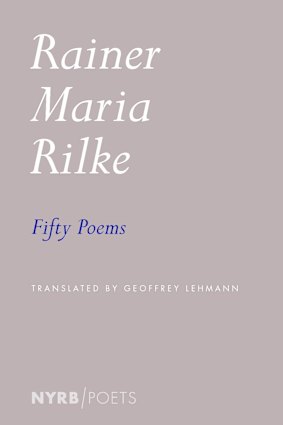
Fifty Poems: Rainer Maria Rilke
translated by Geoffrey Lehmann
New York Review of Books, $29.99
This book is a masterpiece, and it is made out of someone else’s set of masterpieces. It is the translation by the octogenarian Australian poet Geoffrey Lehmann of a group of poems by Rilke, by common consent one of the very greatest poets of the high modern period, the figure in German poetry we might put alongside Yeats for grandeur and formal intensity and range.
We know Rilke primarily from the spacious majesty of the Duino Elegies and the personal mysticism of the Sonnets to Orpheus, sequences of poems written in highly charged free verse which are easily assimilated into English with adjustments according to taste in phrasing. What we tend not to know – or which we wrongly assimilate to free verse, distortedly – are Rilke’s “thing poems”, his Dinggedichte, composed early in the 20th century. Now, Geoffrey Lehmann has translated them using a strict form which replicates Rilke’s nine-syllable line. The upshot is miraculous. We feel we are reading a great poet without any diminution in formal power.
Listen for a moment to how this works:
If you are homeless, you will find no home.
Solitary, you will remain alone,
and wake and read and write long letters,
and along empty avenues will roam,
restlessly here and there, as leaves are blown.
The formal brilliance of this is remarkable. We feel as if we’re in an enchanted world where an early 20th-century poem has come into being through nothing but technical wizardry in service to a belief on Lehmann’s part that the verse form will affect this extraordinary transubstantiation. No one would believe in the undertaking Lehmann has committed himself to, but it works. We believe this is Rilke, and it really is a matter of by their fruits shall ye know them.
The preoccupations of the poems can have their own paraphrasable interest – as in the version of one by Seamus Heaney – and, yes, in this form (which is a neglect of form) there will be the intrinsic interest of a great writer displaying his themes but not with this breathtaking inhabitation of the spirit that comes with the rhythm and the rhyme.
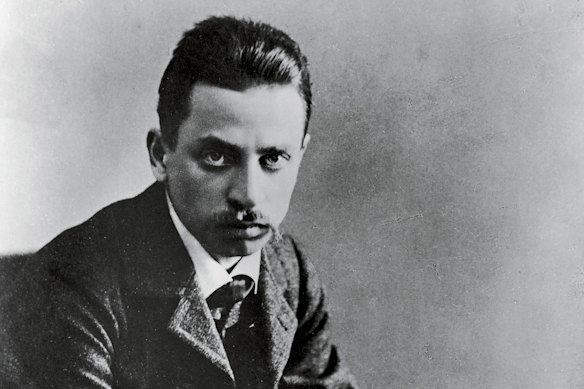
Rainer Maria Rilke’s Elegies were described as “the greatest poem of the 20th century”.Credit: Getty Images
We get biblical motifs, a young man looking at his face, its regularity and its ability to weather pain. There’s the incomprehension in a crucifixion poem of the “Eloi, Eloi, lama sabachthani” cry of forsaking and the butcher boy, soldiers hoping for a show. There are various poems that make the Pieta primarily a landscape for Mary Magdalene. There’s the poet’s feeling for the sensuous figure of Christ.
All of this would have an interest if it were seen as a footnote to the author of the Duino Elegies and Orpheus but the difference in the case of the Fifty Poems is the difference between a flat modern translation of the Bible and the Reformation ones for which the King James is a shorthand:
Magical one: how can the single tone
of these two words become rhymed poetry,
meanings in you we see and do not see. Your forehead sprouts two leaves, a lyre of bone, […]
Here’s the Lament for Antinous:
None of you understood the Bythinian boy at all,
(so how the river took him, none of you could say ...)
I admit I spoiled him. Yet now all of us recall
his fortitude and grace, and the real boy just fades away.
Who knows what love truly is? Or can love? – None.
I have wronged his memory for all time, I fear –.
He’s a Nile god now, and I scarcely know which one,
the soothing sort of god I can never get near.
There is a tremendous verve in this and it’s characteristic of the sequence. You can hear the wry, half-mocking brilliance of the affection that is displayed here and the beauty and the irony come from Geoffrey Lehmann’s mastery of form which he sees as the gift of Rilke which allows him to delineate the contrapuntal logic of a worldview which he appropriates from the German original.
Here is the Magdalen once Christ is risen, what she would anoint him with and then his noli me tangere, so clipped in Rilke’s version:
He never could, right to the end,
bear to say no or turn away,
lest she might make a show of love;
and in the raiment of her grief,
bedecked with her love’s greatest jewels
she knelt convulsed before the cross.
Face streaming tears beside his grave,
she’d come there, wanting to anoint him,
and found him risen for her sake,
seraphic, saying to her: “Don’t –”
Lehmann’s Rilke is a thing of wonder. It’s something we’re compelled to believe, never mind its impossibility. The final poem, not part of the sequence, has an extraordinary power as it looks the agony of death in the face. But read this book and give it to everyone you know who has a feeling for poetry.
It is a staggering achievement, and it somehow captures the voice of a great poet, newly minted.
The Booklist is a weekly newsletter for book lovers from Jason Steger. Get it delivered every Friday.
Most Viewed in Culture
Loading