3 months ago
30
3 months ago
30
In 2006, Paul Churchill became co-owner of a small bar in Spain called Dolce Vita. The irony of the name – Italian for “sweet life” – was lost on him at the time. That’s hardly surprising. What was there not to like? At just 23, he was running a hugely popular drinking establishment in Granada and one of the main players at the centre of a non-stop, booze-fuelled party.
“The energy was electric,” he writes in his book, Dolce Vita, a combination memoir, polemic against the alcohol industry and practical, self-help manual. “I’d bounce from serving sangria, shots, and tubos de cerveza to DJing a mix of hip hop, Spanish pop, and Euro house to our clientele from all over the world. After the bar closed at 3am, the Dolce Vita crew would head to the club, where we’d get ushered past the line of well-dressed partygoers like VIPs. There was always an endless supply of booze waiting for us, and I could invite anyone for a drink, for free, any night of the week.”
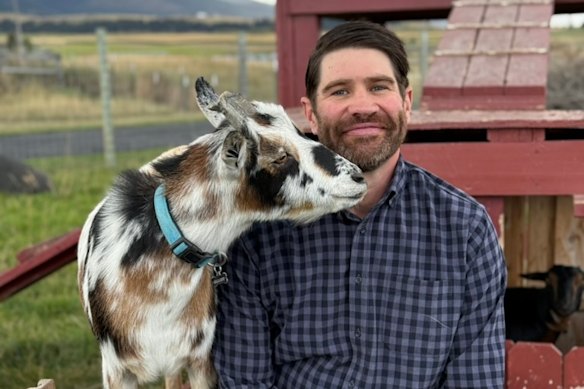
Paul Churchill at home in Montana with one of his favourite companions. Credit:
He was making more money than he had ever dreamt of and the party seemed like it would go on forever. But within not much more than 18 months, that sweet life had soured irreversibly as the alcohol gradually tightened its grip.
“At 20 months in Spain, I was a full-blown functioning alcoholic,” he writes. “In the mornings, after getting one to two hours of sleep, I’d shuffle to the convenience store across the street that opened at 6am and buy two beers and a box of wine. I’d pour the two beers into a large glass, and while the beer was warming in the microwave so I could drink the beer faster, I’d chug the box of wine. I’d then drift off into a drunken stupor, where I’d wake up at 2pm in a malaise of fog and pain before starting it all over again that night at the bar.”
Then, at 27, after a terrifying incident in which he “blacked out” for multiple days on booze and Ambien sleeping tablets, he shut the doors on Dolce Vita and walked away, pulling up just in time from his nose-dive of self-destruction.
“I was medicating profound loneliness with ethanol, one shitty box of wine and cerveza at a time,” he writes. “At first, it worked beautifully … But ethanol is a terrible therapist. It promised to solve my isolation, but ended up creating a prison of its own. It became a desperate daily ritual just to function, and eventually, it nearly became my death sentence.”
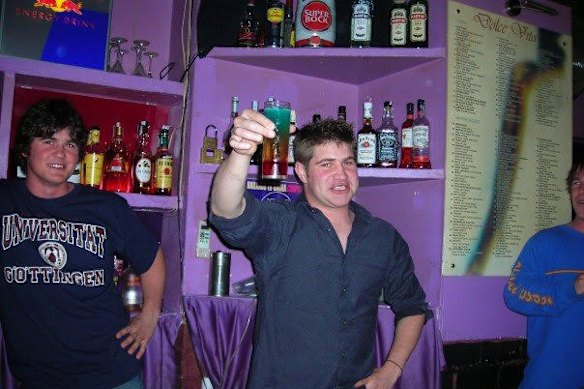
The atmosphere at Dolce Vita was electric. Credit:
If this was a Hollywood-perfect story, Act Three would unfold now with our hero Paul embracing ecstatic sobriety, winning the girl and riding off into a perfect post-booze life.
What happened, in fact, was a multi-year roller coaster of on-and-off again drinking, including “the worst, longest summer of my life”.
“I was travelling in South America, trying to stay sober but unable to do so,” he says. “Then there was a DUI driving to work and a suicide attempt. I hit the low of all lows.”
Finally, aged 33, on September 6, 2014, while on a camping trip with friends, he took his last drink.
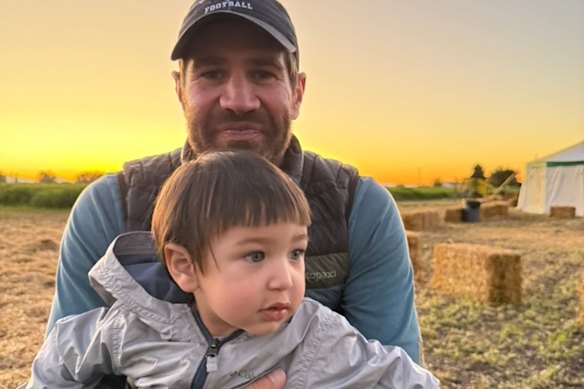
Paul Churchill with his 18-month-old son, Rio. Credit:
“I had a beer in hand and drank half of it,” he says. “I knew if I finished that beer I was going to be a goner. It was just a matter of time. A year, two years. Probably less.”
A few months after putting down that beer, Churchill recorded his first Recovery Elevator podcast. It’s a deceptively simple format. Churchill interviews one person each week about their journey into – and out of – alcohol addiction.
This week, he released episode 567, and Recovery Elevator has been downloaded more than 10 million times.
The podcast is why Churchill first came to my attention and why we’re chatting over Zoom as he sits in his studio/office in the small city of Bozeman, Montana, where he lives with his wife, their 18-month-old son and a growing collection of goats and pet snakes.
Loading
I’ve played more than 80 episodes of Recovery Elevator over the past few months. Listening to the interviews with people from all walks of life and all parts of the globe has become an almost daily routine.
In an outrageous coincidence (Churchill would definitely say it’s a Universe Thing), the morning we chat marks my own 100th day of sobriety. And that’s thanks in no small part to Recovery Elevator. It’s a big deal for me after 40 years on the grog. My drinking had ramped up enormously in recent years and was only going one way.
A sudden health emergency gave me the perspective and clarity I needed to decide to put down the bottle. Podcasts like Recovery Elevator, reading mountains of “quit lit” and therapy make up the self-help plan I’ve stitched together to keep myself on the straight and narrow. So far, so good.
When Churchill recorded and uploaded that first podcast he was, as he says, “burning the ships” in the most public way possible: telling the world he had a problem and holding himself accountable to not pick up another drink.
‘Why would you want to moderately drink? Do you also want to moderately heal?’
Paul ChurchillEven at such an early stage in his own sobriety, he also wanted to extend a helping hand to anyone struggling with alcohol. And along the way, he figured he might pick up some pointers himself from other people who had successfully kicked alcohol to the kerb.
Listen to enough people talking about their alcohol problem and it becomes clear everyone’s story is unique, but at the same time, the same. One of the common factors Churchill has learnt from every one of his more than 550 interviewees is that people who have a problem with alcohol almost always try moderation (“I’ll only drink on the weekends …”) and invariably, that fails.
Loading
“Moderate drinking doesn’t work, even though the mind can think of brilliant plans and strategies that you’re like, ‘Shit, this can’t fail’, ” he says. “In the first 50 to 100 interviews when I would ask ‘Did you moderate and did it work?’. I optimistically and honestly thought I was going to figure out one that did work. There were none at 50, none at 100, none at 200 or four or five hundred. That’s wild.
“You also need to flip the question: why would you want to moderately drink? Do you also want to moderately heal? Do you want to moderately ingest poison? Do you want to moderately drink a Class One carcinogen that is linked to all types of cancers? F, no!”
Of course, many people – so-called “normal” drinkers – can drink without issues. They can have a couple of beers and stop, sticking to the 10 standard drinks or fewer a week.
The million-dollar question, then, is: how do you know if you have a problem with alcohol?
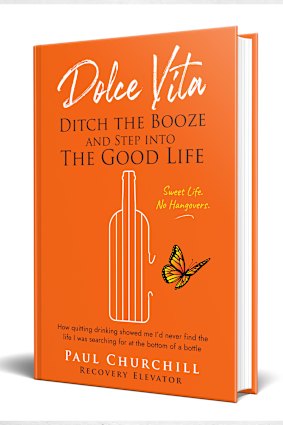
Paul Churchill’s new book. Credit:
There are plenty of self-assessment tests to evaluate your drinking, but Churchill has a deceptively straightforward answer.
“If you have asked yourself or have wondered if you have a drinking problem, then you’ve already answered the question. And that’s it. Normal drinkers, they don’t ask that.”
But that’s not to say normal drinking can’t become problematic over time. “I think if you drink long enough, if you dance with the most addictive drug on the planet and it’s a constant in your life, the inevitable stressors happen – loss of a job, loss of a parent, whatever. When life inevitably kicks you in the groin, then eventually you will develop a dependence on alcohol.”
But what if you’re not the one with the problem? What if it’s someone you love who has an unacknowledged issue?
“The worst thing you can do is not have the conversation,” says Churchill. “Have the conversation. Have a loving and caring, open dialogue. They can no longer say, when they justify to themselves, ‘Well, no one’s ever confronted me about my alcohol consumption’. The thing that must first be overcome is denial. There are some alcoholics where everybody around them is like, that person’s an alcoholic, but they are in denial.
“Having this conversation with somebody is an arrow that slowly pierces through denial. If enough of those show up – and I’ve seen it happen – it’s like, ‘Oh shit, I am an alcoholic’. Then the healing begins.”
In the past decade, there’s been an explosion of people talking and writing about sobriety, a charge led in Australia by journalist Jill Stark with her classic and hugely entertaining 2013 book High Sobriety.
Perhaps the most striking thing about books like Catherine Gray’s The Unexpected Joy of Being Sober or We Are The Luckiest: The Surprising Magic of a Sober Life by Laura McKowen is that ditching the booze is not so much denying yourself or missing out, but is about (eventually) arriving at a sense of contentment and the ability to tackle life’s slings and arrows with clear-headed calmness.
It’s an ongoing theme in Dolce Vita and Churchill’s podcasts. “I asked our followers on Instagram to describe sobriety in one word,” he says. “We had a couple hundred responses and the three most popular responses were ‘presence’, ‘energy’ and ‘peace’. Billions of dollars are spent on diets and elixirs and potions and workouts to achieve those three things, and you get it by not poisoning yourself with alcohol.”
For Churchill, the first step to shaking his addiction was to confess he had a problem to his family, which he regards as essential for anyone wanting to make the leap from “sober curious” to being sober.
“It can be to anyone,” he says. “It can be a psychologist, it can be a counsellor, it can be a doctor, but it has to be an unequivocal, honest conversation how much you’re drinking, what is it doing to you physically and mentally? How do you feel afterwards? What’s the shame and guilt levels like?
“What I want people to do after reading this book is go ‘Oh my gosh, I have to come closer to the fire with my other human beings, with my brothers and sisters, come closer to the human race because alcohol wants you alone in a dark, isolated place with a bottle’.”
Lifeline 131 114; Beyond Blue 1300 224 636
Dolce Vita: Ditch The Booze and Step Into The Good Life is out now. Available on Amazon, for Kindle and in audiobook format. Find Recovery Elevator here.
Most Viewed in Lifestyle
Loading