3 months ago
41
3 months ago
41
POETRY
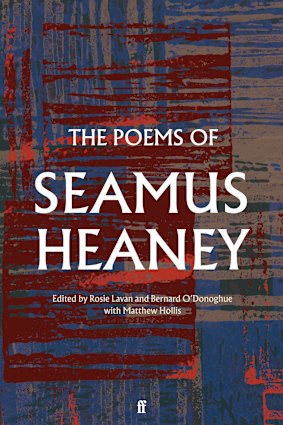
The Poems of Seamus Heaney
Edited by Rosie Lavan, Bernard O’Donoghue and Matthew Hollis
Faber Poetry, $89.99
As editors Rosie Lavan, Bernard O’Donoghue and Matthew Hollis state in their introduction to this final and comprehensive edition of Seamus Heaney’s poetry, Heaney is that rare modern poet who garnered a readership “both critical and popular”. That he sold over a million books in his lifetime and won the Nobel Prize is certainly proof of that.
In the evenings of the days when I was reading this 1200-page opus, I was also reading Ian Leslie’s recent book on John Lennon and Paul McCartney and couldn’t help but think there was a comparison to be made between these three contemporaries, Lennon and McCartney and Heaney, insofar as their work is passionately appreciated by the lettered and unlettered alike.
Firstly though, what should be said about this rather monumental edition is that it is something of a lexicographical masterpiece. The book is both assiduous and thorough in its presentation of everything Heaney published, collected or uncollected, in the years since he started writing poetry at Queens College Belfast in 1959 right up to his final poem, In Time, which he dedicated to his youngest granddaughter Síofra in 2013.
All these poems are accompanied by publishing details and illuminating commentaries involving not only the editors’ understanding of the personal and public context in which the poems were written but also the poems’ critical reception. This, of course, is an especially fastidious effort of historical and lexicographical research, bringing to mind the Petrarchan definition of a literary person being someone who is capable of exactly that.
So we travel from 1959 to 2013 and can’t help but find ourselves assessing the big-picture implications, impact and quality of the output along the way. The primary thing that strikes us is just to what extent the violence of Northern Ireland shaped the poet’s work. That he came to his poetic prime at almost exactly the moment of the Troubles in the early 1970s seems almost predestined due to the hard won wisdom his approach brought to the scene. It has been well documented how Heaney was seen by some of the more militant Catholic groups as facing away from the sectarian strife, both by not composing anything that could resemble a rally cry for the cause and also by moving south to the Republic in 1972. But an overview of Heaney’s work such as this testifies, among other things, to the heft of his remark in a letter at the time that when it came to politics he had a disposition rather than a position.
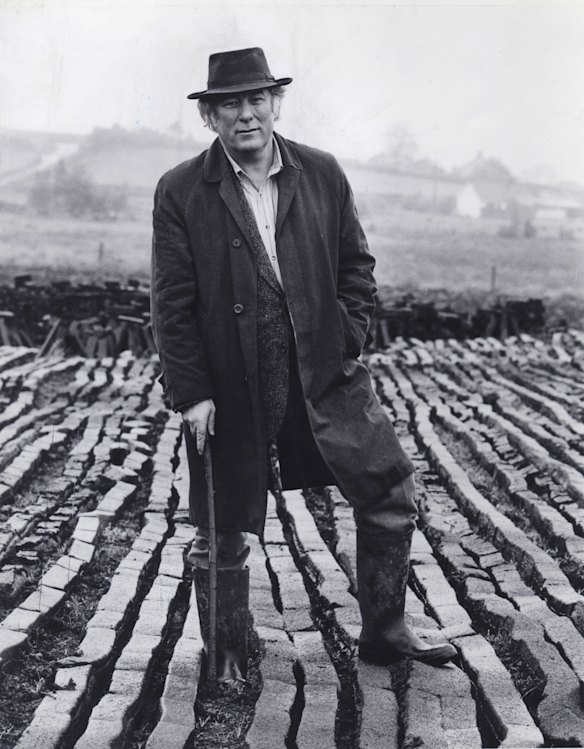
Seamus Heaney in his local peat bog, in 1987, near Bellaghy village County, Derry N. Ireland.Credit: Bobbie Hanvey
In other words, as he said in the retrospective poem Flight Path from the 1996 collection The Spirit Level, whatever he wrote, he wrote for himself, a sensual yet deeply considerate poet with an understanding of how everyone, no matter their cause, or even if they have one, shares both the joy and the tragedy of our mortal predicament.
That his volumes from the early 70s, particularly North, are so properly incisive and unflinching about the visceral realities of the political violence he was born into speaks to how he never fashioned himself as anything but a poet, and possibly a teacher, as well as a husband, father, son, grandson, etc. His first job was to keep the channels of his inner music open. His second was to speak a grounded truth that avoided anaemic notes of idealism and caustic tones of revenge in favour of earth-talk that doubled down on how mythology ratifies the real. The real in his case being a percussive kind of litany, of ancestral mud and farm tools, domestic rituals and irruptive violence, back-step grief, and the courage required to avoid creating any further harm.
In the long and largely progressive arc from the bloodshed of the ’70s to the Good Friday Agreement of 1998, Heaney established himself as the foremost poet in Ireland since Yeats. If Yeats was shamanic, visionary, preternatural, Heaney was artisanal, glottal, natural, in the sense that he found his numinous moments not through occult cosmologies but through the things he could touch and feel with his body as well as his mind.
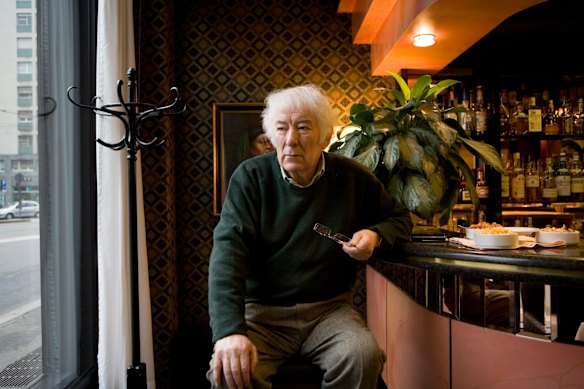
Heaney in Venice in 2008. Credit: Getty
The constellations of his hyperlocal influences are well charted here, as is his progress as a wordsmith. It’s instructive to see in the early and previously uncollected poems how his eventually unobtrusive lineation and the sluice and burr of his unmistakable cadence have yet to consolidate. There are glimpses, but the music of a poem like October Thought, or the very first in the collection, Reaping In Heat, still have the aerial whiff of something pretentiously pastoral, and also an enthusiasm of alliterative feeling reminiscent of Hopkins. In the case of Reaping In Heat this is partly because he describes an almost Virgilian scene, mowing, by hand with a scythe, and thus, unlike the poet’s father digging for potatoes, the poem seems more local somehow to “literature” rather than to the actual Derry ground he came from.
In the end, with it all laid out in front of us and properly contextualised by this edition, Heaney’s poetry seems all about that ground, its deep psychic grip, its familial texture and endemic sound. Bitten at first by the pleasure of language, he found himself gradually enlisted by time and place into an ancient trade requiring all his moral fibre and thus his sense of imaginative independence too.
In a late poem, from his last collection, Human Chain, he riffs on the Bretagne poet Eugene Guillevic’s paean to the herbs of his region. With his ear for Celtic commonality, Heaney transports Guillevic’s continental original to his own patch, has some fun with it, but also seizes on the herbal as a way of telling us what is so profound about his approach.
Loading
That he looked as hard and conscientiously at the world around him as he did into himself is perhaps the most admirable thing about his art. That he tuned his voice to balance the two was his great achievement. Unity of being was also Yeats’ ambition but for Heaney, the ongoing music of a poem was in the squelch of lough margins as much as it was in the singing bird on the golden bough.
The Booklist is a weekly newsletter for book lovers from Jason Steger. Get it delivered every Friday.
Most Viewed in Culture
Loading