3 months ago
40
3 months ago
40
By STAN CHOE
January 16, 2026 — 7.46am
Australia’s sharemarket is expected to edge lower on Friday after a slump in oil prices overnight, as a rise in technology shares helped Wall Street break a two-day losing streak.
The U.S. sharemarket was higher shortly before the end of trading, as stocks in the artificial-intelligence industry bounce back following an encouraging report from a Taiwanese chip giant and as oil prices ease sharply.
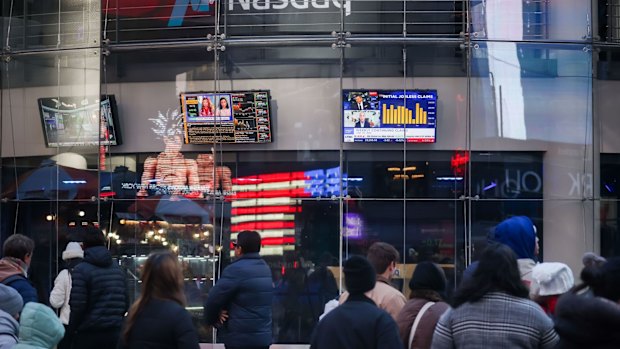
Wall Street was in positive territory shortly before the end of trading, helped by a rise in technology shares.Credit: Bloomberg
The S&P 500 was 0.3 per cent higher, the Dow Jones Industrial Average was up 331 points, or 0.7 per cent, with a little less than an hour remaining in trading, and the Nasdaq composite was 0.4 per cent higher.
Shortly after 7.30am, futures were pointing to the S&P/ASX200 opening 0.2 per cent or 15 points lower, after the market rose 0.5 per cent on Thursday, its fourth day of gains in a row, thanks to a surge in mining share prices.
Nvidia and other formerly high-flying AI stocks helped lift the market after Taiwan Semiconductor Manufacturing Co., a major supplier to the industry, reported a stronger profit for the latest quarter than analysts expected. TSMC also said it could boost its investment in equipment to $US56 billion ($83.6 billion) this year to take advantage of the AI boom.
Loading
The frenzy around AI has already sent Nvidia and other superstar stocks to dizzying heights, but that stirred criticism that their prices had shot too high. Nvidia was one of the heaviest weights on the S&P 500 Wednesday (US time) after sinking 1.4 per cent. But it rose 3 per cent after TSMC Chief Financial Officer Wendell Huang said it’s seeing “continued strong demand” in an encouraging signal for the entire AI industry.
TSMC is a crucial player as a major supplier for Nvidia and other giants and as a key customer for ASML and other providers. TSMC’s stock that trades in the United States rose 5.1 per cent, while ASML’s U.S.-listed stock rallied 6.1 per cent.
Other chip-related companies helped lead the U.S. sharemarket, including gains of 8.3 per cent for KLA Corp. and 7.1 per cent for Applied Materials.
Also helping to calm financial markets was a sharp easing in oil prices.
A barrel of benchmark U.S. crude sank 4.6 per cent to $US59.19, while Brent crude, the international standard, dropped 4.1 per cent to settle at $US63.76 per barrel. Analysts pointed to comments from President Donald Trump, who said Wednesday afternoon that he heard “on good authority” that plans for executions in Iran have stopped amid widespread protests against the country’s leadership.
Financial markets took that as a signal that tensions flaring above some of the world’s largest oil deposits could ease and lower the possibility of a disruption to the flow of oil.
Gold’s price edged back 0.3 per cent in another signal of potentially calming nerves across financial markets.
Earnings reporting season for big U.S. companies continued to pick up pace, meanwhile, with several more big financial companies delivering their results for the last three months of 2025.
Loading
BlackRock, the giant that’s now overseeing more than $US14 trillion in investments, rose 6.3 per cent after reporting stronger profit and revenue than analysts expected.
Morgan Stanley climbed 6.2 per cent after likewise delivering stronger profit and revenue than expected. Goldman Sachs rose 4.5 per cent after the investment bank topped analysts’ forecasts for profit but fell short on revenue.
In the bond market, Treasury yields rose following encouraging reports on the U.S. economy.
One said fewer workers applied for unemployment benefits last week in an indication that the pace of layoffs may be slowing. Other reports, meanwhile, said manufacturing was significantly stronger in the mid-Atlantic region and in New York state than economists expected.
The yield on the 10-year Treasury climbed to 4.16 per cent from 4.12 per cent just before the release of the reports.
The stronger-than-expected data on the U.S. economy helped stocks of smaller companies to lead the market. Their profits can be tied more closely to the strength of the U.S. economy than their bigger, multinational rivals, and the Russell 2000 index rose 1.2 per cent. That’s triple the gain of the S&P 500 index of the biggest companies.
AP
The Business Briefing newsletter delivers major stories, exclusive coverage and expert opinion. Sign up to get it every weekday morning.
Most Viewed in Business
Loading