3 months ago
7
3 months ago
7
By Stan Choe
November 19, 2025 — 5.18am
The US stock market is falling again on Tuesday, following a sell-off that swept Asia and Europe, as Nvidia, bitcoin and other Wall Street stars keep swinging on worries that their prices shot too high.
The S&P 500 dropped 0.7 per cent and pulled further from its all-time high set late last month. The Dow Jones was down 458 points, or 1 per cent, and the Nasdaq composite was 1 per cent lower.
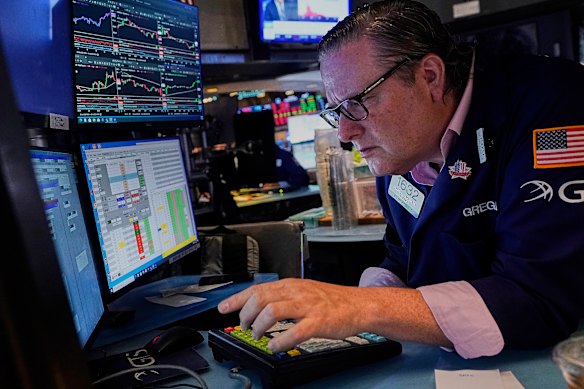
Wall Street is waiting on Nvidia’s results on Thursday (AEDT).Credit: AP
The Australian sharemarket is set to edge lower, with futures at 4.51am AEDT pointing to a slide of 6 points, or 0.1 per cent, at the open. The ASX dove 1.9 per cent on Tuesday. The Australian dollar was trading at US65.13¢ at 5.12am AEDT.
Technology stocks were the biggest weights on the market. Microsoft fell 3.2 per cent and it was the heaviest force driving the market lower. Amazon.com fell 3.3 per cent.
Nvidia was again one of the heaviest weights on the market, and its drop of 1.9 per cent brought its loss for the month so far to 9.6 per cent. The stock is hovering close to a 10 per cent drop, which is a steep enough fall that Wall Street has a name for it: a correction.
Loading
What Nvidia does matters disproportionately to savers’ retirement accounts because it’s the most influential stock on Wall Street due to its immense size. It single-handedly steers the direction of the S&P 500 some days, after fervent demand for its artificial-intelligence chips helped it briefly top $US5 trillion ($7.7 trillion) in total value.
The US stock market’s recent struggles are a sharp turnaround from a nearly relentless rally since April, when Wall Street last sold off after President Donald Trump shocked the world with stiff tariffs. That rally, though, was so strong that critics said it may have carried prices too high, too fast and left the market at risk of a sharp drop. They pointed in particular to stocks swept up in the AI mania, which have been surging at spectacular speeds for years.
Nvidia’s price more than doubled in four of the last five years, for example, while Palantir Technologies’ stock more than doubled in the first six and a half months of this year.
Many big investors still seem to be expecting stock prices to rise further, according to the latest monthly survey of global fund managers by Bank of America Global Research. But when asked what the No. 1 risk for the market is, one with a lower probability of happening but a chance of very big damage, 45 per cent pointed to an AI bubble. That beat out potential trouble in the bond market, inflation and trade wars.
A record percentage of investors is also saying companies are “overinvesting,” according to the survey. The worry is that all the dollars pouring into AI chips and data centres worldwide may not produce the kind of revolution that AI proponents have been predicting, or at least not as profitable a one.
Other high-flying areas of the market with their own evangelists have also been struggling lately. Bitcoin’s price briefly fell below $US90,000 in the morning, down from nearly $US125,000 last month. It later recovered some of its losses and moved above $US93,000.
Home Depot also helped drag the market lower after falling 4 per cent. It reported a weaker profit for the summer than analysts expected and cited a variety of reasons. Chief among them was a lack of storms, which would have driven customers to buy more home-improvement supplies. But CEO Ted Decker also pointed to “consumer uncertainty and continued pressure in housing” for preventing an expected increase in demand.
Reporting stronger profits is one of the ways a company can make its stock price look less expensive, because stock prices tend to track with earnings over the long term. That’s raising the stakes for Wednesday’s profit report from Nvidia, which could either help halt its stock’s slide or worsen it.
Elsewhere on Wall Street, Cloudflare fell 2.4 per cent after an earlier issue at the internet infrastructure provider had caused global outages for ChatGPT and other services.
Loading
In the bond market, Treasury yields eased. The yield on the 10-year Treasury fell to 4.12 per cent from 4.13 per cent late Monday.
The US government reported that the number of workers applying for unemployment benefits in the week through October 18 was roughly where it was a month earlier. It did not fill in data for the prior three weeks, though. The government is just beginning again to report data about the job market and other signals about the economy following its six-week shutdown.
The dearth of data has helped raised doubts about whether the Federal Reserve will cut its main interest rate at its next meeting in December, something that traders had earlier seen as very likely. What the Fed does is extremely important to the market because stock prices ran to records in part because of expectations for continued cuts to rates.
The Fed has cut rates twice already this year in hopes of shoring up a slowing job market. But lower interest rates can make inflation worse, and inflation has stubbornly remained above the Fed’s 2 per cent target.
In stock markets abroad, indexes tumbled across Europe and Asia.
Japan’s Nikkei 225 dropped 3.2 per cent after feeling extra pressure from a jump in Japanese government bond yields, reflecting rising risks as Prime Minister Sanae Takaichi prepares to boost government spending and push back the timetable for bringing down Japan’s huge national debt.
South Korea’s Kospi sank 3.3 per cent, and France’s CAC 40 fell 1.9 per cent for two of the larger drops worldwide.
AP
Most Viewed in Business
Loading