
 3 months ago
51
3 months ago
51
3 hours ago
Chris MarshallBusiness reporter

 Softstar Shoes
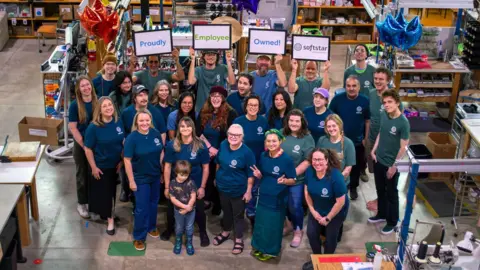
Staff at Software Shoes in Oregon now own the business
Staff at Softstar Shoes in Oregon have discovered a newfound enthusiasm for eking out resources and growing profits.
It started in January when the shoemaker became owned by its 30-strong workforce.
Former sole owner and chief executive Tricia Salcido had decided to sell the business to the employees, because at age 56 she is starting to plan for her future retirement.
Salcido, who for next few years is staying on as chief financial officer, says that colleagues are now offering lots of suggestions for how to best run aspects of the business.
"I'm getting personal emails from employees saying, 'well, have you thought about this idea?'," she says. These are business insights that weren't forthcoming before!"
Salcido is among a small but growing number of business owners in the US said to be choosing to entrust their ventures to employees, rather than sell to an outside buyer.
One 2025 study said that up to 600 US firms are now being sold to their workers per year, with investment funds available to help finance the deals rising 78% to $865m last year from $500m in 2024, an indication of more businesses making the transfer.
As well as motivating staff – who share in the risks and rewards of ownership – research shows that employee-owned companies can be more productive, less likely to make staff redundant, and that they pay higher wages.
For Salcido, it was a way to preserve local jobs and prevent her firm's artisan shoemaking from being taken out of the US – which she was convinced would happen under a cost-cutting corporate buyer.
"It's something you put your life's work into… most small business owners really care," she says.
 Softstar Shoes
Tricia Salcido has sold her business to her staff as she eyes future retirement
A huge number of other US entrepreneurs are in the same boat as Salcido – they are approaching retirement age, and therefore having to decide what to do with their businesses.
The "baby boomer" owners of about six million American small and medium-sized companies will retire between now and 2035, says a report this year from business consulting firm McKinsey. Some commentators have dubbed this a "silver tsunami".
McKinsey adds that this mass retirement will result in "a once-in-a-generation wave of ownership transitions".
Ethan Rouen, associate professor at Harvard Business School, says: "I don't think a week goes by where I don't talk to an owner who is looking to sell their business." Their grown-up children often aren't interested in taking on the family venture, he adds.
Rouen and his Harvard colleagues believe a switch to employee ownership could help many firms survive, and that such a move often appeals to owners who care deeply about their employees, and worry about what would happen following a sale to a larger company or private equity firm.
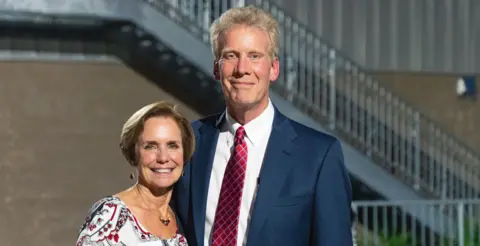
That was the case for William Stockwell, who wanted to protect the future of Stockwell Elastomerics, the Philadelphia-based manufacturer of industrial components that his great-grandfather started in 1919.
Stockwell made the decision to sell to his employees after seeing what happened to other firms that had been bought out. "The new [outside] ownership might move the business, they might shut it down, or drastically change it in other ways, and the people remaining are stuck," he says.
There are a number of different schemes available in the US by which a workforce can buy their company. At Softstar Shoes they used an Employee Ownership Trust (EOT).
Under an EOT a trust is set up, which takes ownership of the business on behalf of the staff, removing the need for them to buy the business out of their own pockets.
The trust then pays the former owner the agreed sale price of the business in instalments as a share of future profits.
This means that Salcido has committed herself to a waiting game before she gets her money, with an element of risk on top – she needs the business to continue to be successful.
"I carry the risk, in that if anything happens, I don't get paid," she says. But she has faith in her team to deliver. They also get a share of annual profits.
Stockwell, who now works part-time for Stockwell Elastomerics, opted for a slightly different method of transferring ownership to the stuff – an Employee Stock Ownership Plan or ESOP.
This also sees the business placed under trust ownership, but instead of staff sharing the annual profits, they get shares which they can only cash in when they leave the company.
Meanwhile, the retiring owner also must wait for his and her money. "I'm accepting payments over 10 years," says Stockwell, who acknowledges he is making a "short-term financial sacrifice".
 Stockwell Elastomerics
William Stockwell didn't want his staff to be at the mercy of a new owner
ESOPs are the most common method by which firms are handed over to their workers in the US. In 2023, the most recent year for which data is available, there were 6,609 companies under such ownership structure. These employed 10.9 million people, and held combined assets of more than $2tn (£1.5tn).
A third method of staff taking ownership is through the creation of a worker co-operative, whereby workers purchase a share of the business.
Harvard's Rouen says employee ownership doesn't just appeal to older founders looking to preserve what they have built over many years. Younger workers, "disillusioned" by traditional, unequal corporate structures, are also attracted to the model.
"The only way to truly create wealth in this country is through ownership of capital. And this is a way to democratise that," he says.
However, EOT and ESOP schemes are undoubtedly more complex to set up than a simple, traditional sale of the business, which may put off some owners. As does the longer wait for their money, and the increased risk.
Adoption is also hampered by a lack of awareness that the schemes even exist. "No one's heard of them," says Salcido at Softstar Shoes.
 SilkoTek Corporation
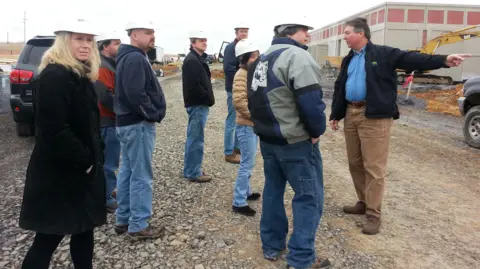
Paul Silvis, right, says he is confident that staff will look after his business
In central Pennsylvania, Paul Silvis is in the process of selling his manufacturing business SilkoTek Corporation to his employees. He says he is confident that he has made the right decision.
"I'm getting ready to ride off into the sunset at some point," says the 71-year-old.
Stockwell cautions that retiring business owners who want their staff to take over ownership need to start planning early for a process that could take years. "It's not something you want to begin the year you want to retire," he says.
Rouen says that, thankfully, there is now political will in Washington to simplify the process of employee ownership, as the US government has started to encourage it. The Department of Labour has a new Employee Ownership Initiative, which aims to both promote the practice and offer advice.
He adds that there is also bipartisan support in Congress "to figure out ways to make [selling up to staff] an easier and more realistic option for business owners." As a result, "my hunch is that we will see more successful employee ownership conversions in the next few years."

















































