3 months ago
32
3 months ago
32
It was late September and an ageing Australian journalist-blogger with 7400 subscribers was preparing to board a flight from Bangkok’s Suvarnabhumi Airport when he was stopped by a pair of Thai immigration officials.
“Are you Murray Hunter?” one asked. He was.
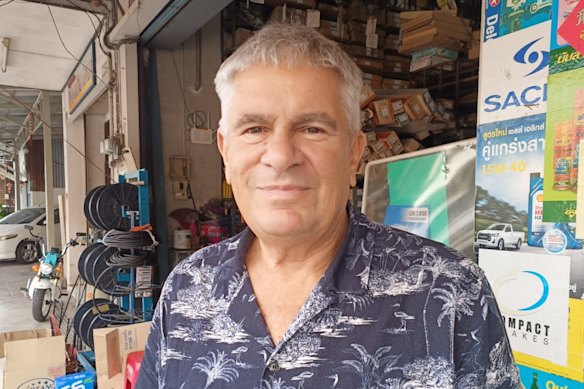
Australian independent journalist and blogger Murray Hunter.
He was not going to Hong Kong that day, they explained. The retired academic and long-time resident of Thailand had, in fact, been flagged as a wanted man. The police would collect him shortly.
Hunter, originally from Melbourne, was rocked.
“Can you imagine if you’re in Sydney airport or Melbourne airport and you’re about to fly out on a holiday and the federal police stop you and say, ‘Sorry, there’s an arrest warrant out for you’,” he said.
Police officers bundled him into a car and drove him to the lock-up at Bangkok’s Yannawa police station, stripping him of his possessions and passport.
“Then, when that cell door slams. That’s a shock,” he said. “I thought no one would be interested in my story. I just have a blog. I’m in a foreign country. I’m on my own.”
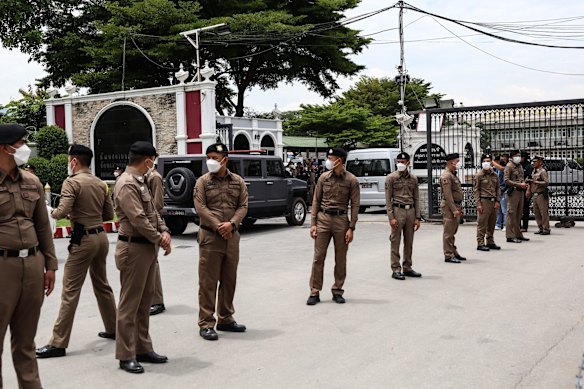
Murray Hunter spent a night in a Bangkok jail after his arrest.Credit: Bloomberg
The night in jail, before being bailed the following day, was the beginning of a 15-week ordeal – courts, nightmares and the daily crush of worry – that ended this week in what he described to this masthead as a mixture of humiliation, regret and relief.
His alleged crime was his writing.
Thailand has form in prosecuting defamation, particularly on matters of lèse-majesté – slights on the royal family. But Hunter had not defamed the monarchy. He was not even alleged to have defamed anyone from Thailand.
What set his case apart, attracting the reforming attention of a powerful Thai senate committee, is that Hunter, 68, faced prosecution in Thai courts and eight years’ in a Thai jail for offending an agency of the Malaysian government. Rights groups in Thailand and elsewhere labelled it “transnational repression”.
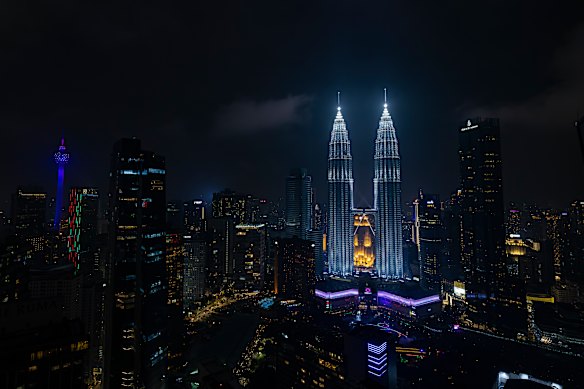
The allegedly defamatory articles were about the Malaysian media regulator.Credit: Getty Images
The four allegedly defamatory articles, posted to the blog site Substack in April 2024, accused the Malaysian Communications and Multimedia Commission, the country’s statutory media regulator, of blocking sites critical of the Malaysian government and its chairperson of having conflicts of interest.
Knocking the Malaysian government for attempting to silence critics was nothing new among writers and freedom watchers. In a detailed 2024 report about freedom of speech in Malaysia, the Centre for Independent Journalism wrote, “Authorities, including the Malaysian Communications and Multimedia Commission, invoked ... laws to target individuals with significant reach, leveraging legal action as a chilling signal to wider digital audiences.”
Hunter, though, was a vulnerable target.
“I don’t have a media organisation behind me,” he said. “I’m an individual, who’s retired.”
Weeks before his arrest in Bangkok, a Malaysian court found Hunter liable for defamation in proceedings he claimed he was never informed about. Now he was facing possible conviction and jail in Thailand.
Following a 12-hour mediation session in a Bangkok court on Monday, in which neither the accused nor the accuser spoke Thai, Hunter agreed to post an apology to the Malaysian Communications and Multimedia Commission and remove a host of critical blogs from Substack.
“All those articles coming down, there’s humiliation there,” he said. “And there are people saying, ‘You gave in’. You know, I’d like them to be in my position. But there’s also a lot of people that are very supportive.
“At 68, I just want to get away from their [MCMC] clutches.”
Transnational repression was a “matter of record” in South-East Asia, Thai politician and member of the Senate foreign affairs committee Pornchai Witayalerdpan said.
“Whether there are formal quid pro quo deals or not, the effect is that ASEAN nations appear to be acting as proxy enforcers for each other’s political censorship, which contradicts the ASEAN human rights declaration,” he said.
The way the Malaysian Communications and Multimedia Commission got Hunter was through a “loophole” in Thailand’s criminal defamation laws. Someone acting on behalf of the commission filed a complaint claiming to have accessed Hunter’s online articles while in Thailand, allowing local police and prosecutors to press charges under section 328 of the Thai Criminal Code, the senator said.
“Technically, the complaint was filed by a representative of the MCMC acting as a damaged party, rather than the government in a diplomatic stance. So it’s like an individual filing a defamation case against another individual,” he said.
“The legal mechanism that makes this possible lies in the interpretation of the ‘place of crime’ regarding online defamation ... consequently, a representative of a foreign agency can claim jurisdiction in Thailand simply by accessing the alleged defamatory content in Bangkok.”
Loading
Pornchai warned the precedent set by Hunter’s arrest suggests that any writer, whether a professional journalist or otherwise, could face arrest in Thailand for writing critically on foreign governments or their agencies.
“I think it’s very detrimental to Thailand’s image as a country that would like to protect human rights and freedom of speech,” the senator says.
“I am very concerned that Thailand is being utilised as a transnational repression hub, where our justice system is used to silence critics of foreign regimes.”
Pornchai is seeking change to Thailand’s laws so that a case like Hunter’s does not come up again. This is not only for human rights purposes. It is Thai taxpayers who bear the costs, he said.
Loading
The governments of Thailand and Malaysia did not respond to requests for comment. The Australian Department of Foreign Affairs and Trade also declined to comment on the case and outcome, citing privacy reasons.
Hunter remained in Thailand with his partner. While he could not discuss all details of the mediation, he hoped for the reactivation of his blog and archive in Malaysia, which had been blocked there for several years, long before the case was brought against him in Thailand.
Most Viewed in World
Loading