2 months ago
18
2 months ago
18
Opinion
December 9, 2025 — 5.00am
December 9, 2025 — 5.00am
When US military elites gathered in Simi Valley on the weekend for the Reagan National Defence Forum, they were treated to some surprising results from the organisation’s annual survey. Support for the US sending weapons to Ukraine rose to an all-time high of 64 per cent. There was an increase in every demographic, but the biggest was among Republicans (44 to 59 per cent), and in particular, among MAGA Republicans (42 to 62 per cent).
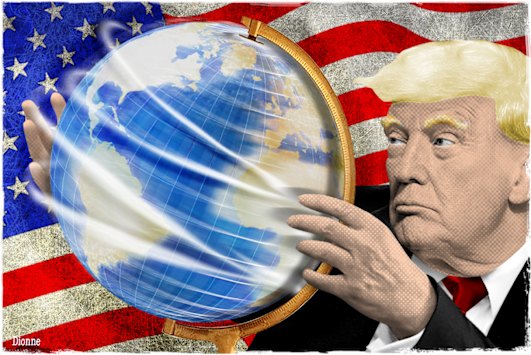
Illustration by Dionne GainCredit:
Three in four Americans said it was somewhat or extremely important for the US military to defend Taiwan against Chinese aggression. Among Republicans and MAGA Republicans, the figure climbed above 80 per cent.
According to the survey, the proportion of Americans who support dispatching US forces to Taiwan’s aid in the event of a Chinese invasion is now 60 per cent, up from 48 per cent.
The combined telephone and online survey of 2500 Americans, undertaken in late October, suggests deep and widespread enthusiasm for the US being actively and seriously engaged in the world, from the Indo-Pacific to Europe.
In doing so, it defies the conventional wisdom about prevailing trends in US politics, and in particular Trump’s base. “The American people are not isolationist, and MAGA Republicans are not isolationist,” said the Ronald Reagan Institute’s policy director, Rachel Hoff.
Loading
She pointed out that on the broad question of whether it was better for the US to be more engaged in the world and take the lead, or less engaged and react to events, 64 per cent backed more engagement, climbing to 79 per cent among MAGA Republicans.
Mike Gallagher, a former Republican congressman turned head of defence at Palantir Technologies, said: “You could make the argument based on the survey data that MAGA Republicans … are more Reagan-esque in their views about the world than even non-MAGA Republicans.”
Now, some caveats. We should be sceptical when a historically hawkish outfit like the Reagan Institute proclaims greater support for intervention overseas. It’s one thing to say it to a pollster on the phone – quite another when it’s a real matter of life and death. And there’s naturally an element of people following the leader – large increases in Republican support for these policies reflects the fact they now have their man in the White House. They trust Donald Trump to make the right calls.
Still, other polls have tracked increased support for Ukraine, including a July survey by the Chicago Council on Global Affairs that found six in 10 Americans backed US military and economic assistance for Kyiv – higher than in March.
Loading
Against that backdrop, the Trump administration last week released a document that envisaged a very different role for the US on the world stage. The new National Security Strategy sets out a US vision that prioritises “re-establishing strategic stability with Russia” and seeking the most expeditious end to the Ukraine war, rather than the most favourable or just. It is a US that reserves its harshest criticism for European allies who have embraced net zero, mass migration and the central bureaucracy of the European Union.
At its most extreme, the document says US foreign policy in Europe should prioritise “cultivating resistance to Europe’s current trajectory within European nations”, a clear endorsement of far-right nationalist parties which espouse the great replacement theory and want to crush Brussels’ centralised power.
“We want Europe to remain European, to regain its civilisational self-confidence and to abandon its failed focus on regulatory suffocation,” the strategy states.
Justin Logan, director of defence and foreign policy at the libertarian Cato Institute, says if the EU thought it won a reprieve from the Trump administration after NATO allies agreed to hike defence spending to 5 per cent of gross domestic product, the new strategy was a reminder that’s not necessarily the case.
Speaking at the Reagan Defence Forum, the top Democrat on the House of Representatives armed services committee, Adam Smith, wondered whether Trump now stood apart from his base on foreign policy issues, particularly when it came to Ukraine and Russia.
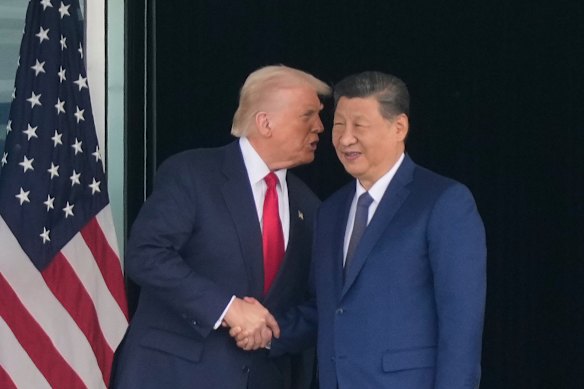
US President Donald Trump and Chinese President Xi Jinping after their summit meeting in South Korea on October 30.Credit: AP
‘There’s every indication … that Trump wants some kind of grand deal with China.’
Justin Logan, Cato Institute“If you read the National Security Strategy … it doesn’t seem that Trump is with the MAGA people in terms of being able to show strength on Ukraine,” Smith said. “He has shown nothing but weakness to Vladimir Putin, and Putin has exploited that.”
Indeed, Kremlin spokesman Dmitry Peskov told Russian state television that the changes to US strategy in the document “correspond in many ways to our vision”. How’s that for an endorsement?
Loading
In the Indo-Pacific, most analysts see the new strategy as taking a softer approach to China’s rise – one that is much more concerned with trade and economics than Chinese aggression in the region. Indeed, it prioritises building a “mutually advantageous economic relationship” between Beijing and Washington.
“China is no longer framed as a systemic challenge with a vision of world order that is incompatible with US interests,” says the Council on Foreign Relations’ David Sacks.
Sacks points out a seemingly small but potentially significant change to the document’s language on Taiwan. Whereas the Joe Biden-era manifesto said the US “opposes” any unilateral changes to the status quo, Trump weakened the position to “does not support” any such changes. “This shift is baffling,” Sacks writes.
But the strategy does not take the additional step of declaring the US “opposes” Taiwanese independence – something Beijing has reportedly pressured Trump to do. The long-standing US position is that it “does not support” independence for Taiwan. The new NSS does not mention Taiwanese independence at all.
Loading
“That’s something to watch for,” Logan says. “The administration itself has been somewhat less hawkish on China than you might have expected … it has not been a sort of fire-breathing, unidirectional hostile policy. There’s every indication in the NSS and elsewhere that Trump wants some kind of grand deal with China.”
The president has been almost deliberately flippant on Taiwan, dismissing the notion of any move by Beijing. That’s despite Xi Jinping telling Trump in their most recent phone call that Taiwan’s return to China was “an integral part of the postwar international order”, according to China’s Foreign Affairs Ministry.
This distance from and indifference to the big geopolitical questions of the era seems at odds with what most Americans want – if we believe the aforementioned polls.
The reality, as always, is probably in the middle. Americans are likely less gung-ho about US intervention in overseas affairs than the Reagan polling suggests, and Trump is likely more hawkish than he lets on. He has insisted Xi “knows the consequences” of any infringement on Taiwan.
At any rate, Logan cautions against putting too much stock in a document that represents a hodgepodge of thinking from government institutions – Defence, State, the National Security Council – at a time when policy is largely set by the whims of an unpredictable actor in the Oval Office.
“Trump hasn’t read it, he’s not going to read it, and he’s not going to be constrained by it,” Logan says. “If he wakes up one morning and decides he wants to do the exact opposite … he’s going to do that.”
Michael Koziol is the North America correspondent for The Age and The Sydney Morning Herald.
Get a weekly wrap of views that will challenge, champion and inform your own. Sign up for our Opinion newsletter.
Most Viewed in World
Loading