3 months ago
14
3 months ago
14
I wish to thank Waleed Aly for giving us his deeply personal account of his own ego-dethroning pilgrimage to Islam’s most sacred and holy cities of Mecca and Medina (“Pilgrimage to a better masculinity”, December 5). But what stood out for him was this: “Such vulnerability ceases to be emasculating because in places like these, invulnerability has already shown to be a lie.” Aly, while not dismissing the problem of misogyny within Islam, experienced the huge potential of the possibility of there being a vastly different form of masculinity. He saw how many thousands of men from all walks of life could act with such grace and humility towards one another at the wonder of being at this holy place. He saw how utterly powerless was Pauline Hanson’s burqa-wearing stunt when “politics retreats to anxiety, anger and fear”. But most importantly, he saw that a masculinity centred on service, sacrifice and self-effacement is far greater than any egocentric power a man can wield in this world. And yes, as one who is a follower of Jesus Christ, I would truly and honestly say “Amen” to that. Rev Vincent Zankin, Rivett (ACT)
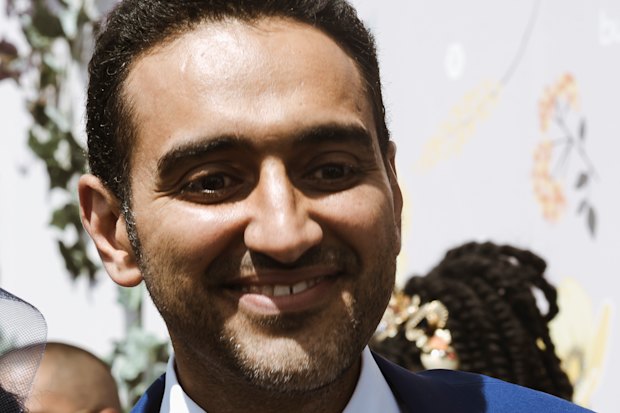
Waleed Aly; There’s no place like MeccaCredit: Fairfax Media
Waleed Aly takes us to many places with his thoughtful, incisive missives. Medina and Mecca? A first for me. A pilgrimage to a better masculinity? My life’s work, perhaps. It’s humbling to realise how far I have to go. Service, sacrifice and self-effacement are the key. Add patience and soft-heartedness and we’re back on track. How refreshing it would be if the puffer fish of this world were to realise the place of power and its ability to do good, rather than divide and demean. Thanks for the inspiring insights. Geoff Nilon, Mascot
Reading Aly’s account of his trip to Mecca and Medina, even I – an avowed atheist – had to cry. Not only does Aly shine a new and creative light on the growing horror of toxic masculinity, rife in our chaotic world, but he also demonstrates how humans from whatever background and however different their cultures are essentially equal in showing the important values of life – kindness and tolerance. I am unable to participate in the subtle spirituality that suffuses Aly’s writing, but I now have a new and clearer understanding, I hope, of the values embodied in powerful religious faith. This article is not just outstanding in the insights it provides; it is, in my opinion, an example of beautiful literature. Andrew Caro, Greenwich
Waleed Aly was overwhelmed with humility visiting Mecca. I get the same humbling experience every time I set foot in the garden, or a forest – abundant with life, energy and beauty. No prophets required. Here’s to the many good men (and women) making it their life’s work to protect, promote and secure what is our ultimate life-support system. These are the guys to watch and the ones who will lead us from temptation into a brighter, more respectful future, because all those symbols of greater humanity – mosques, cathedrals and the multitudes of houses of worship and those who inhabit them – mean nothing if we keep polluting and plundering that which gives us life, our beautiful planet Earth. Dorin Suciu, Eleebana
I am not religious, but earlier this year, I walked a “pilgrimage” on the Camino Frances to Santiago de Compostela, Spain. I totally understand Waleed’s observations and truth. I walked hundreds of kilometres in the footsteps of millions of past pilgrims through beautiful wilderness and by ancient holy relics, carrying all my possessions on my back. I experienced a wistful inner peace and sanctuary and met hundreds of “foreigners”, who were immediately my friends, confidants and comrades. We could walk in shared silence, but sharing more than words. You are stripped of all artifice for there is nothing to compete for, no place for pride and nothing to achieve but a voluntary acceptance of your insignificant presence in a shared humanity, spiritualism and natural beauty. This is a salve and a solution to so many social ills. I am returning in April. Rowan Godwin, Rozelle
Too many kooks
Thanks to James Massola for the reminder that One Nation is nothing more than a collection of aggrieved amateurs pushing a diet of superficially attractive, short-lived gimmickry to garner support (“Steaking her claim on more defectors”, December 5). If stubby holders, branded sandwich presses and other shallow flummery are what satisfy your hunger, then you are easily pleased but just as easily disappointed. And the idea that those who merely throw up quick-fix solutions, empty slogans and tasteless stunts could ever competently run a national government is beyond ludicrous. I’ll be neither buying their tawdry merchandise nor dining on their grievance-fuelled, undercooked fast-food menu. Adrian Connelly, Springwood
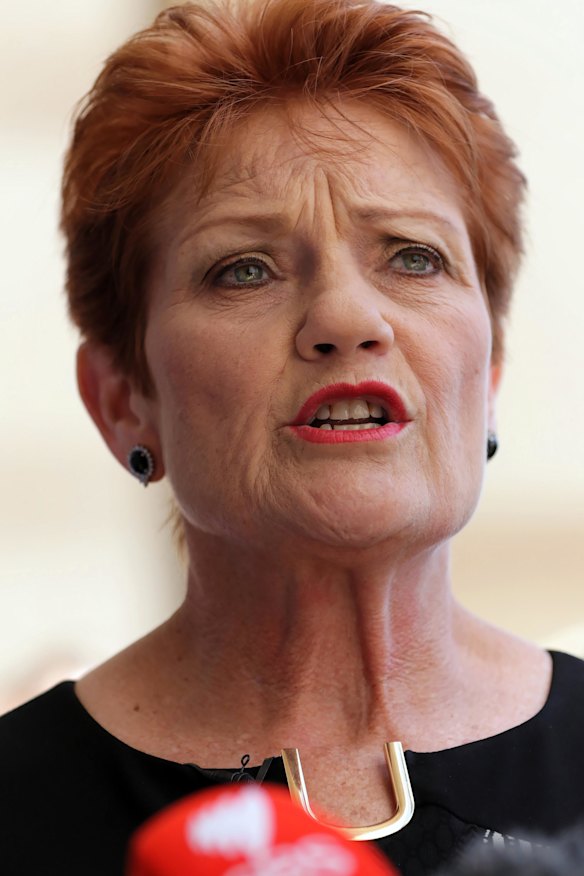
Take Pauline Hansen with more than a grain of saltCredit: Trevor Collens
Hanson might be “steaking” her claim on more defectors joining her, but she will definitely continue to create more fear and divisiveness in the wider community. Con Vaitsas, Ashbury
James Massola leaves us guessing with his latest predictions who will join One Nation in 2026. One thing is certain. Hanson continues to surprise us all with her ability to upset the status quo of politics in Australia. Like her or not, she has lasted longer than anyone could have foreseen. The next election could reshape the Australian political landscape once again. Denis Suttling, Newport Beach
Immoral compass
Pete Hegseth may well have misread his moral compass in “the fog of war” (Letters, December 5), but in December 1941, when Pearl Harbour was shrouded in smoke as the United States lost more than 2400 men and women, did they kill the only Japanese sailor to survive the attack? No, they did not. Kazuo Sakamaki, who swam ashore when his mini-sub was wrecked attempting to enter the harbour, was arrested, becoming America’s first POW of the war. Sakamaki was attacking the United States, was found on American soil and was spared. The crew in the Caribbean, clutching floating wreckage in international waters, could and should have been rescued by the US Navy. But they weren’t. They were murdered in cold blood. Pat Sheil, Camperdown
I wonder how many people noticed that when Hegseth appeared with President Trump to pass the blame to the admiral for giving the order for the alleged war crime, his name card read “SSECRETARY OF WAR”. Clearly the sign writer was comparing Mr Hegseth with past murderers of Nazi Germany. Mark Berg, Caringbah South
Desperation v decency
Michael Koziol has written of the concerns people have about the World Cup in the US (“Fears for foreign visitors as US gears up for World Cup”, December 5). Discrimination and refusal to allow entry to people Trump and his followers disapprove of could be a serious put-off. At the same time, our government here is dragging its feet over the return home to Australia of ISIS brides and their children (Letters, December 5). Our government expects other countries to deal with our desperate women and children, but not us. Come on, Albo and company, out of common decency just bring them home; we should look after our own, not expect others to do so. We can and we must. Nola Tucker, Kiama
Mixed aims of single-sex schools
Jenny Allum shares many notable insights on the considerable social changes she’s observed and navigated as principal of SCEGGS over 30 years (“SCEGGS head defends single-sex schools upon her retirement”, December 5). However, her logic falters in her arguments upholding single-sex schools. She wants “SCEGGS girls to understand that they’re empowered and they’re strong, and they can fight for equality and justice and stand up for themselves”. This is the core antithesis of how segregation by sex and private school privilege affects and shapes individuals, and ultimately society. It’s disappointing that any education leader would harbour the misguided belief that wholesale segregation in formative years makes girls “strong” or, more importantly, able to navigate the realities and critically evaluate the world after leaving school. A world that still oppresses and discriminates against women, who need to fight much uglier battles than anything encountered in such a cosseted environment as single-sex private schooling. Two counterarguments: the world is still being torn apart by conflicts generated by outdated, sustained religious and sex segregation; and, if we condition kids to sex segregation, we arguably create a mystery of difference, which counters a worldly education. Robyn Dalziell, Kellyville
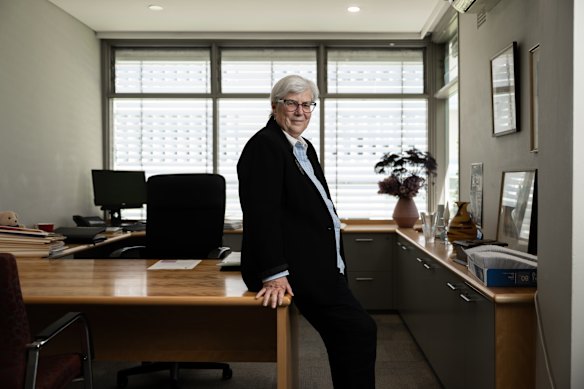
Jenny Allum, head of Sceggs Darlinghurst is retiring after decades in the role. Credit: Louie Douvis
Hear, hear, Jenny Allum! Why should girls’ education be sacrificed to enable boys to become civilised? Her statement about the workplace being male-centric is certainly true and that is unlikely to change just because some of the males attended co-ed schools. Our girls need all the help they can get at school to survive in the workplace that awaits. It’s strange that we never hear parents complaining about their daughters not having access to co-education, unless it’s in the private system and they wish all their children to attend the same school for convenience. It has been very disappointing to see the NSW government force co-education on many state high schools, against the wishes of many parents of girls. Mary Lawson, Marrickville
Congratulations, Jenny Allum on 30 years of leading young women and teachers. Her success makes sense; her thoughts on anxiety, student focus, bullying and the role of teachers are sensible and pragmatic. Voices like hers are needed: her leadership and “formidable intellect and formidable presence” will be missed. Lisa Williams, Dulwich Hill
Life and debt
It is not only mortgagees who have a problem of servicing debt (“Government interest bills soar, as does public debt”, December 5). Our governments have an increasing problem, taking on ever more debt to appease our society to win and retain government. Eventually, it will bite hard. There needs to be a review of what is “good debt” and what is non-essential expenditure. We all have to live within our means, and it appears that our various levels of government, including local councils, are running into big trouble as servicing costs balloon, reducing funds for essential services. The federal government’s reliance on the Future Fund to finance expenditure other than public servants’ superannuation is a classic example of its financial mismanagement. With a projected federal interest bill of $54.1 billion, there needs to be a serious cost-benefit analysis on this level of debt. The big debt crunch is only a few years distant, when our AAA credit rating will be no longer. Bruce Clydsdale, Bathurst
As Australia’s interest bill nears the annual cost of the NDIS, yes $54 billion, why is it so hard for a Labor government to get things right? Budget management is pretty simple: you either increase your revenue (no tax changes proposed) or reduce your costs (no plans here either). Brian Barrett, Padstow
If state and federal governments are struggling to get on top of their health spending, then clearly we have a lot of sickness on our hands. So why is there so much illness? What are we doing so wrong in our physical, emotional, mental and spiritual selves? Shouldn’t our priority now be our well-being? We need to address the cause rather than the surface symptoms. That’s how the ballooning budgets will eventually be reduced. We humans always seem to approach important matters tail-up. Is our focus on the money rather than what humanity needs? We need to learn to celebrate life. We’ve forgotten what a gift it is. Neville Williams, Darlinghurst
Money well spent
People will always have different views. Some will laud the specific spending of government money; some will not (Letters, December 5). Detractors need to look at what the money was spent on, not just how much was spent, and then decide whether it was well spent. In this case, it’s the mental health not just of Australian children but of children across the world. Had the government made a $94,000 contribution to Save the Children or to UNICEF, would the detractors have complained? Peter Butler, Wyongah
The great Gough Whitlam, in attempting to cut government costs, instructed all MPs to travel economy class. He countered the cabinet outrage by saying: “I fly economy and I am a great man, and I could fly economy for the rest of my life and I’d still be a great man. But most of you around this table are pissants, and they could fly first class for the rest of their lives and they’d still be pissants.” Alan Marel, North Curl Curl
Health up in smoke
The article about tax and tobacco (“Illegal tobacco has become an economic cancer”, December 5) misses the point. It is a social cancer. Nicotine is so addictive that millions of Australians are prepared to support criminal organisations to maintain an unhealthy habit. Should we surrender to the criminals and let more Australians die of tobacco-related illness? I hope not. Steve Bright, North Avoca
Rego for e-bikes
The dangers presented by e-bikes and their young riders are well documented (Letters, December 5). Some form of licensing/registration for these bikes is necessary and must include third-party insurance. Back in the day, surfboards were registered with local councils. If your board did not have a registration sticker, it was not to be ridden. Why not something similar for e-bikes? Arthur Hennessy, Gymea Bay
An e-bike with a motor is simply a motorbike. It should be liable for all the regulations that apply to such vehicles. Registration (with plates), third-party insurance, no driving though red lights, no parking on footpaths and certainly no driving on footpaths. Charles Hargrave, Elizabeth Bay
Bound for Bondi beach
What Bondi Junction needs is an underground railway line from the station to Bondi Beach (“Breathing new life into Bondi Junction”, December 5). Such infrastructure would encourage developers to build more housing because the beach would become more accessible to Bondi Junction residents. At the moment, travelling from the Junction to the beach by either car or bus is a shemozzle. For that, we have to thank the celebrity blow-ins who pressured the weak-kneed government in power at the time. Riley Brown, Bondi Beach
Bandler history gone
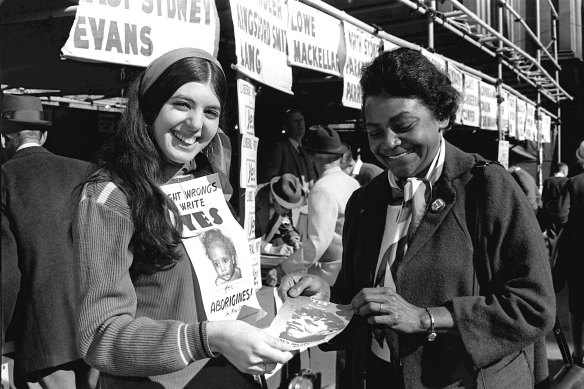
Civil rights activist Faith Bandler (right) on her way to vote in the 1967 referendum.Credit: George Lipman
I recently contacted Ku-ring-gai Council about the current demolition of a house in Kissing Point Road, Turramurra. The house is the former home of Faith Bandler, the well-known campaigner for Indigenous Australians and South Sea Islanders. She was best known for her campaigning in 1967 for the right of Indigenous Australians to vote. The council said there was nothing it could do as the development application had been approved by a private certifier and there was no heritage listing on the property. Faith Bandler’s home would have been the venue for many interesting discussions over the years. She was well known in the local area. As she grew older, she would wave her walking stick to catch a ride up the hill of Kissing Point Road to get to the shops. I was honoured to give her a lift whenever I saw her. A piece of history gone. Jane O’Donnell, Turramurra
Mental illness licked
It looks like the old but “new” cure for depression and increasing mental well-being is being licked by a dog and benefiting from its specific gut bacteria (“Teens who kiss their dogs are happier”, December 5). We could save millions by bulk billing this service within Medicare, thus solving the rampant rise of mental ill health. The downside is that some dogs (such as border collies, and maybe a few poodles) would inevitably seek to rort the system and begin charging exorbitant specialist fees for their expertise. Judy Finch, Taree
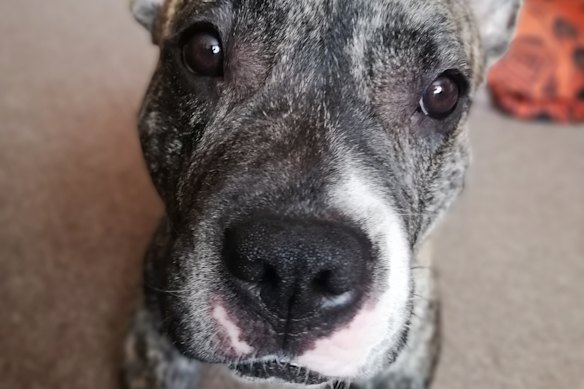
Do you believe in the Power of Dog?Credit: Getty Images/iStockphoto
I can still hear my dad now. “Don’t kiss the dog, you’ll get hydatids.” But in the end, it looks like it probably made me happier. Lisa Clarke, Watsons Bay
The story should have a warning. Ingesting a dog’s tapeworm eggs can result in hydatid cysts when the eggs hatch, including in the brain, and may require surgery. Michael Britt, MacMasters Beach
Happens every year
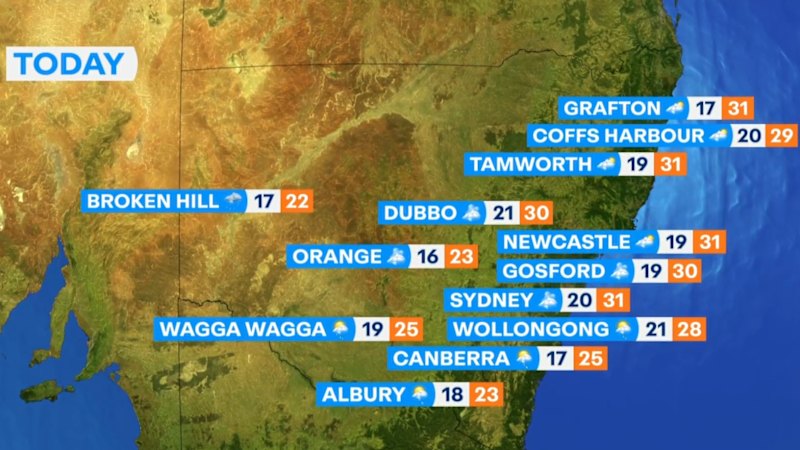
Sorry to break this to you. It is summer (“Heatwave alert as Sydney braces for scorchers”, December 5). Mustafa Erem, Terrigal
- To submit a letter to the Sydney Morning Herald, email [email protected]. Click here for tips on how to submit letters.
- The Opinion newsletter is a weekly wrap of views that will challenge, champion and inform. Sign up here.