3 months ago
24
3 months ago
24
The world’s biggest mining company is applying artificial intelligence to conveyor belts, blasting zones, giant ore-carrying trucks, rock crushers and safety apps as it seeks to cut downtime, eliminate risks and add up to $250 million a year to its bottom line.
Perhaps the most explosive use of AI in Australian resource giant BHP’s global operations is the machine learning it has applied to blast patterns for breaking up orebodies of different densities at its cornerstone Escondida copper mine in Chile, an asset that accounts for about 5 per cent of the world’s red metal output.
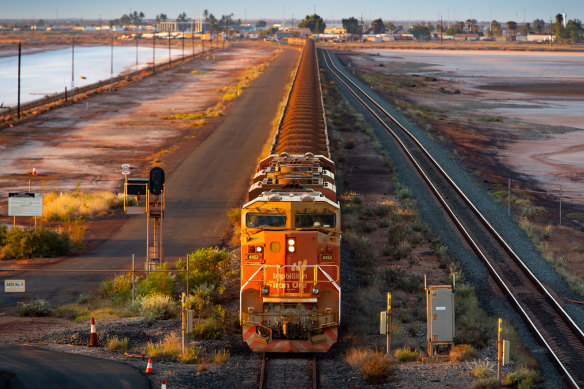
AI can identify spillage from BHP’s iron ore trains, avoiding accidents.Credit: Getty
Mine operators typically drill ore samples in the bedrock they are excavating about 10 to 12 weeks before they begin digging to determine the mineralogy and grade of material they will excavate after loosening it with explosives.
Chief technical officer Johan van Jaarsveld said BHP began applying AI to historic drill data at Escondida about a year ago to help workers look for connections between “not-directly-correlated variables” that allow them to predict the orebody’s density and design a blast pattern that puts the most intense explosions against the hardest rock.
“You break the rock a lot more efficiently, to the point where the mills don’t have to work so hard, which means you can actually get more rock through the mills,” van Jaarsveld said. “The day we started doing that, mill throughput went up 3 per cent. On a mine like Escondida, that’s quite significant.”
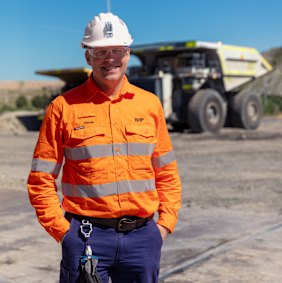
Johan van Jaarsveld is applying AI across rail, safety and mining operations at BHP.Credit:
It’s an improvement of around 30,000 tonnes of copper from the mine, which is 57 per cent owned by BHP and 30 per cent by rival giant Rio Tinto. The remainder is held by a Japan-based partner.
In its latest annual results, BHP highlighted its record full-year copper production of 2 million tonnes, pointing out a 16 per cent increase at Escondida. The open-pit mine is 3100 metres high in the remote Atacama Desert and yields about 1.3 million tonnes of the metal a year – enough to satisfy a significant portion of the ballooning global demand, driven by major economies rushing to build out the copper-intensive infrastructure needed to power clean energy.
Another key change at Escondida and in BHP’s massive West Australian iron ore (WAIO) operation is extensive use of machine vision with a software overlay, a technological innovation that can identify spillage on key ore rail transports or oversize rocks and foreign objects on conveyor belts.
The company tapped into its existing CCTV system and built a real-time spillage detection model using computer vision. If a surge is detected, the system stops a train loading and raises the chute – all in under half a second.
“[We] have an AI agent that’s watching the video in real time and can identify objects quickly that will either tear a conveyor or that might block a crusher,” van Jaarsveld said.
Loading
“An alert goes to control room, the item gets removed, and then the process continues. That’s a much better outcome than tearing a conveyor belt. Then you’re down for six hours.”
Cameras are also installed on some of the loaders that fill the monster tip trucks transporting ore out of the pits to the conveyor or crusher. They can identify overly large rocks as they are loaded and alert the driver to tip the contents elsewhere to avoid obstructing the system.
Van Jaarsveld estimates avoiding downtime from blocked crushers or damaged conveyors equates to up to 1 million tonnes of extra ore through WAIO’s export system, all of which is loaded onto ships in its ports and bound for China, where it is the key ingredient for the country’s vast network of steelmaking mills.
“Any downtime that you avoid in that system is additional revenue,” he said, adding the change has boosted returns by about $50 million a year. “For the outlay of, say, a couple of million dollars across the whole place, you get $50 million back every year forever.”
Loading
Simple AI tools such as voice-to-text are changing how hazards are reported, letting employees speak into a mobile app instead of filling out paper forms. Reports are geotagged, logged in real time, and the system also gives quick digital risk assessments with warnings based on past incidents, he said.
Since the company began introducing AI applications, it has rolled out about 200 such “point” solutions across the business. “Since 2021, there’s roughly $2 billion in value that’s been created. You either increase revenue or you reduce costs, but it’s got a lasting [earnings] impact.”
After applying AI to “low-hanging fruit” that “creates big value quickly”, van Jaarsveld said BHP is focusing on a platform-wide approach targeting annual savings or revenue gains of about $250 million.
“Instead of developing something at Escondida and having something else at WAIO, we can have a system that works on a platform and that you install everywhere. That will take a little bit more effort, both on the hardware and the software side, [but] will have a much bigger impact across the business.”
The Business Briefing newsletter delivers major stories, exclusive coverage and expert opinion. Sign up to get it every weekday morning.
Most Viewed in Business
Loading