3 months ago
26
3 months ago
26
Of all the excuses in all the world that could possibly be used as an explanation for doping, North Korea’s women’s football team had a new one.
The banned steroid detected in the systems of five senior players during the 2011 World Cup in Germany was, in fact, a natural substance derived from the glands of a musk deer.
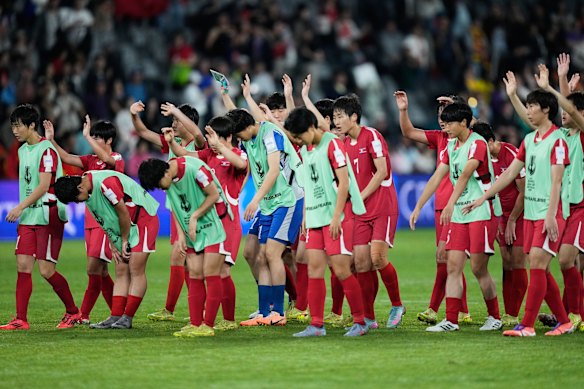
North Korea bows to their supporters following the Women’s Asian Cup soccer match between China and North Korea in Sydney.Credit: AP
And why were these players given such a substance? Well, all five had been struck by lightning and required treatment.
The North Korean federation’s version of events was too outlandish even for FIFA – and FIFA is responsible for many an outlandish version of events – and the team was banned from international football for four years. In the end, the musk-deer-ate-my-homework incident and its fallout resulted in a major tournament absence lasting more than a decade – effectively until the Asian Cup in Australia right now.
Because of the suspension, North Korea missed the 2015 World Cup in Canada, failed to qualify for the 2018 Asian Cup and 2019 World Cup, before spending the 2022 Asian Cup and 2023 World Cup in voluntary COVID lockdown.
It seems crazy to think that none of this has negatively affected North Korea’s international standing. That they are still ranked ninth by FIFA – one spot below Asia’s top dog Japan and six above the 15th-ranked Matildas. But it is part of what makes this side one of the most fascinating in women’s football and perhaps the team to watch at this tournament.
Loading
The ranking part is slightly less mysterious than almost everything else about the world’s most isolated nation. During the pandemic, FIFA implemented several adjustments to its ranking system to account for the massive disruption in international fixtures. This included an extension of the period a team could remain inactive before being removed from the rankings, and a guarantee that inactive teams would not drop points and thus fall down the rankings.
So there North Korea stayed inside the top 10, primed for an advantageous tournament seeding upon their return. At last year’s 2026 Asian Cup draw they landed in a group with defending champions China (world No.17), Uzbekistan (world No.49) and Bangladesh (world No.112), and scored a total eight unanswered goals against the latter pair (which had nothing on their 26 goals in their three qualifiers) before a 2-1 loss to China (and a VAR-related tantrum) left them as runners-up in their group and confirmed a quarter-final date with Australia in Perth on Friday night.
But the other, larger-scale factor contributing to the country’s success is its mother of all youth programs. In the late 1980s, when FIFA announced plans to launch women’s competitions, Kim Jong-il made it a national priority. His totalitarian state introduced football training for girls into the school curriculum, and created women’s football teams in the army to offer a way to be paid to play.
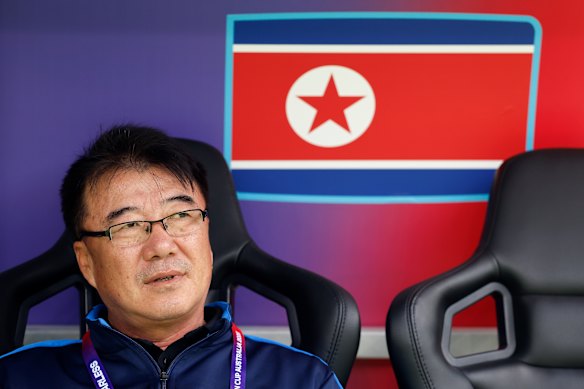
Ri Song-Ho won the under-20 Women’s World Cup before being promoted to coach of the senior team ahead of this tournament.Credit: Getty Images
In 2013, during the doping ban, the Pyongyang International Football School was founded. This addition changed the texture of international women’s youth football. The first and second cohorts of girls through that school are reigning champions of the under-20s and under-17s Women’s World Cups, and the youth national teams as a whole are the most successful in women’s international youth football history.
Loading
That means that, in a way, this Asian Cup team is 12 years in the making. It’s the first time any of the original cohort of Pyongyang students will compete in a major tournament at the senior level and the squad selected for it is littered with under-20 World Cup stars, including golden boot and golden ball winner, 19-year-old Choe Il-Son – also a graduate of the Pyongyang school.
The winning under-20s coach Ri Song-Ho was also promoted to the senior team ahead of this tournament and is under immense pressure to deliver at this age group what the country’s under-17 and under-20s teams have been able to do; win the whole thing. To help do that, the team underwent a month-long training camp in China to prepare for the heat in Australia.
Former Matildas coach, Tom Sermanni, says North Korea play soccer like it’s a matter of life and death. Credit: Getty Images
Before the ban, the unmatched success of the national team, as one of the few occupations allowed to operate outside the clamped-down and oppressively secluded country, became a powerful tool for soft power and propaganda. For Asian Cup rivals, they make for a tricky opponent.
“My favourite team, my favourite team,” says Tom Sermanni, who coached the Matildas to that 2010 Asian Cup final win and is the last Australian coach to have gone up against the team. “They’re a team you kind of love and hate at the same time. The often old-fashioned cliche about football being a matter of life and death and people say, ‘No, it’s more serious than that’. They kind of have that attitude to it. That it is a real matter of life and death.
“They’re amazingly competitive, focused and at the same time very different to all the other Asian teams, simply because of their isolation – socially and otherwise. Just a really interesting group with some interesting behaviours to go with it.
“I think you need to compare North Korea to the communist regimes of Russia and East Germany, when being an athlete was a way to get privileges and get out of their way of life. I think that still exists in North Korea. And probably the regimes they have to go through to play in those teams are probably quite brutal and ruthless … so there’s that added incentive.
“Plus there’s the propaganda around playing for the great leader. And it’s a case of ‘if we actually lose this tournament when we go back to North Korea, who knows what’s happening next with us? We could be back to an ordinary member of society again’.”
Of course, if winning is a matter of life and death, the North Korean team have a reputation for going to great lengths to psych out their opposition, as we’ve already seen in this tournament.
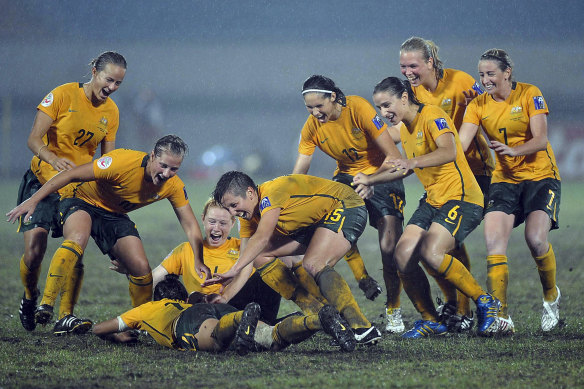
The Matildas celebrate after winning the final of the 2010 AFC Asian Cup, played in Chengdu in China against North Korea.Credit: AP
When the Matildas used to travel to the country for games, Sermanni would warn his players about these tactics. Occasionally, the team buses would arrive late to pick them players up for games, cutting into their warm-up time. In the hotel they stayed in, the electricity would go out, forcing players to slug up and down flights of stairs instead of using the elevators.
“It wasn’t as daunting in the sense of going into North Korea as you thought it would be because there’s nobody else there. People say, ‘are they spying on you?’ But you don’t know [and] you don’t really need to because you’re the only group of foreign people in the whole place,” he said.
With such a long absence from international football at the senior level, the Matildas will have little to go on besides their performance in this tournament and past tournaments at the youth level.
Loading
“I don’t think you can,” Sermanni said of being able to prepare against a team that hasn’t played a major tournament in more than a decade.
“I think the only thing you can do is, fortunately, we’re not in the same group as them. So you’re going to be able to see them play at least three games before you get a chance to come across them. So that’s what you’re doing. You’re actually using this tournament to scout them.”
Regardless, Sermanni believes that it would have been in the Matildas favour to try and avoid the team for longer, which they would have had they beat South Korea earlier this week.
“They’re a dark horse because you just don’t know who’s going to turn up for them. But I think you can assume that if they’re here, they’re going to be here, and they’re going to be competitive, and they’re going to have had some significant preparation to be here,” Sermanni said.
“They will be a team that you want to avoid as much as you can.”
News, results and expert analysis from the weekend of sport sent every Monday. Sign up for our Sport newsletter.
Most Viewed in Sport
Loading