3 months ago
26
3 months ago
26
A royal commission into antisemitism is a risk, but Labor’s excuses are wearing thin
Royal commissions have become one of the most symbolic ways that Australia chooses to confront its ugliest problems, even if they do not solve them.
At the beginning of last century, these Commonwealth inquiries looked at topics such as the butter industry and tobacco monopolies. These days they’re reserved for more seismic issues, including those that involve the most vulnerable members of our society: child sex abuse; Indigenous deaths in custody; and the abuse and neglect of people with disabilities.
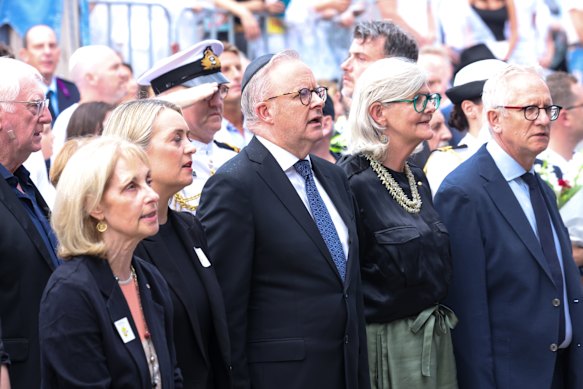
Prime Minister Anthony Albanese at Sunday’s vigil at Bondi Beach.Credit: Edwina Pickles
Now the Jewish community is asking for a royal commission to look antisemitism in the eye. Just as child abuse victims, Indigenous Australians and the disabled community volunteered to have their traumas interrogated so they wouldn’t happen again, Jewish Australians are prepared to share their worst experiences in public to stop another event like this month’s Bondi massacre.
The Albanese government is doing its best to turn down that request with sympathy and reason.
For just over a week, Prime Minister Anthony Albanese has been building on his argument for why he won’t call a royal commission.
Last Monday, he said NSW would hold its own inquiry, while the feds would ask former ASIO boss Dennis Richardson to review the security ecosystem – a Commonwealth commission would only duplicate and delay, he said, and urgency was required. The next day, he went to historical examples: there was no royal commission after Port Arthur or the Lindt siege.
On Monday, the government gave two new arguments. First, on national security: that Richardson was better equipped than a retired judge to review such matters, which would not suit the public forum of a royal commission.
Second, that a royal commission would become too divisive. “The necessary outcome would be to re-platform and provide a public platform for some of the worst statements and worst voices, to effectively relive some of the worst examples of antisemitism over the last two years,” said Home Affairs Minister Tony Burke.
Loading
“No one can tell me that that is in the interest of unity, to re-platform some of the worst voices. But a royal commission by definition does that, and does that publicly.”
But the calls for a royal commission have not gone away – instead, they’ve grown in number.
The case was first pushed by the federal Coalition as it mounted a political attack over the government’s response to Bondi. Then former treasurer Josh Frydenberg, judges, former governors, top silks and even two Labor backbenchers joined.
Now the families of those killed on December 14 have added their voices in an open letter. This is a much more difficult request for the prime minister to reject.
Of course the government wants to strive for unity at a time like this. It is looking for points of common ground, not division.
But Monday’s argument does not land when it is Jewish Australians asking for a royal commission.
To suggest there is inherent danger in talking about the worst examples of antisemitism dismisses the wishes of people who want their experiences shared and reckoned with. It contradicts the philosophy behind truth commissions around the world: that there can be healing and justice in talking about painful issues head-on.
There are also measures to mitigate a scenario where bad faith voices are amplified: commissioners decide who they platform at public hearings, and can hold closed sessions where appropriate.
Most importantly, the federal government can set the terms.
Albanese keeps pointing to the “proposed terms of reference by the Coalition” as if it’s the default starting point for an inquiry. But it’s him in the driver’s seat, not Opposition Leader Sussan Ley.
Albanese thinks the Coalition’s terms – which would interrogate everyone from the Australian Human Rights Commission to the media – are unwieldy and unreasonable. He doesn’t need to follow them. He doesn’t even need to follow the wishes of family members who have suggested the commission investigate Labor’s recognition of a Palestinian state.
But his defensive posture on this issue reflects how political the last few weeks have become. Even if Albanese’s argument for rejecting a royal commission is reasonable, his rebuttals start sounding like excuses. Meanwhile, the royal commission morphs into another flashpoint in a polarised debate.
It shouldn’t be – it’s not a zero-sum issue.
A comb over past royal commissions reveals their shortcomings. The 1991 royal commission into Indigenous deaths in custody gave 339 recommendations, many of which remain unimplemented. This year, Indigenous deaths in custody reached their highest level since 1980.
The 2023 disability royal commission – which took four and a half years – dealt with issues so complex, not even the commissioners could agree on the future of segregated schools, group homes and disability workplaces. The government has not touched the question since.
Still, these giant reports have served as symbolic admissions of systemic problems, and they provide a yardstick to measure government inaction decades into the future. They are clear-eyed about Australia’s biggest social problems and can be one of the most thorough historical records of marginalised people’s experiences.
Loading
A royal commission into antisemitism could meet a similar fate. That’s not to say it is not worth doing, but there are inevitable limitations to any report’s capacity to solve deep and intractable social issues.
There are two paths of inquiry that must be interrogated after Bondi. The first follows the specific circumstances that meant a man once investigated by ASIO could become further radicalised, along with his father, who purchased six guns legally.
The second traces the circumstances that have enabled antisemitism to fester more broadly in Australia, evidenced again just days ago, when a rabbi’s car was firebombed on Christmas.
The Richardson review will get to issues with the first. It does not grapple with the second.
Start the day with a summary of the day’s most important and interesting stories, analysis and insights. Sign up for our Morning Edition newsletter.
Most Viewed in Politics
Loading