
 2 months ago
57
2 months ago
57
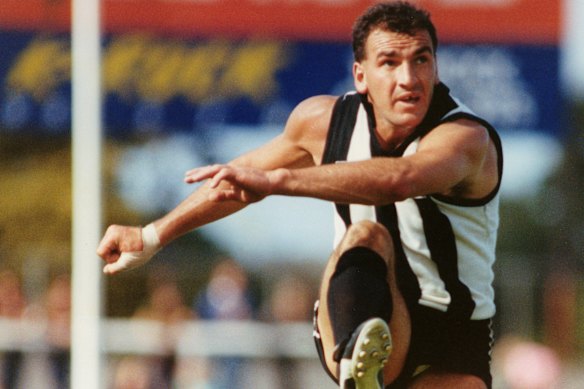
John Bourke kicked the Swans player first.
When the field umpire saw the incident, he ran in, drawing his notebook and pencil out to report the Collingwood player for kicking. Bourke looked up, his eyes rolling. He then kicked at the umpire’s leg and pushed him over.
It was 1985 in an Army Reserves Cup game and one of the uglier scenes in football, which also delivered some of the most quoted commentary in football.
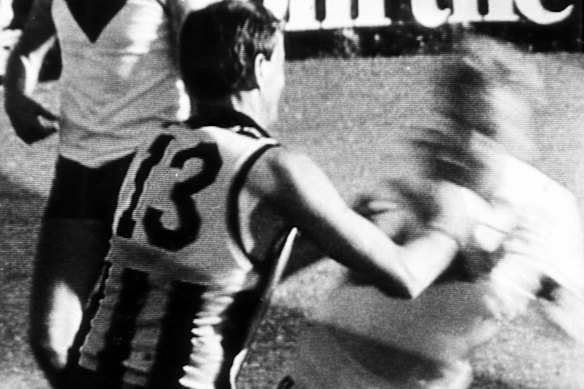
“Oooh, he’s just whacked the umpire. That’s unbelievable,” Ray “Slug” Jordon said on Seven’s broadcast.
Peter Landy helped: “You have got to get the Collingwood runner out now.”
“He’ll whack the runner now,” Jordon added. “I’d take him off now, the boy … You’ve got to take the boy off.”
The runner dispatched with the unenviable task that day to “take the boy off” was Mark McKeon, who had been Bourke’s teammate at Preston the previous year.
“The year before he [Bourke] actually jumper-punched an umpire. But the umpire was so scared he didn’t report him. I love John and still see him a lot, he is a great person … he could have been a 100-game senior Collingwood player,” McKeon recalled.
McKeon’s presence did little to calm Bourke that day in 1985. He got to Bourke and put a paternal hand on his shoulder to guide him back to the bench. But as they started to jog off, a fan unwisely heckled the Collingwood player. Bourke jumped the fence and knocked the fan over, too. Bourke, who played 14 games for the Pies’ reserves, was suspended for 10 years, reduced to six years.
The job of the runner is one of the quirkiest parts of the quirky game of Australian rules football.
Initially, coaches would send trainers on with a message as well as their wet towel. Then, in 1955, runners were sanctioned by the VFL partly to stop the dark arts of Phonse Kyne, Norm Smith and Reg Hickey getting around the rules. For a period, clubs could have two of them each per game – until the league got sick of the sight of them.
These days, there are much tighter restrictions on AFL runners. Still, no other game in the world has people scuttling onto the ground like Greek messengers during play. Partly, that is because most other sports are played on an arena small enough that when a coach yells from the sidelines, players can hear.
The runner, thus, has a privileged position. They are a conduit for the coach – privy to their first, unvarnished and unfiltered thinking. They are the coach’s voice – though the words they deliver to the players might not bear much resemblance to those they were sent out with. They also get advice to give back to the coach. That seldom arrives.
Runners are eyewitnesses to the game, not participants. And they have plenty of stories to tell.
‘It’s the best song’
Noel Duncan ran to the Collingwood bench at the MCG and picked up the phone to the coaches’ box.
It was 1998 and his first game as an AFL runner. He was warned that the most important thing to worry about was the comms to the box. No comms and you’re stuffed.
So as the Magpies players finished their warm-up, Duncan headed to the bench and grabbed the phone.
“All I could hear were some male voices singing the Richmond theme song really loudly,” Duncan recalled.
He thought there must be a problem. He had the phone to the Richmond box. But being his first game, he just shut up and listened.
“Yellow and black ...”
Loud and proud.
“Oh we’re from Tiiiigerlaaaaand.”
The song ended. Silence.
“Then I heard this voice say, ‘It’s the best song’.
“I thought, ‘That’s Spud’. Then another voice said, ‘Yeah, I reckon it is’. And it was Shawry.”
Tony Shaw and Danny Frawley were coaching Collingwood that day. As the game was about to start, the two Collingwood coaches were singing the opposition’s theme song. To be fair, it is the best club song and hard not to join in with (also, Collingwood kicked seven goals to none in the first quarter and won the game by 45 points, so maybe the singing had a calming effect in the box).
The runners’ mantra
Cameron Schwab, who worked at Melbourne in various roles but eventually as CEO, enjoyed re-hearing a story that reaches back to one of the game’s most famous coaches, Norm Smith.
Sam Allica, one of the game’s first runners, was the runner for Smith.
One day, Smith sent a message out to Ron Barassi to do better (ponder that idea quietly for a moment). Barassi, who lived with Smith and his family, was incensed. “You go back and tell Norm he can get stuffed.”
Allica looked at him without breaking stride.
“I only bring the messages out, I don’t take them back,” he said.
It became the runners’ mantra.
One day at Subiaco, when top-level football was still played at the ground, Leigh Walker was sent out by Dockers coach Chris Connolly to take off the original “Wizard”, Jeff Farmer. Walker duly relayed the message.
“You can tell Connolly to get f---ed. I’m staying here,” Farmer said.
Walker ran back to the bench.
“Chris was on the phone asking what happened,” Walker recalled.
“I just laughed, took a deep breath and said, ‘He thinks the world of you Chris, and will be off shortly’.”
On another occasion, Connolly and the coaches were less forgiving.
In round 19, 2003, at the MCG, the Dockers were playing North. At the time, clubs could have two runners. With the game tight, Connolly had them both running four and five messages at a time. The key message in those last minutes was to get full-forward Luke McPharlin loose behind the ball to protect a lead.
Walker ran out and delivered every message he could remember. The other runner, his good mate Justin O’Dwyer, did the same. Walker got back to the bench. Connolly’s face was turning an unhealthy shade of plum as he demanded to know why McPharlin was still at full-forward.
Walker and O’Dwyer looked at each other. Did you tell him? No. Did you? No.
Fremantle had just kicked another goal and the scores were level. Steven Icke, the football manager, was in the background screaming at Walker that if they lost this it was all his fault. Connolly was apoplectic.
Walker got to McPharlin with less than two minutes to go and got him back behind the ball. The rest was a blur as Walker ran off. North got a clearance and the ball went forward. McPharlin, freshly arrived, delivered a thumping spoil. The ball went the other way and Freo scrambled a behind from Des Headland. The siren went. Freo won by a point.
“I simply looked at Chris Connolly after the game and smiled,” Walker said.
“I said to him, ‘We had it under control mate, just ran out of paper to write all your bloody messages on and we missed that one’. We delivered it when it was needed, it was timed to perfection, our message got us over the line.”
‘A life-saving decision’
David Arnfield was Port Adelaide’s runner/provocateur from 1997 to 2007. He arrived in the AFL with the Power from the SANFL, where rules were a little more relaxed. More than once, the coach, the legendary John “Jack” Cahill, sent him out to the umpires with a performance review.
“Jack thinks you’re a cheat,” he told one umpire during a SANFL game.
“You can tell Jack to get f---ed,” came the response. “Now get off the ground.”
Message sent, by coach and umpire. No more action taken.
In their first year in the AFL, Port Adelaide knew that sort of stuff wouldn’t be tolerated, and they had to tone things down. Cahill, still coach, agreed.
That lasted until the third quarter of their first game, when Cahill dispatched Arnfield with another umpire appraisal.
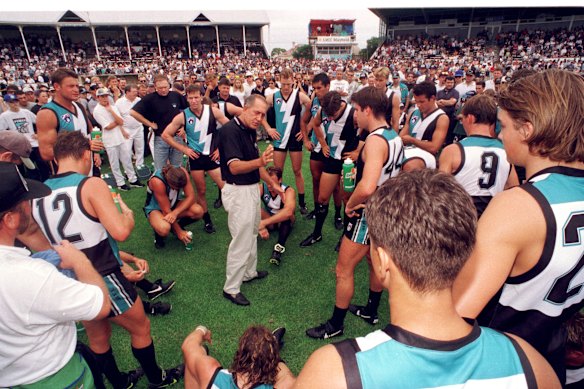
Arnfield ran out to veteran umpire (not author) Peter Carey. “Jack thinks you’re cheating,” Arnfield said.
Carey looked at him perplexed, shook his head and ignored him.
Arnfield recalls another time, when Cahill got on the phone as the Power played the Swans.
“You know where Lockett leads, don’t you?”
Yes. Everyone knew where Tony Lockett led: out of the goal square, on a 45-degree angle to space about 40 metres from goal. Like a Shane Warne leg-break, everyone knew where the ball would land. Hitting it was another matter.
“Well, go out and stand there,” Cahill told Arnfield.
At the time there were no restrictions on how long runners could spend on the ground and little control of what they said and did. So Arnfield went and stood in the hole.
“I heard this voice behind me yelling out. Steve Paxman was on ‘Plugger’ and I knew it wasn’t him. I turned around, and it was Plugger yelling at me,” Arnfield recalled.
“Don’t stand there,” Lockett barked.
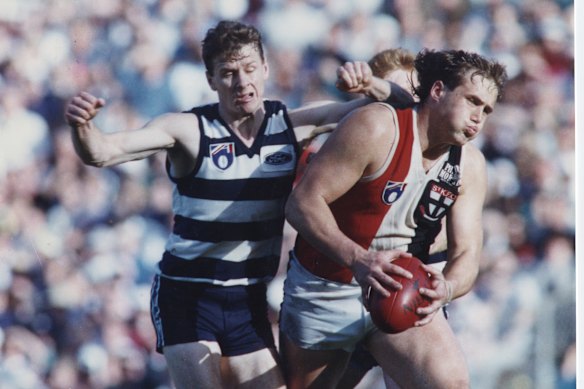
Arnfield kept standing there.
Another yell.
“I don’t want to get reported, and you don’t want to get killed. So don’t f---ing stand there.”
This time, Arnfield decamped.
“I got back to the bench and Jack said ‘What are you doing?’ I said the umpires told me to get off.”
It might have genuinely saved his life.

George Stone could relate. He has told the story often of the match when Dermott Brereton was having a dirty day and Hawthorn coach Allan Jeans told Stone to get the blond-haired expletive off the ground. Stone did as he was told ... up to a point.
As he neared the combustible Brereton, Stone could see him glaring and fuming, pawing at the ground and pacing. Stone ran straight past him to the also blond Russell Morris, who had kicked several goals to that stage, and told him to come off. Bewildered, Morris ran off with him. They got to the bench and Jeans asked what had happened.
“I made a life-saving decision,” Stone said.
‘Never change a message’
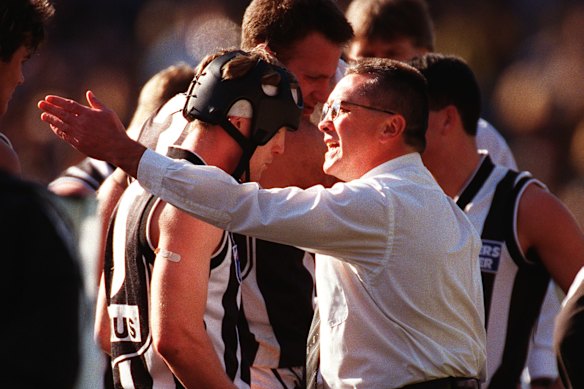
When Tony Shaw took over as Collingwood coach, he was keen to embrace technology. So the Magpies began experimenting with McKeon wearing an earpiece, meaning Shaw was able to speak to him from the coach’s box while he was on the ground. The problem was: the earpiece acted like a speaker. With the volume up, everyone close by – umpires, opposition players – could hear when Shaw was speaking.
“Tell Shawry to shut up. And get that thing out of your ear,” an umpire told McKeon as he dispatched him from the field.
Other times it was not the coach who used him to deliver messages to players.
“Darren Millane used to call me over after a goal. He would be on the wing, and he would get me to come over and stand the other side of his opponent and he would be bent over and just start talking to me loudly across the player,” McKeon recalled.
“‘Can you believe what I am doing to this bloke? His parents would be so embarrassed watching this. Have you ever seen a humiliation like it? You’d take yourself off the ground and never come back if you were this bloke. He hasn’t had one kick.’”
Millane was such an intimidating character, players wouldn’t say anything.
Arnfield used to do something similar – as well as talk to the opposition to sledge his own player to get an edge. He did that with the opponents of the then Port player and now coach Josh Carr. He knew it would send the feisty Carr’s eyes spinning.
Frawley was fond of using the runner to heckle and intimidate opposition players. Often it was in fun, more often it was the old full-back’s red mist that still clouded his coaching eyes. On one occasion when he was coach of the Collingwood VFL team, he sent the runner out with a message for a veteran player who was being especially physical in the reserves with a very young emerging Collingwood forward, Chris Tarrant.
He was to be told if he went anywhere near Tarrant again, Spud would find him in the car park after the match, and he’d be leaving in an ambulance. He was serious. Suffice to say, the message got lost on the way out to the field.
Unlike other runners, Arnfield delivered his messages verbatim after an incident in one of his first games. He was sent out to give a player a spray. The team was winning easily, so he got to the player, gave him a pat on the bum and told him to keep going.
He arrived back on the bench to Cahill on the phone. “Do you want to do this job?”
“Yes.”
“Well, never change a message. I am the coach, not you.”
It came at a cost. One game, he had to run out to (now commentator but then Port player) Dwayne Russell after an unfortunate bit of play. The siren had gone for half-time, but Arnfield ran up and passed on the message. Russell turned and punched him hard in the chest.
Come back next Sunday for our in-depth chat with Brendan Riseley, who ran for nine clubs over 24 years and more than 400 matches for some of the biggest-name coaches in the history of the game.
Keep up to date with the best AFL coverage in the country. Sign up for the Real Footy newsletter.

















































