
In the 250 years since America's inception, there have been a handful of presidents with an outsized impact on the course of U.S. history. Their words are etched into collective memory, found everywhere from monuments to sitcoms.
These six presidential speeches are some that have most reverberated through the ages, and whose impacts are still felt today.
In the 250 years since America's inception, there have been a handful of presidents with an outsized impact on the course of U.S. history. Their words are etched into collective memory, found everywhere from monuments to sitcoms.
These six presidential speeches are some that have most reverberated through the ages, and whose impacts are still felt today.
George Washington's farewell address — Sept. 19, 1796
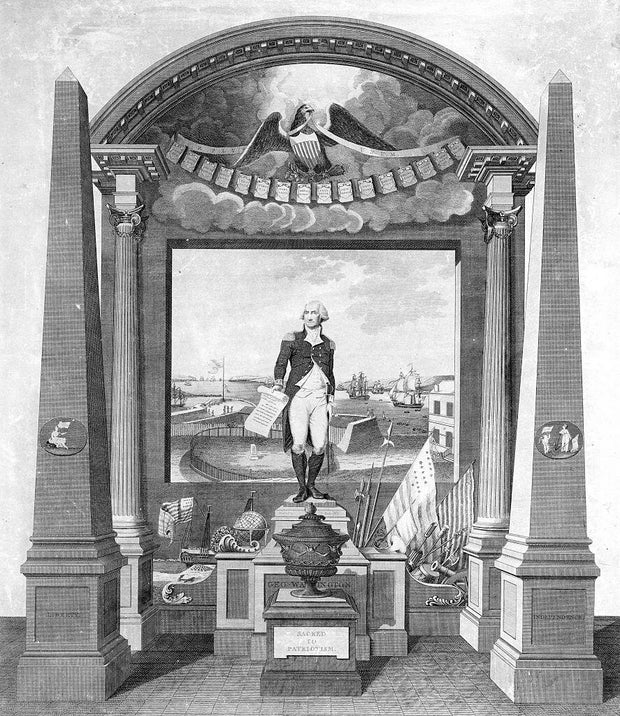 Engraved portrait of George Washington depicts him standing on a pedestal holding his farewell address in his right hand. From the New York Public Library.
Smith Collection / Gado / Getty Images
Engraved portrait of George Washington depicts him standing on a pedestal holding his farewell address in his right hand. From the New York Public Library.
Smith Collection / Gado / Getty Images
In this speech, which he did not deliver publicly, choosing instead to disseminate it through the press, Founding Father and America's first President George Washington established the tradition of the presidential farewell address while also explaining another precedent he had just set: serving only two terms as the chief executive.
"Every day the increasing weight of years admonishes me more and more that the shade of retirement is as necessary to me as it will be welcome," Washington wrote.
As he witnessed the young republic begin to split along regional and partisan lines, Washington felt compelled to remind his fellow citizens that "with slight shades of difference" they shared "the same religion, manners, habits, and political principles," dedicating much of the remainder of the address to warning about the "baneful effects" of factionalism.
"It agitates the community with ill-founded jealousies and false alarms, kindles the animosity of one part against another, foments occasionally riot and insurrection," Washington said.
Since 1893, the Senate has maintained an annual tradition of reading aloud the address to commemorate Washington's birthday.
Monroe Doctrine — Dec. 2, 1823
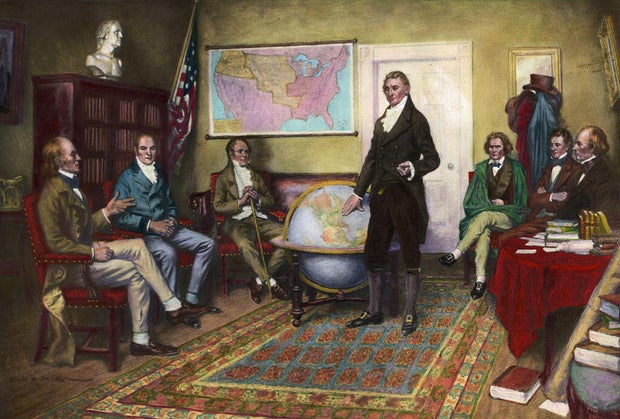 A painting by Clyde DeLand of the birth of the Monroe Doctrine. President James Monroe stands at center.
Bettmann contributor via Getty Images
A painting by Clyde DeLand of the birth of the Monroe Doctrine. President James Monroe stands at center.
Bettmann contributor via Getty Images
By the time James Monroe ascended to the presidency in 1817, South America's struggle for independence from Spain was well underway. The U.S. maintained a neutral stance, only recognizing the new republics after acquiring Spanish Florida in 1821.
Concern broke out in the U.S. government in the fall of 1823 when France invaded Spain to oust its fledgling liberal government and restore Ferdinand VII to the throne.
The ultimately successful campaign prompted Monroe to speak out more forcefully against European intervention in the Western hemisphere in a message to Congress later that year, wary that the powers could next target the liberated colonies of South America.
"We should consider any attempt on their part to extend their system to any portion of this hemisphere as dangerous to our peace and safety," Monroe told lawmakers, establishing the eponymous foreign policy.
Several presidents invoked the doctrine throughout the 20th century, such as John F. Kennedy during the 1962 Cuban Missile Crisis, when the U.S. and the Soviet Union feuded over nuclear Soviet missiles stored in Cuba. President Trump has also echoed the policy, referring to his administration's capture of former Venezuelan leader Nicolás Maduro as an example of the "Donroe Doctrine."
Gettysburg Address — Nov. 19, 1863
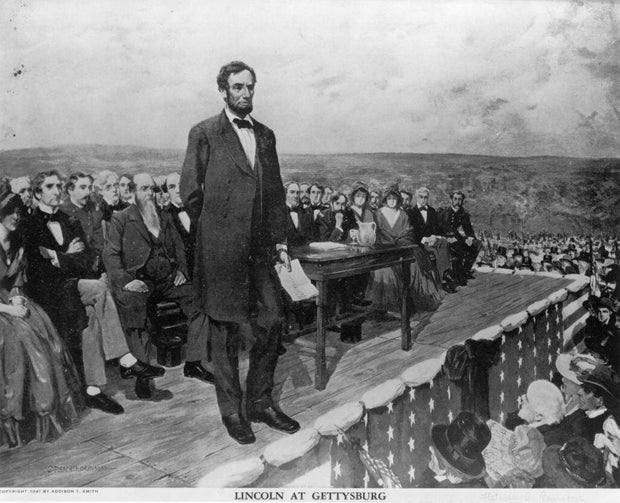 President Abraham Lincoln making his famous Gettysburg Address at the dedication of the Gettysburg National Cemetery during the American Civil War. Painting by Fletcher C Ransom.
Library Of Congress / Getty Images
President Abraham Lincoln making his famous Gettysburg Address at the dedication of the Gettysburg National Cemetery during the American Civil War. Painting by Fletcher C Ransom.
Library Of Congress / Getty Images
Eight score and nearly three years ago, an embattled Abraham Lincoln addressed the crowd at the dedication ceremony for the then-named Soldiers' National Cemetery in Gettysburg, Pennsylvania.
The brief speech, now instantly recognizable from just its first six words, paid tribute to the Union soldiers who died during the Battle of Gettysburg at the same site four-and-a-half months earlier. It was the bloodiest fight of the Civil War, with more than 51,000 casualties across both sides, according to the National Park Service, which administers the former battlefield.
Lincoln used his remarks to rally the living to continue fighting so "that government of the people, by the people, for the people, shall not perish from the earth."
The Union's victory at Gettysburg proved to be a major turning point in the war, precipitating the Confederacy's ultimate defeat in 1865.
Today, American popular culture still references the Gettysburg Address, and it is engraved at the Lincoln Memorial in Washington, D.C.
FDR's first inaugural address — March 4, 1933
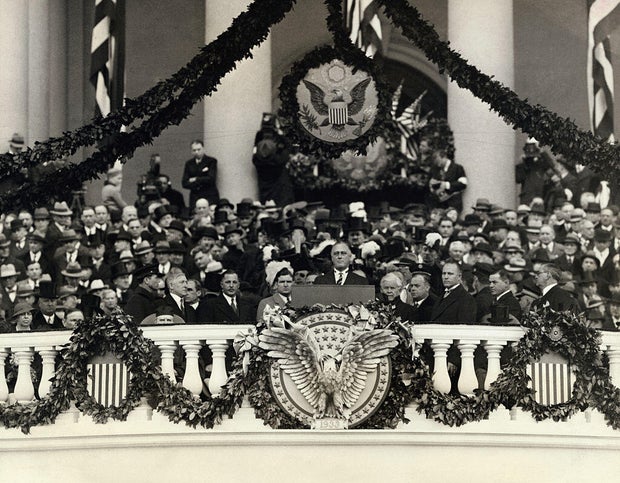 President Franklin D. Roosevelt delivering his inaugural address on March 4, 1933.
George Rinhart/Corbis via Getty Images
President Franklin D. Roosevelt delivering his inaugural address on March 4, 1933.
George Rinhart/Corbis via Getty Images
Franklin D. Roosevelt's landslide victory over incumbent Herbert Hoover in the 1932 presidential election ushered in a new era for an America battered by the Great Depression. To a majority of voters who had soured on Hoover amid a harrowing economy, Roosevelt represented change.
In his first address to the American public as president, he felt it best to speak plainly about the crisis plaguing the country, rather than obfuscate the state of affairs, stating it was "preeminently the time to speak the truth, the whole truth, frankly and boldly."
In acknowledging the grim reality of America's economic perils, Roosevelt sought not to fearmonger but to avoid being a "foolish optimist" while still inspiring hope, proclaiming his belief that the U.S. "will endure as it has endured, will revive and will prosper." It was then that Roosevelt delivered arguably the most well-known line from the speech:
"Let me assert my firm belief that the only thing we have to fear is fear itself — nameless, unreasoning, unjustified terror which paralyzes needed efforts to convert retreat into advance," he said.
Roosevelt dedicated much of the remainder of the speech to outlining his New Deal plan for national recovery, likening it to a war effort that would require expanded executive power.
Most voters thought Roosevelt's policies successful, going on to reelect him three times, an unprecedented feat later prohibited with the 1951 ratification of the 22nd Amendment, which established the two term limit for Oval Office occupants we are familiar with today.
LBJ's "American Promise" speech — March 15, 1965
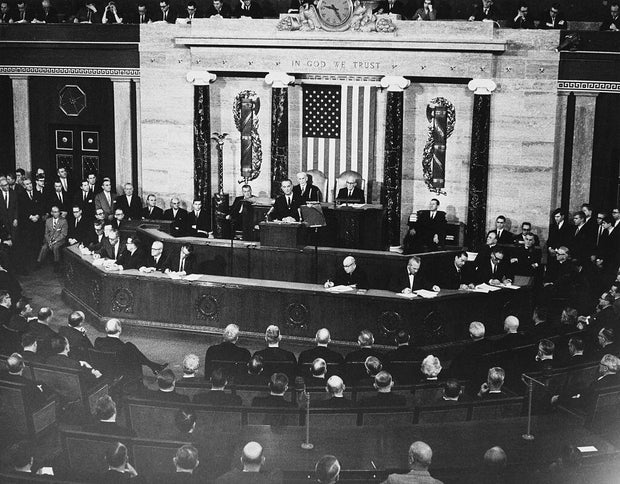 President Lyndon B. Johnson during a speech to Congress on March 15, 1965.
Pictorial Parade / Archive Photos / Getty Images
President Lyndon B. Johnson during a speech to Congress on March 15, 1965.
Pictorial Parade / Archive Photos / Getty Images
Eight days after the events of Bloody Sunday, when Alabama Highway Patrol troopers and deputized White men of Dallas County brutally attacked civil rights demonstrators marching across Selma's Edmund Pettus Bridge, President Lyndon B. Johnson took to the House floor to address a joint session of Congress.
Johnson condemned the brutality, saying there was "no cause for pride in what has happened in Selma," and pressed lawmakers to pass the Voting Rights Act, telling the chamber "we cannot, we must not, refuse to protect the right of every American to vote in every election that he may desire to participate in."
He acknowledged that "even if we pass this bill, the battle will not be over," and urged all citizens to join Black Americans' effort to secure "the full blessings of American life."
"Because it is not just Negroes, but really it is all of us, who must overcome the crippling legacy of bigotry and injustice," Johnson said. "And we shall overcome."
Nearly five months later, Johnson signed the landmark Voting Rights Act into law.
Nixon's resignation speech — Aug. 8, 1974
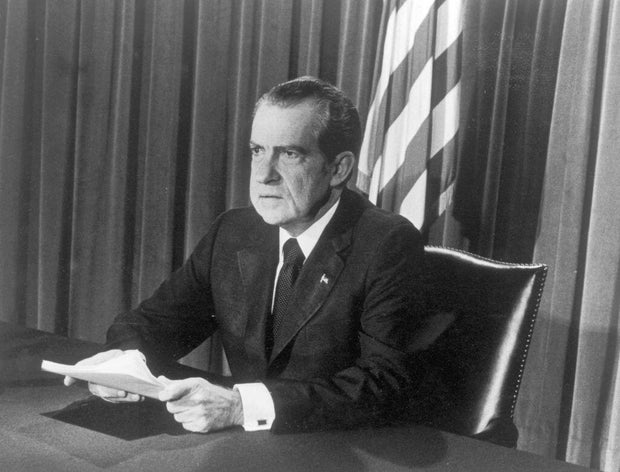 President Richard Nixon announces his resignation in a televised address in Washington, D.C., on Aug. 8, 1974.
Hulton Archive / Getty Images
President Richard Nixon announces his resignation in a televised address in Washington, D.C., on Aug. 8, 1974.
Hulton Archive / Getty Images
Amid the Watergate scandal, Richard Nixon saw his support plummet in Congress and among the public. The revelation that he had ordered a cover-up of his administration's ties to a 1972 break-in at the Democratic National Committee headquarters all but guaranteed his impeachment.
Nixon instead chose to resign from the presidency, a first in U.S. history. He announced the decision in a televised address, telling the American public that he "always tried to do what was best for the nation."
"I have never been a quitter," Nixon said. "To leave office before my term is completed is abhorrent to every instinct in my body. But as president, I must put the interests of America first."
Vice President Gerald Ford took the presidential oath at noon the next day, famously announcing, "Our long national nightmare is over." Nixon remains the only U.S. president to resign from office.
In:
Influential presidential speeches
Influential presidential speeches
(13:11)

















































