3 months ago
22
3 months ago
22
The number of people killed by sharks in Australia is increasing, while climate change is upending the range of many dangerous species, sending bull sharks further south to Sydney and white sharks to Victoria and Tasmania.
Since 2000, 56 deaths by shark bite have been recorded in the Australian Shark Incident Database, the vast majority involving a white shark. There are also two that are yet to be added – Mercury Psillakis, 57 who was killed by a white shark at Dee Why in Sydney in September, and Thursday’s death of a young woman at Crowdy Bay National Park on the NSW Mid North Coast.
The NSW Department of Primary Industries has confirmed the shark involved in Thursday’s attack was a bull shark over 3 metres long, based on forensic evidence. Bull sharks like warm water of 23 degrees and over, and are considered more aggressive than many other shark species.
The range of bull sharks is moving further south because of climate change. Professor Culum Brown, a shark expert at Macquarie University, said Sydney Harbour was becoming increasingly suitable for the animals over summer.
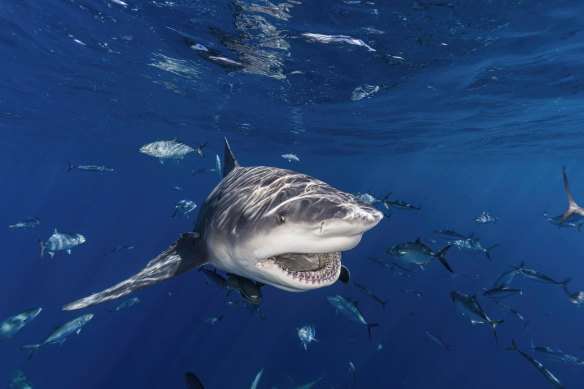
Climate change is upending the range of many dangerous species, sending bull sharks further south to Sydney.Credit: iStock
In the decade from 2000 to 2009, 14 people died around Australia from being bitten by a shark, the shark incident database shows. From 2010 to 2019, there were 21 deaths. And in the third decade of the 21st century, the tally has hit 23 after less than five years.
The number of non-fatal interactions has also risen. However, Brown said the ratio of fatalities per incident had declined or held steady because of better surf lifesaving and emergency services.
The increase is not due to an increase in shark numbers. White sharks, or great white sharks, are listed as vulnerable, and a recent study reported by this masthead found there could be fewer than 500 adult breeding individuals across almost 60,000 kilometres of Australian coast.
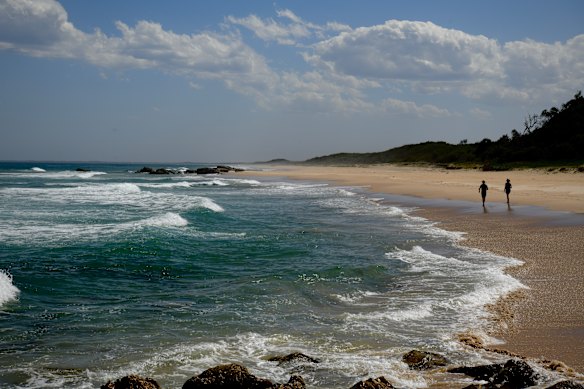
Kylies Beach in Crowdy Bay National Park, where a young woman died and a young man was seriously injured after being bitten by a bull shark.Credit: Dean Sewell
Brown said the human population growth was increasingly concentrated on the coast, and lifestyle change meant people were spending more time in the ocean.
“Even if you account for increases in human population growth, [incidents] are going up slightly,” Brown said.
“But it’s not the number of sharks that’s going up – it’s environmental changes and increases in the number of people who are engaging in water sports. With climate change, you can swim off Sydney pretty much all year round now, so there are more people in the water. Everyone has a wetsuit.”
Brown said it was unusual for a shark to injure two people at once, as in Thursday’s attack where the young woman died and her male companion was taken to hospital in a rescue helicopter in a serious but stable condition. It was most likely in a scenario where one person ran into difficulties, and the other tried to help, Brown said.
This famously occurred in 1993 when two newlyweds on their honeymoon were scuba diving near Byron Bay. Looking for harmless grey nurse sharks, the couple instead encountered a massive white shark that witnesses said was as wide as a Volkswagen Kombi van. The man intervened to help his wife of 15 days and was pulled to the bottom and killed by the shark.
Loading
By 2060, NSW coastal waters could be too warm for juvenile and subadult white sharks most of the year, sending them further south to Victoria and Tasmania, according to a paper published in the ICES Journal of Marine Science in May.
South-eastern Australia has two prominent white shark nursery areas – Forster in the Manning Shelf bioregion off the Mid North Coast of NSW, and the Twofold Shelf bioregion in south-eastern Victoria. By 2060, under a high-emissions scenario, the NSW breeding ground would be unsuitable and the Victorian one more favourable.
Brown, who was not involved in the study, said the research was important because juvenile white sharks were most likely to bite humans, while the adult animals had generally learnt that humans were not a good food source.
“The trouble with juvenile white sharks in particular is, like all young animals, they have to learn what’s edible and what’s not,” Brown said.
“Usually juvenile white sharks, around the 2.5 to three-metre range is when they start to try something other than fish. Their jaw is starting to crystallise so they can actually take on bigger prey. Prior to that, they just literally cannot.”
The co-authors, from Southern Cross University and Flinders University, warned that the loss of a top predator such as white sharks would disrupt ecosystems, potentially disrupting food web dynamics and commercial fisheries and tourism.
The East Australian Current was strengthening at the same time, the paper said, which would mean cooler waters were restricted to close to shore. If sharks were seeking refuge from the heat this would increase the risk of interactions with humans.
Get to the heart of what’s happening with climate change and the environment. Sign up for our fortnightly Environment newsletter.
Most Viewed in Environment
Loading