3 months ago
7
3 months ago
7
Opinion
November 24, 2025 — 7.30pm
November 24, 2025 — 7.30pm
There’s a new trend playing out on LinkedIn: women are changing their gender setting to “man” and suddenly seeing a jump in engagement on their posts. It sounds absurd, but it’s happening. And for anyone wondering, yes, I’m still a woman.
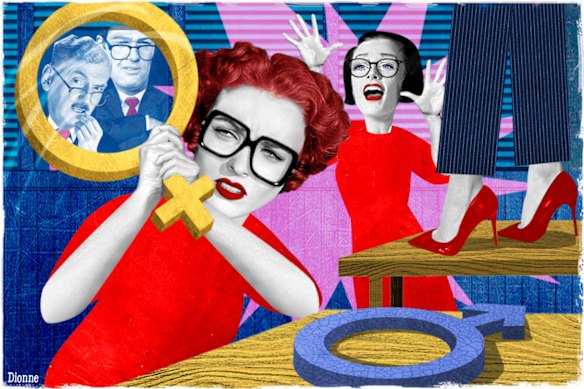
Women are changing their gender setting to “man”. Credit: Dionne Gain
Just last week, over dinner, my girlfriends and I were laughing as we scanned through numerous posts by women with photos of themselves with a moustache, announcing “today I came out as a man” because those posts mysteriously performed better.
It’s now known as “the bro boost”. Change your setting to man, and like magic, the algorithm plays nicer. Some are even getting ChatGPT to rewrite old posts in a more agentic, traditionally masculine tone before reposting them and watching the impressions climb. But while most have jumped on the bandwagon, I refuse to. I’m not having a sex change just to fit in with an algorithm that a man most likely coded.
The suppression of women’s voices is nothing new, online or offline. But switching your LinkedIn gender to “man” is not going to fix it. When I first saw the trend, my reaction was anger. You have got to be kidding me. Then I sat with it. Is this actually that shocking? And my inner voice answered immediately, “No”.
Platforms such as LinkedIn will insist that gender plays no role in impressions or engagement. But we all know algorithms prioritise what we interact with. What you consume, you get fed. What you like, you will see more of. And the simple reality is that men, particularly those in CEO roles, tech and high-visibility industries, post more, have larger networks, and receive more amplification. If thousands of people like a post and hundreds repost it, that content lands in thousands of other feeds. So goes the rhythm.
Loading
But this isn’t only about gender. Biased algorithms disproportionately suppress women, and even more so women of colour. Here’s one practical step anyone can take if they genuinely want to support marginalised voices. Search a topic you care about, such as property, technology, leadership or economics, then click “people”. Now deliberately follow 20 new creators who don’t look like you. People with different backgrounds, lived experiences or perspectives. Then read their posts. Comment. Share. Engage. Teach the algorithm what you want to see, and even if you don’t, teach it to be fair.
Does LinkedIn have problems? Of course. No large tech platform is immune to bias, and no human being is either, which is why users have to change their habits. It starts with us. Not a robot or some guy inputting code in the backend. And that’s a good thing. When social media platforms emerged, the premise was on connection. So let’s actually connect.
I’m proud to be a woman. A strong, opinionated, intelligent woman who has worked hard and consciously unlearnt the good-girl conditioning of earlier decades. A woman who chooses to advocate for other women and for people of colour. So excuse the bluntness, but why on earth would I change my gender in a settings menu just to be seen or heard? That goes against everything I stand for.
I’ve written countless posts and articles on LinkedIn. Some performed brilliantly, some quietly. I’ve copped misogyny, criticism and pushback from strangers. One man sent me a DM concerned that my gender equality post was “too much for a Monday”. I wondered whether Wednesday would be more palatable for him. Others have hit on me. But I keep going. Because it’s worth going. And most of the negativity never comes from my network anyway. It’s from others looking for outrage or attention.
Let’s channel that energy differently. Let’s be “controversial” in the best possible way and back each other. I’ve met extraordinary people on that platform, men and women, from all over the world. Let’s own who we are and widen our circles. Let’s bring more women, especially Black women who are chronically underrepresented, into visibility and let the algorithm know that this is the content we value.
So, ladies, please don’t digitally transition to a man to fit in online. You’re not the problem. And for clarity, men aren’t either. The issue is a system wired one way for far too long. One that sadly rewards what it has always rewarded, and it needs a reset – frankly, a cultural awakening. We can retrain algorithms, and cultures can shift. But none of that requires women to shrink, soften or change who we are. I don’t want to game the system or hide my identity. I love men ... But I love being a woman more.
Sarah Curnow is the founder of Anu Advisory.
Most Viewed in Business
Loading