3 months ago
20
3 months ago
20
By Kate Prendergast and Peter McCallum
November 10, 2025 — 11.19am
THEATRE
So Young
The Old Fitz, until November 22
Reviewed by KATE PRENDERGAST
★★★★½
The abstract of Scottish playwright Douglas Maxwell’s award-winning So Young is enough to make anyone rub their hands in anticipatory glee. Get this: a widower, his beloved wife of many years just three months in the earth, has fallen for a super-fit barmaid more than 20 years his junior.
How scandalous! How derisively rudimentary of male behaviour. I mean, really – what an egregious, avoidant and dick-driven way for that middle-aged fool Milo to handle his grief. His two good friends Liane (Ainslie McGlynn) and Davie (Jeremy Waters), a couple who knew the aforementioned dead wife since their teacher training years, undergo the predictable reactions when introduced to the cheerily unabashed “so young” Greta over dinner at Milo’s.
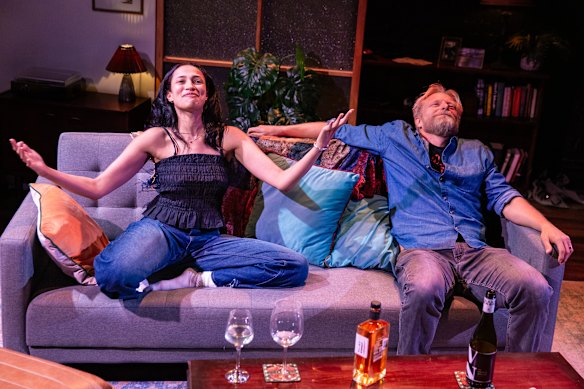
Milo’s new fiancee Greta (Aisha Aidara) and long-term friend Davie (Jeremy Waters) do their best to navigate a new and unfamiliar terrain in So Young.Credit: Richard Farland
Dowdy schoolmistress Liane does not let decorum stay her sortie of scathing inquisitions and “pronouncements”. She positions herself firmly as merciless truth teller, the only one remaining to defend the honour of a dead woman who was also her dear friend.
“It’s her or me!” she delivers in her ultimatum to Milo.
Davie – a simple man, whom we are introduced to in the first scene by a roar of self-satisfied early ejaculation – actually seems a bit smitten by the charming young woman with the cute and ready smile. She listens to his stories and appreciates his record collections. But he’s hardly one to stand up to his sharp-tongued wife.
Loading
Of course when it’s mounted by Outhouse Theatre, you know that what is kneejerk outrageous or ostensibly taboo is in for a sound dramatic wringing. To borrow from the dialogue of Greta (Aisha Aidara), these guys “don’t flinch”. The company, founded by Waters, has been consistently impressive that way – bringing first-rate modern plays (largely from the US and UK) to rattle our certainties: first with a riotous comedy of manners, then a finely tuned choreography of radical compassion, as human relations run the gamut of clashing preconceptions, are broken open in their frailties, and – with great pain and tenderness – made gingerly anew.
Actor and writer Sam O’Sullivan matches form with his directorial debut. What do we risk by being absolutely uncompromising in our battles? What are we willing to sacrifice for our convictions, and what does it take to examine them in a real and immediate context? And, at the centre of this particular play, what right do even those closest to us have to tell us who and how we love? Lord knows it’s never been frictionless for a friendship group to absorb a new romantic partner, no matter the particulars.
It’s an excellent ensemble that bubbles up this cauldron of questions, with passing Scottish accents too. Waters, wide-eyed and sprawling in his movements, plays a man a little lost in life, gaffe-prone but sweet. McGlynn does important work in overcoming her character’s cliche of a morally righteous harridan.
Loading
Henry Nixon, with his boyish looks and sincere presentation, somehow doesn’t figure Milo as seedy or delusional. Aidara definitely helps in this: her Greta radiates natural strength, animated intelligence and dauntless self-composure.
When the characters peeled off in opposite partner pairs, a tawdry dread portends. Subtle blocking and body language suggests that we may be about to witness real “bad behaviour” on display. That the plot didn’t collapse to this obvious crisis point was a huge, commendable relief.
Two startlingly poignant symbols are at work in Maxwell’s tale. One is a wine-soaked anecdote of a lion’s paralysing roar. The other is an unopened bottle of Japanese whisky. It may be served a little too neat at the end, but So Young is strong, sterling stuff, pitting the “shapeable present” against the “irreconcilable past”.
MUSIC
Cocteau’s Circle
Australian Chamber Orchestra
City Recital Hall, November 8
Reviewed by PETER McCALLUM
★★★½
In 1918, as a shell-shocked France adjusted itself to the prospect of peace, writer, filmmaker and general avant-garde polymath Jean Cocteau produced a small collection of opinionated aphorisms, Le Coq et l’Arlequin, which became, for a time, the unofficial manifesto of the six composers, George Auric, Louis Durey, Arthur Honegger, Darius Milhaud, Germaine Tailleferre and Francis Poulenc, then known as Les Nouveaux Jeunes, but subsequently christened simply as Les Six.
French music, Cocteau argued, should resist the seductive influence of Debussy, Stravinsky and Wagner in favour of the simplicity discovered by Satie. Informality, lightheartedness, irreverence and the spirit of the music hall should always be preferred to the kind of music one listens to with “one’s head in one’s hands”.
In fact, any sense of collective aesthetic among these composers quickly dissolved but the spirit of that moment endured.
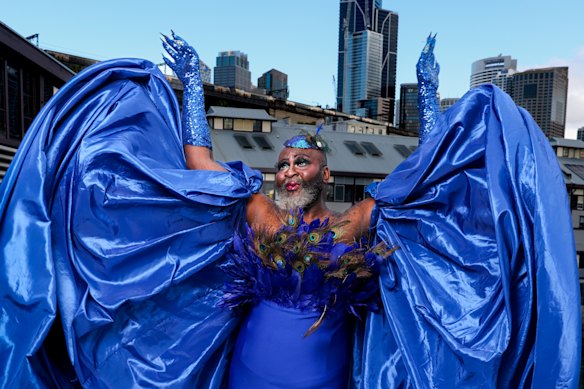
Le Gateau Chocolat supervised proceedings at City Recital Hall.Credit: Edwina Pickles
The Australian Chamber Orchestra under Richard Tognetti with director Yaron Lifschitz, cross-dressing singer and maitre d’ Le Gateau Chocolat and true-voiced soprano and talented chanteuse Chloe Lankshear joined forces to conjure that spirit.
Excerpts of pieces by some of Les Six and their contemporaries were woven together with commentary by Le Gateau Chocolat and five subtly allusive interludes by Elena Kats-Chernin.
Bearded, 198 centimetres tall, and dressed in different hues of outrageousness on each appearance, Le Gateau Chocolat linked the anarchic irrationality of the time with modern gender bending and drag.
He mixed deep bass and falsetto in Bess’s song I Loves You, Porgy from Gershwin’s Porgy and Bess, though his difficulty in weaving melodic lines with nuance made his earlier slow rendition of Gershwin’s Oh, Lady Be Good! less successful.
Lankshear sang Bien Chapeautee from Swiss composer Henri Christine’s operetta Phi-Phi with a pure, richly coloured voice of vivacious flexibility. Her reading of Pie Jesu by the tragically short-lived Lili Boulanger, one of the genuine emerging geniuses of the era, was dark and striking and a musical highlight of the program.
Loading
Lankshear closed the evening with a touchingly simple rendition of L’Hymne a l’amour by Edith Piaf, who died the day before Cocteau, her close friend.
A highlight of the instrumental numbers was the first movement of Jean Francaix’s Concertino for Piano and Orchestra, dispatched with light agility by pianist Stefan Cassomenos. With visiting brass and percussion, Tognetti and the ACO captured well the way composers of this period created disorientation and distancing through unusual blends and unconventional balance.
They began with an Ouverture by Auric, contributed angular excerpts by Stravinsky, and ended with the polytonal energy and exuberance of Milhaud’s Le Boeuf sur le toit (a ballet by Milhaud and Cocteau, which gave its name to their favourite nightclub).
The first movement of Tailleferre’s String Quartet wafted caressingly, although the arrangements of movements from Ravel’s and Debussy’s Quartets were less precise in pitch. Restricting the music to excerpts in cabaret style, had some frustrations but whetted the appetite to hear complete performances of the era’s many neglected gems.
Find out the next TV, streaming series and movies to add to your must-sees. Get The Watchlist delivered every Thursday.
Most Viewed in Culture
Loading