
 5 months ago
74
5 months ago
74
Albert Camus’ The Stranger is as slippery as an eel: it is the book everyone has read, especially in France, where it is a perennial set text in high schools, but nobody quite understands. Even the characters in Camus’ story struggle to understand why Meursault, a young Frenchman in colonial Algeria, shoots an Arabic man on a deserted beach. Meursault himself can only tell the court that the sun was in his eyes.
The Stranger was published in 1942; despite its classic status, only two attempts have been made to adapt it as a film. Italian maestro Luchino Visconti, fresh from his success with The Leopard, made a version in 1967 with Marcello Mastroianni. By his own admission, it was a failure; the general conclusion was that the book couldn’t be filmed at all. Until last year, when French director François Ozon realised that this was the next film he wanted to make.
Ozon is an indefatigably prolific filmmaker, whose 24 features include a starry musical comedy (Eight Women, 2002), a sombre examination of priestly abuse (By the Grace of God, 2018) and the delicious black comedy about a mushroom poisoning, When Fall is Coming (2024). He had been trying in vain to finance another script about a suicidal young man – “Nobody wanted to see that film,” he says, ruefully – when a friend pointed out that it was rather like The Stranger.
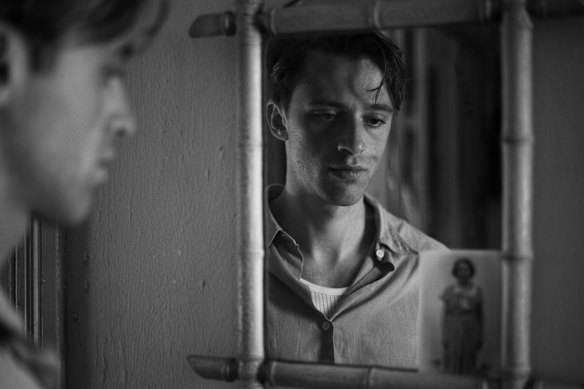
Like everyone, he had read the novel at school. He hadn’t much liked it. “But reading it again was very strong,” he says at the film’s London opening. “I realised the book was still mysterious and powerful. These were exactly the themes I wanted to address: this indifference to the world, this way of detaching oneself from things.”
It was just as difficult to fund, however, despite being a classic. Financiers assured him The Stranger was their favourite book, until they read his script and were reminded of what it was actually like. “It’s not The Count of Monte Cristo,” Ozon snaps.
From the start, he wanted to adhere closely to the original text. At the same time, it had to take a contemporary point of view. “It’s 2026, so I had to look at this story from today’s perspective, with everything that has happened since the book was published.” Throughout the 1950s, Algerians fought a bitter war for independence. Relations with France remain severed. For modern audiences, the murder is not only morally monstrous but politically charged. So is the fact that Camus doesn’t give the dead man a name.
“Reading the book again, what shocked me was the invisibilisation of the Arabs,” says Ozon.
Camus, who was born in Algeria, wrote frequently about the oppression of the local population under French rule. In The Stranger, however, the Arabs exist only in the margins. Algerian readers found it hurtful to be effectively written out of their own story. Almost 40 years later, The Cure’s song Killing an Arab caused a ruckus among listeners on both sides of the political fence; Robert Smith stopped performing it when he realised it had been taken up by right-wing racists. Ozon restores it to its proper literary place by playing it over the film’s end titles.
The book remains controversial. “The Stranger is misinterpreted by many people, especially in America, as a colonialist or a racist text, which it absolutely is not; it would be a mistake to think that,” says Ozon. “But you have to understand the context of the time. Algeria was France. It was two French departments, where Arabs and French lived in parallel. The Arabs didn’t exist for the colonists. Camus didn’t need to explain that – but, through our eyes today, it’s difficult to understand.”
Accordingly, he has shifted the story’s goalposts by opening the film with a newsreel from the period praising the marvellous quality of life in France’s very own desert oasis, a piece of propaganda that is jaw-droppingly offensive now and puts a decisively different slant on what is to come. Djamila, the victim’s sister and the abused mistress of Meursault’s neighbour, becomes a character with her own dignity and presence; the murdered man is given a name, Moussa.
Visually, on the other hand, Ozon fully embraces the period, shooting the beaches and sun-bleached buildings of his Tangier locations in rich black and white. This was partly an economic choice – there wasn’t enough money, he says, to recreate the 1930s in colour – but it was also appropriate. “Our entire collective memory of that era [is] in black and white,” he says. “It seemed to me that it would bring a sense of realism. And it’s a forgotten era that no longer exists, so there’s a sense of a lost world.”
Those silvery greys are certainly luscious. Meursault is played by the languidly beautiful Benjamin Voisin; his girlfriend Marie, another female character Ozon has amplified from the original, is the luminous Rebecca Marder. Both gleam in the sun; the way Ozon shoots bodies on the beach, as well as his formal use of the sea and horizon, may remind Australian viewers of Max Dupain’s photographs of Sydney beach life.
“I read the other books of Camus, which are full of sensuality,” says Ozon. “To me, it was quite obvious that while we would not be making a film about emotions, because Meursault doesn’t have emotions, we had to sense the heat, the wind, the sea, all these elements. I had the feeling everything had to be erotic around him.”
Meursault himself had to be charismatic, despite his frigidity. “It’s a difficult part because Meursault is an unsympathetic character, but we still have to follow him and be fascinated by him.”
Voisin, an irrepressibly impish tease in real life, withdrew uncomfortably into his fictional self. “For four months, I was quite gloomy, quite flawed, with a much more distant outlook than usual,” he says. “It was a kind of sacrifice, so that I could arrive on set and let the character play itself.”
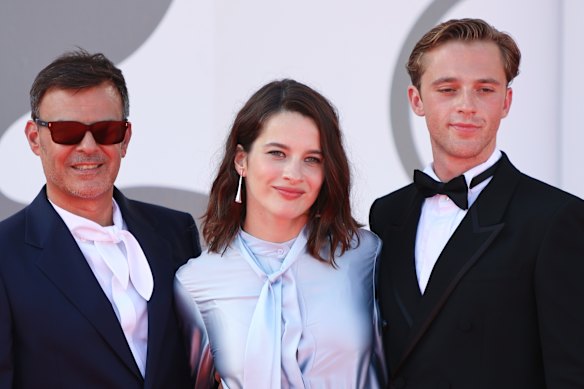
While the rest of the team met for drinks, he stayed in his room and watched flies buzzing overhead. “I read a lot of sad German philosophers like Schopenhauer. François said to me: ‘This is wonderful; don’t be happy, please! You’ve got this!’”
Neither Ozon nor Voisin knows even now why Meursault shot Moussa; when they filmed the scene, Voisin had no idea what he was supposed to do. “I think this is a true masterpiece of directing because the other actor and me, we didn’t know what happened when Francois said, ‘OK, perfect, that’s fine.’ For me, that scene was a mystery.”
Ozon laughs. “For me, too. We just try to follow the words of Camus. I had in mind the western movies of Sergio Leone, where two men face each other in a duel and could either f--- or kill each other. I didn’t know if it would work or not.”
It is intimidating, he says, to present your version of a book everyone knows. “When we read the book, we are our own directors. We imagine the faces, we imagine the situations and locations.”
He braced himself for a chorus of disapproval from all those competing auteurs but, in the end, The Stranger won both best film and best actor for Voisin at France’s Lumiere awards. “People, I think, did accept my vision,” Ozon says. And in a few years, he says cheerfully, the book comes out of copyright; everyone can make their own Stranger if they want. Let’s see how they go.
The Stranger opens on April 16.
Must-see movies, interviews and all the latest from the world of film delivered to your inbox. Sign up for our Screening Room newsletter.

















































