3 months ago
27
3 months ago
27
Every rule change during the reign of the ARLC’s can-do chair, Peter V’Landys, has been made with the intention of making games both faster and closer, principally to attract fans and TV dollars.
Given V’landys’ “damn the torpedoes, full speed ahead” approach, it came as a surprise this week when the commission abandoned a proposed change to the kick-off rule amid opposition from clubs. The rule change would have curbed the momentum of the try scoring team – and the potential for blow-outs – by allowing the conceding team to receive the ball from the kick-off.
Instead, the rule-change – allowing the non-scoring team the option to kick off or receive – will be trialled in games with no bearing on the 2026 semi-finals. But the strategic V’landys may have already outflanked the clubs. How? Because one change the clubs did accept for 2026 could result in his preferred kick-off rule becoming essential.
“Six-agains”, or set-restarts as the NRL terms them, will now apply from the 20-metre line as opposed to the 40-metre line, for both ruck breaches and infringing the defensive corridor. V’landys likes six-agains as opposed to penalties because they don’t result in stoppages, increasing on-field action. In 2019, according to NRL data, ball-in-play time per game averaged 54.2 minutes. In 2020, when six-agains were introduced, it jumped to 55.4 minutes, now stands at an all-time high of 56 minutes and is set to rise further in 2026.
When repeat sets were introduced, NRL clubs deliberately conceded breaches early in the tackle count simply to set their defensive lines, knowing the opposition could not kick for touch and territory. The Panthers choked the Rabbitohs with this tactic in the 2021 grand final. The NRL subsequently changed the rule to award penalties for these breaches up to the 40m line, to help lift teams out of their own half.
However, in 2026, penalties will only be awarded between try line and 20-metre line. So, if the defenders breach from the kick-off, the referee can piggyback them upfield with consecutive six-agains. If this happens late in a match, when the forwards are tired, struggling against repeat sets and quick play-the-balls, a team can quickly score a try. If the current kick-off rule applies, they would receive the ball again and repeat the cycle.
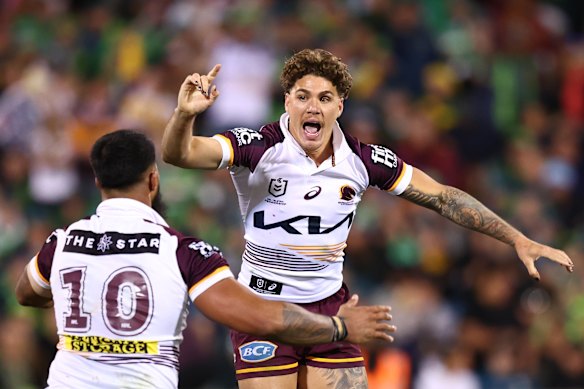
Reece Walsh masterminded an incredible Broncos comeback against Canberra in last year’s finals.Credit: Getty Images
In other words, expanding the threshold of six-agains could necessitate a change to the kick-off rule. Otherwise, the team scored against after facing a flurry of six-agains has no chance of gaining possession. We would see more games like the Canberra-Brisbane semi-final, where the Raiders had barely any possession in the last 15 minutes and the Broncos were able to score three quick tries in a stunning comeback.
Referees love the six-again. There is no scrutiny on them; no accountability, compared to a penalty where the broadcaster has time to replay vision of the breach. The current automated “ruck infringement” broadcast over the loudspeaker is far too generic. No sooner than the fans ask, “What for and who?“, the referee has signalled another six-again.
A further reason for expanding the use of repeat sets was that Rugby League Central found numerous examples of referees not blowing penalties when a team was in its own half. They were reluctant to do so, aware a penalty is a major punishment at one end of the field but a lesser one at the other end when they can award a six-again for the same offence.
Multi premiership coach Wayne Bennett has been campaigning for a change to the kick-off rule and was an early advocate for six-agains. Back in 1997 in the Super League era, when he was coach of the Broncos, the tryscoring team kicked off. A World Club Championship between the Australian and English clubs was played and as, John Ribot, chief executive of the Australian competition, says, “The strong teams beat up on the weak teams.”
Expanding the threshold of six-agains could necessitate a change to the kick-off rule. Otherwise, the team scored against after facing a flurry of six-agains has no chance of gaining possession.
The standard tactic applied by coaches when forced to kick off after scoring a try was: boot the ball high and long to a corner, employ ruthless defence for six tackles and earn the ball back in an attacking position.
The Skinny Coach’s Broncos won the competition that year. The twin rule changes for which Bennett has long lobbied could come together in 2027 should it become clear the expanded threshold of six-agains makes a change to the kick-off rule mandatory.
Another rule change, recommended unanimously by a committee of the code’s top coaches and endorsed by the ARLC, is to expand the number of bench players in 2026. NRL clubs did not object.
Financial considerations are always foremost in the minds of club chief executives but most travelling teams take an extra two players in addition to a bench of four, mainly to cover training accidents or sickness. A coach will now have six players on the bench, but is still restricted to using only four. Most clubs only activate the fourth player for about ten minutes. However, the expanded bench will overcome situations of players forced to stay on the field with debilitating injuries, or playing in an unfamiliar position.
Loading
Had the rule applied in the 2025 NRL grand final, both teams would have benefited. The Storm lost Jack Howarth with a groin injury early in the first half. Their single bench back, Tyron Wishart, replaced him in the unfamiliar position of centre, against one the code’s best, Kotoni Staggs. Stranded out wide, it meant the Storm lost the value of the speedy Wishart around the rucks at the end of each half.
A six-man bench would have included centre/wing specialist, Grant Anderson. Broncos coach Michael Maguire gambled with only two forwards on the bench, aware he needed cover for halves pair Adam Reynolds and Ben Hunt. As it transpired, both were forced off late in the match, meaning the Broncos had a tired middle forward standing on the left wing. Only desperate defence by Walsh – made easier by Storm fullback Ryan Papenhuyzen running too close in support – prevented a Melbourne try under the posts near full-time.
With added backs on the bench, some coaches will be more adventurous with tactics. Others will pull the trigger early and be left with no forwards to withstand a strong counter-attack. Most coaches will play it safe and nominate in advance four bench men to play. But they now have been given tactical options to excite the fans
V’landys would have liked the kick-off rule operational for this year’s Las Vegas games, particularly with negotiations for a new broadcasting deal intensifying over coming months. Six-agains and a changed kick-off rule are both good for TV because they deliver continuous action and closer results.
They are complementary, as the 2026 season may well demonstrate, meaning a trial of the kick-off rule involving teams out of semi-final contention may be redundant. With half the NRL clubs making the play-offs, it may be impossible to identify enough of these games, anyway.
Most Viewed in Sport
Loading