
 5 months ago
97
5 months ago
97
“Can we sit here?” asks a young woman, standing with a friend at the other end of a communal cafe table. “Yes, of course!” comes the immediate reply from the woman I’m sitting with.
The duo take their seats and prop a phone against a vase of cut flowers, selfie mode activated. When their matcha drinks and pretty cakes arrive, they arrange (and rearrange) the cups and plates, then film themselves taking sips and nibbles.
So far, so normal. It’s just another morning at Tori’s, a cosy bakery-cafe in the Melbourne city grid’s bluestone-paved Niagara Lane. What the TikTokers don’t know is that they happen to be sharing their vintage laminex table with Tori’s owner and founder, Sutinee Suntivatana, a Thai-born entrepreneur who is helping shape the vibrant, ever-changing northern CBD, a buzzing hive of mostly Asian food businesses.
Suntivatana, 46, has almost 100 employees across five city venues: there are two Tori’s, Humble Rays in Carlton, vegan gelato shop Sugar Rays, and Regale’s in the grand old CUB building at the top end of Swanston Street, which is a uni student third space by day and offers homey Thai cooking at night. Like many of her customers and most of her staff, Suntivatana came to Australia as an international student – in her case, from Bangkok in 2006 to study cookery.
Through a combination of determination, inspiration, collaboration and sheer hard work, she’s become one of Melbourne’s most significant placemakers, with a reputation for trend-spotting, clever risk-taking and hands-on creativity. Even if you don’t frequent her venues, you may well be eating and drinking on-trend items that have filtered through to other places, but were originally spotted by Suntivatana in Asia and tweaked for her hungry home town.
Tori’s retro share-house aesthetic, complete with an old piano and sewing machine, makes a strong statement in these Temu times. Suntivatana is under the radar as usual, looking like any customer, sipping coffee in a baggy pin-striped shirt and pale denim jeans. If there’s any clue to her identity, it’s the headwear: she’s wearing an orange cap with the words “Hospitality Survivor” embroidered on the front.
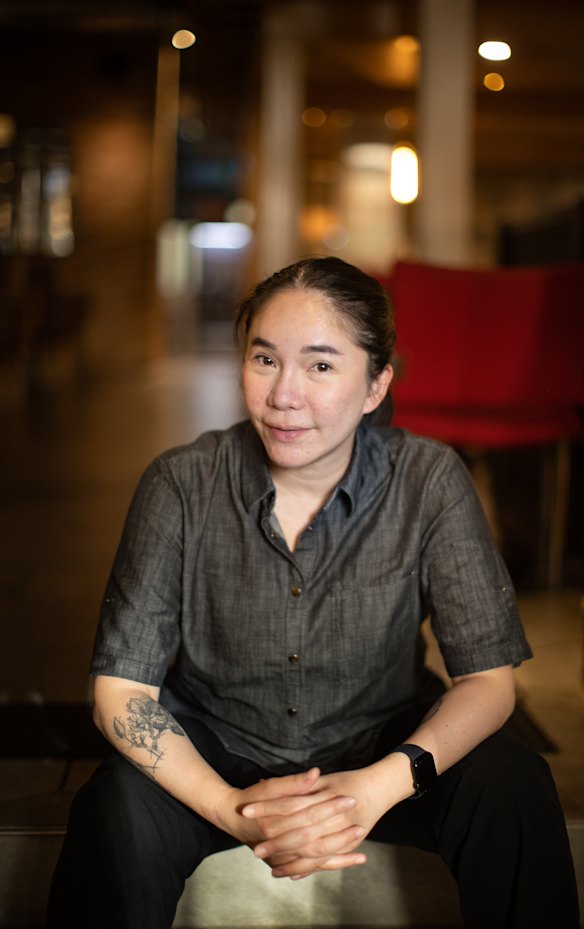
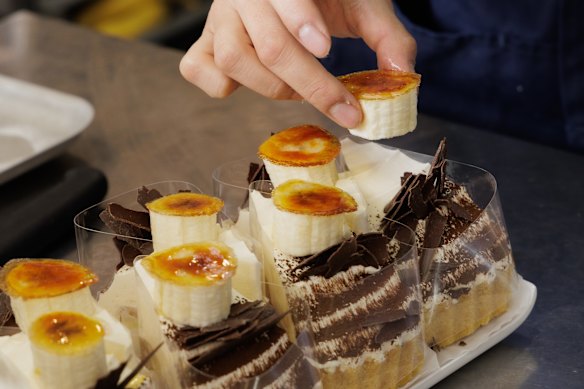
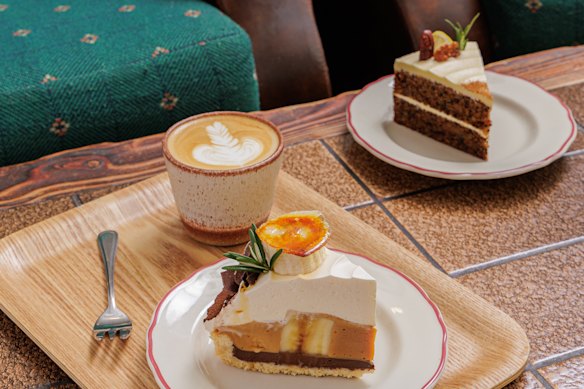
Under the brim, Tinee – everyone calls her “Tinee” – is animated and thoughtful. I’m on a cafe latte, Tinee drinks her coffee black. The cakes are all mine (hey, it’s research), mostly European classics with Asian flavours. There’s a madeleine mini-sponge with yuzu glaze, canele (a baked treat from Bordeaux) scented with jasmine tea, and fluffy Basque cheesecake turned purple with ube, a Filipino yam.
There’s also a squishy bonbon that’s gone internet viral: du-jjon-ku is a Korean marshmallow cookie stuffed with Dubai chocolate, the already trending combination of pistachio paste, dark chocolate and crunchy pastry threads. It’s characteristic of Tori’s to sell a product that people queue for, and even more so that it’s a next-step iteration of something that’s already blown up online.
“I hated study and loved art. I was the black sheep of the family.”
Tinee Suntivatana“Tinee studies, researches, learns, adapts,” says Christina Zhao, president of the Melbourne Chinatown Business Association, and convenor of a group of northern CBD proprietors. “She really knows the local market. She’s a game-changer, not just a business owner, always thinking about what’s next.”
That ceaseless questing started young, when Tinee was a child in Bangkok, the third of six children. “Food is big in our culture,” she says. “The big question is: have you eaten?” Family meals were 6pm banquets. “There would be a pot of soup, stir-fries, vegetables, whole fish, maybe another protein.”
The only downside was that her father, who ran a rice bran oil company, always wanted to talk about school. “I hated study and loved art,” says Suntivatana. “I was the black sheep of the family.”
Food on TV made an impression, especially World Class Cuisine, an American show from the mid-1990s that depicted chefs around the world. “I remember a chef in a farmhouse, picking herbs in the garden, then cooking a beef stew. I thought it sounded like a good life.”
As a high-schooler, Tinee started helping her mum, peeling garlic, prepping coriander, working her way up to cooking. She dutifully went to university, but after a couple of years studying graphic design, she packed it in and found a job cooking in a hotel. Her parents were alarmed, but she loved it – not only the challenge of rolling 200 pieces of sushi, or hand-slicing smoked salmon, but the exposure to different cultures. “The chefs were Swiss and German, the pastry chef was French; every day, I learned new things,” she says.
She also learnt to put herself forward. “In Thai culture, when seniors tell you to do things, you do it. But I had enough confidence to ask questions, I think because I have lots of siblings, because my dad always encouraged me to think outside the box, and my mum is very bold and brave.”
One chef mentor loaned her some English cookbooks; she studied them avidly, building an understanding of terms like “blanching” and “macerating”, and when she moved to Melbourne, found herself ahead of many of her contemporaries. “I didn’t expect it, but I was top of the class,” she says.
Suntivatana fell in love with Melbourne, entranced by its diversity. “You go to different suburbs, they have a different cuisine.” She trawled Middle Eastern groceries, buying new spices like fennel and sumac, then going home to experiment.
“Tinee was a standout student,” says Robyn Elliott, one of her teachers at Holmesglen TAFE. “She was talented, always on time, holding down a job while studying, practising her English, working incredibly hard.” After graduation, the two stayed in touch, and Elliott ended up endorsing her former student’s Australian citizenship application.
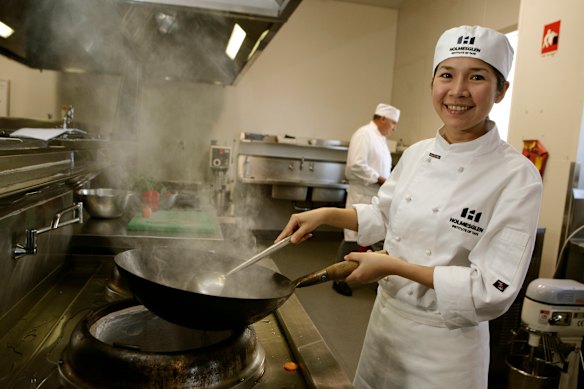
By 2008, Tinee was working two full-time jobs, clocking in at the Grand Hyatt between 3pm and 11pm, sleeping, then toiling at Red Petite cafe from 7am until 2pm. Her friend had opened the South Melbourne lunch spot with Gough, the man who would later become Tinee’s husband and now works with her in all the businesses. (Thai nicknames need a whole other article: Gough used to be Golf, a common moniker for Thai boys, but he changed it to Gough, “like the Australian prime minister”.)
For Tinee, it was all about gaining experience. “It was a big playground of learning. At the Hyatt, I met amazing people from different countries and backgrounds. I’d ask everyone what they ate. One of my friends put mashed potato between two slices of bread. That surprised me. A Canadian chef put vinegar on his chips. I had never seen that.” Suntivatana worked her way up
the hierarchy to chef de partie, which meant she had staff below her.
Daniel Rosenow, now co-owner of highly rated Lumos bakery in McKinnon, was a 17-year-old apprentice in his first job. “I’m 35 now, and she’s still the best boss I ever had,” he says. “We were chalk and cheese. I am talkative, she is quiet. I’d be emptying a fridge and ask her if I should throw something out. ‘Uh’. Okay, that’s a no. This? ‘Uh’. Okay, that’s a yes. I don’t know how I knew, but I did.”
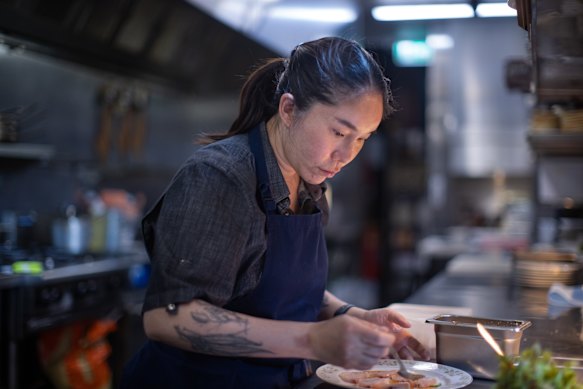
Beyond skills and processes, it’s an attitude that’s stayed with Rosenow, especially as he’s become an employer himself. “She instilled respect, patience and understanding in me. She would let me be hands-on, let me make mistakes. At Lumos, we give a lot of kids their first job. I wouldn’t have the patience with these teenagers and their attitude without thinking back to her dealing with me. I’ve passed on her values to everyone I’ve ever taught.”
After Tinee’s father died in 2012, she and Gough went back to Thailand and opened two Melbourne-style cafes, Sweetery and Tinee Eatery Workshop. To educate their Thai staff, they brought the team of 18 to Melbourne for a two-week learning holiday in 2015. “They bought their own tickets, but we paid for accommodation and activities,” says Suntivatana. “We went to Tasmania, Mornington Peninsula, I wanted to help them be less shy, learn more, be more chatty, be present.”
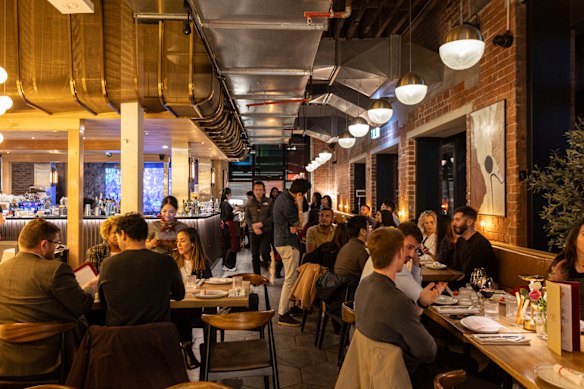
Robyn Elliott visited the group’s Footscray rental house for a multi-cuisine feast. “I have never in my life heard of a boss doing that for the staff,” she says. “That generosity from Tinee and Gough is fundamental to the way they operate.”
Back in Australia in 2016, Suntivatana opened Humble Rays. The mid-2010s were Peak Brunch in Melbourne, and Tinee was part of a small coterie rethinking Euro morning classics through an Asian lens. Humble Rays was one of the first cafes to serve eggs Benedict with sticky pork belly instead of bacon and the first to add crab to chilli scrambled eggs over a croissant, somewhere between Thai street food and five-star swank. It took off.
“I thought it would just be me, my husband and my sister, maybe one or two staff, but it was busy every day for the first three years, the line was endless,” she says. When COVID hit, Humble Rays was embedded in the local cafe scene and popular with international students, not only as a hangout but as a place to work. Because visa holders weren’t eligible for the government’s JobKeeper income replacement scheme, 80 per cent of Suntivatana’s staff were instantly imperilled when Melbourne locked down for the pandemic.
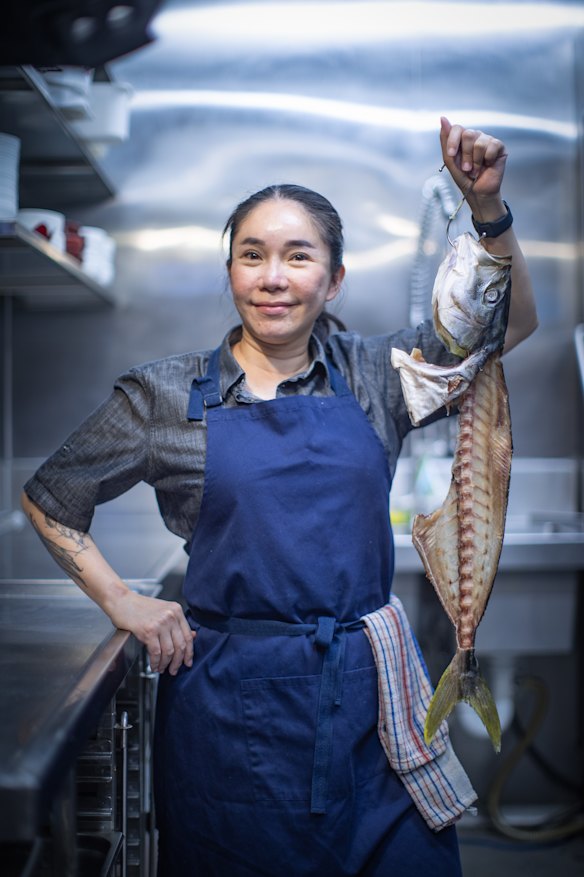
“I started giving away food and cooking meals for them. I told my staff to take bananas, milk, eggs, bread, rice.” She burnt through savings, estimating that she and Gough lost $200,000 during the pandemic, largely to help her staff. “We thought community is more important; these people are more important,” she says. “They don’t have money, we don’t have money, it’s okay. We know how to make money … we’ll make it back.”
The pandemic was hard, but it crystallised her philosophy. “Sometimes things aren’t fair in this world, but complaining won’t help. Even one minute is a waste of your time. Use that minute to change your mindset.”
We walk through the city, Suntivatana’s canvas, exiting Tori’s and turning north, hitting Lonsdale Street, then walking all the way east up to Exhibition Street. The CBD shows itself: busy in patches with pockets of torpor, a sense of possibility hard up against signs of dreams dashed.
We spot a new Vietnamese restaurant hidden in a basement. I’m always interested in stuff like that for my day job as a restaurant critic, and Tinee is perennially scouting too. We walk in, down the stairs to a dim cavern. Suntivatana appraises the menu in one quick glance. “I don’t think rent is cheap here, but dishes are not expensive, $10, $20,” she says. There’s a sigh. “When every business goes cheaper and cheaper, the whole system collapses, it’s not sustainable,” she says. “We should be building brands and identity, making hospitality better, rather than keeping everything cheap.”
“We need help from the city to make sure people feel safe when they’re walking on the street day and night.”
Suntivatana says her biggest worry is safety and crimeSuntivatana’s biggest worry is safety and crime. Windows were kicked in at Humble Rays three times in 2025. Staff members have been assaulted on their way to and from work. “We need help from the city to make sure people feel safe when they’re walking on the street day and night,” she says, delineating between the responsibilities of business owners and authorities. “If we don’t have customers, it’s our challenge to come up with new concepts or better marketing. But if a customer will not come to us because they don’t want to walk in the city, that’s hard. What can we do?”
We walk past the theatres on Exhibition Street and she watches matinee crowds spill onto the footpath. “The theatre is great. It draws people in. And maybe people will eat lunch or dinner too. But parking is difficult: people need to move the car every two hours. It’s all connected.”
Any hospitality owner will tell you profits are slim and getting slimmer. “All the ingredients increase, wages, tax and super, but we cannot charge the consumer that much. Even if we add a credit card surcharge, people complain and give us a one-star review,” she says. The traditional paradigm is to aim for 10 per cent profit. “If you can reach 7 or 8 per cent these days, it’s amazing,” says Suntivatana. “We have to move fast and try something new all the time.”
Robot waiters and QR-code ordering are some ways operators try to peg back profit. “We are looking in some places to use QR codes,” says Suntivatana. “But I still love the personal touch, looking after the customer. I search for team members that are trying to learn new things, keen to learn cultures.”
She’s looking for kids like her, basically. “The difference is that they have an iPhone and I had a Melway, I was catching trains and trams, they have Ubers,” she says. “However, the learning part, the good environment, the right one for them, that will shape them just like it did me. And whether they stay here or go back to their country, they will help the community if they’ve been taught well and treated well.”
That doesn’t mean they should have an easy ride. “You have to make them feel comfortable, but at the same time challenge them. If they have a bit more pressure, I think that will give them more depth, more layers and then they are better at taking responsibility.” Challenge and pressure are different from the shouting and belittling that have been rife in hospitality. “There’s no reason to not be kind,” she says. “Why wouldn’t you be? It costs nothing.”
Suntivatana credits her two eight-year-old Samoyed dogs, Trixie and Paxton, with much of her perspective on life and business. “They are my therapists,” she says. “They teach me about being happy and kind, being funny and goofy. My husband and I walk them in the morning; it’s non-negotiable, the fresh air, talking about what’s working in the businesses and what isn’t.”
Gough and Tinee share a house in Doncaster with Prem, her younger sister by six years, Prem’s husband and their two children, aged five and seven. “Even at home, Tinee is always finding something to cook,” says Prem, who does the graphic design for Tinee’s eateries, and made the “Hospitality Survivor” caps.
“When Tinee has a day off, she doesn’t have a massage, do hair and nails. She is more likely to decide she wants to have a hotpot, so she goes to Costco and buys a big tray of meat. She cooks enough for a whole village.”
We’ve arrived at the second Tori’s on Exhibition Street. It’s neutral and sleek compared with the higgledy-piggledy original: more suits, fewer students. Tinee walks up to the counter to order and pay, just as she did in Niagara Lane a couple of hours ago. “My staff don’t work for free, why should I eat for free? Regular customers are our VIPs, not me,” she says.
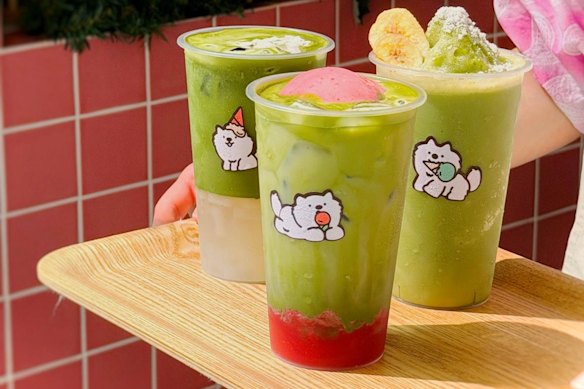
The trending drink here is an extremely cold “cryo matcha” served in a glass frozen to minus 85 degrees. (A minus-85 degree coffee drink is at Prem’s cafe Regulars, and sells out every day; Tinee created the hype.) Vanilla soy milk, crafted to a secret Tori’s recipe, sits at the base of the glass. Thick matcha is poured over to form a bright-green top layer. The drink comes with instructions: sip to taste the matcha, sip again to experience the mouth-feel mixed with milk, then scoop the frozen layer at the base to create a final ice-creamy spoonful. It’s fun and enchanting, a series of arresting sensory moments that require full attention: there’s no way you can doomscroll while drinking cryo matcha.
“People are stressing out in this world, with everything going on right now,” says Suntivatana. “It’s nice to offer small good things, special moments, and to create spaces where people can have a little escape.”
Start the day with a summary of the day’s most important and interesting stories, analysis and insights. Sign up for our Morning Edition newsletter.

















































