3 months ago
7
3 months ago
7
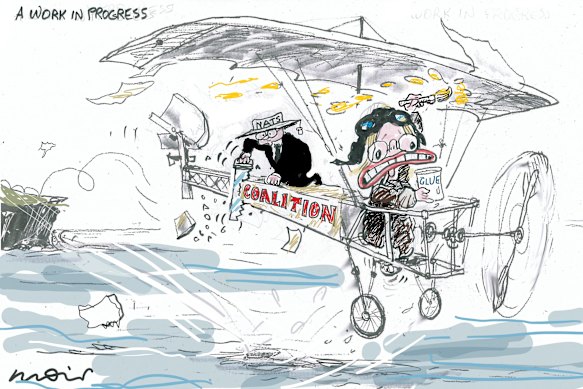
If the Coalition can’t agree on some form of net zero position, they have no hope of ever returning to government (“Hume laments ‘crazy’, ‘binary’ net zero debate”, November 7). The majority of voters favour net zero, but the Nationals are thumbing their nose at them. A politically savvy party would be educating its support base on the importance of strong action on climate change, rather than catering to its ignorance. Saying “no” to net zero smacks of climate change denial – definitely not a vote winner. I suggest that Sussan Ley’s inability to bring the party together on this issue after all this time has made her leadership untenable. Indeed, it appears that she is just going through the motions while waiting for the inevitable leadership challenge. In any case, Ley has exceeded the expectations of many by surviving for six months. I don’t understand why anyone would want to lead this bunch of uncontrollable misfits anyway. However, apparently the ego-driven duo of Andrew Hastie and Angus Taylor seem happy to shepherd the party into another humiliating defeat. Graham Lum, North Rocks
Credit: Alan Moir
While the Coalition debates its 2050 vision for Australia, it should also tell us where it sees us in the next decade or so. It must provide the security, social, health and economic policy basis for not embracing the EV revolution. Noting that rising energy costs are influenced by supply, the Coalition must list all the “shovel ready” projects that would have been “pumping out juice” that Labor stopped after winning in 2022. Consequently, it must tell us how much more supply is now needed in the near term, and how it should be provided, noting that everywhere, renewables are cheaper than coal, gas or nuclear – and quickest to bring online. If the Coalition does not volunteer this information, the media should try to extract it. Failing that, the media should take over and provide the answers via analysis and expert commentary. Carlo Ursida, Kensington (Vic)
Six months since its electoral defeat, when “all policies were to be reviewed”, the Liberal Party is still essentially policy-free. It hasn’t stopped MPs from commenting and criticising anything and everything the government suggests or does. Liberal consternation and infighting over net zero and the transition to renewable energy is even more astounding as this is not a new issue. The party has had decades to think, read and formulate policy. By the time this rabble has united, agreed on what it believes in, and can appear as an alternative government, the climate wars will be over and renewables will be delivering enough energy to end the party’s obstructions and objections. Alan Marel, North Curl Curl
Sadly, a large part of the Liberals’, and to some extent the Nationals’, debate regarding climate change is more about the contest for leadership and “power” within the parties than the science. Personal interests have well and truly trumped the interests of Australians as a whole. Brenton McGeachie, Hackett (ACT)
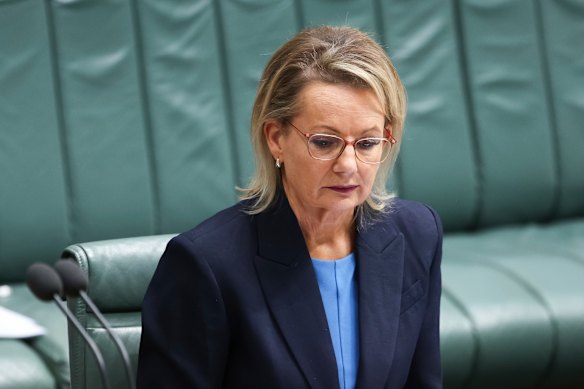
“If it were done when ’tis done, then ’twere well it were done quickly.” As Sussan Ley fossicks about in parliament, standing as if to deliver some game-changing point, then meekly sitting back down, it’s already too late to be done quickly. Rosemary O’Brien, Ashfield
Sussan Ley, busily not going anywhere much?Credit: Alex Ellinghausen
I agree with your correspondent (Letters, November 7) that the Coalition should be dissolved and that the Liberal Party should produce a climate policy embracing the Paris Agreement, net zero, renewables and emissions reduction. But what would really swing my vote is if Sussan Ley dissolved AUKUS, allowing those funds to be spent on more worthy causes for all Australians. Peter Nelson, Moss Vale
Building EV confidence
It’s not surprising that the perception of poor charging infrastructure has affected the level of EV sales (“EV sales too slow to meet government energy target”, November 7). But that perception is possibly overstated. There is an app (which presumably all EV owners have) that shows the location, type and availability of all EV chargers. And there are plenty of them. Also, EVs have another advantage over cars powered by internal combustion engines in that you can “top up” at home. This idea you have to go somewhere else to “fill up” is old school. Of course, perception is reality, and so more chargers may need to be built. However, if that is left to the private sector, then there is a “chicken and egg” scenario: that is, that while more chargers are needed to boost EV sales, investors won’t pay for more chargers if there aren’t more EVs to use them. That is where the government is needed, to subsidise the construction of this infrastructure. And while it’s about it, it needs to make EV chargers more prominent. Motorists are used to seeing petrol stations and are comforted that fuel is easily obtainable. They don’t need an app to reassure them. The same needs to apply to EV chargers. David Rush, Lawson
Historic win in New York
Zohran Mamdani’s historic election as New York City’s first Muslim mayor is more than a political win – it’s a resounding triumph of people power over entrenched interests (“New faces to old power: Mamdani’s victory gives me hope”, November 7). His victory wasn’t just over veteran politician Andrew Cuomo; it was a bold rejection of the political establishment, corporate influence and even Cuomo’s backing by Donald Trump, whose repeated attacks only seemed to galvanise support for Mamdani.
Running on a platform of rent control, free school buses and taxing the rich, Mamdani’s message resonated deeply with working-class and young voters – those struggling to make ends meet in one of the world’s most expensive cities.
His campaign offered a clear alternative to the divisive rhetoric of MAGA politics, instead championing equity, affordability and dignity for all. Crucially, Mamdani drew strong support not just from New York’s over 1 million-strong Muslim community, but from across the board of all young people. His win echoes the spirit of past justice movements, the pivotal role cities such as New York played during the civil rights era of the 1960s, when northern urban centres stood in solidarity with the struggles of black Americans in the south. Mamdani’s rise is a signal to the world – including places such as Australia – that grassroots movements, when united around bold ideas and inclusive leadership, can overcome even the most formidable opposition. Mukul Desai, Hunters Hill

Mayor-elect Zohran Mamdani, right, and his wife Rama Duwaji react to supporters during an election night watch partyCredit: AP
Satara Uthayakumaran is spot on when she says political change requires Australians to get active and engaged. The political establishment she hopes to bring down have known what it takes all along, leaving our parliament filled with chief executives and lobbyists pursuing their own interests. Uthayakumaran’s ordinary Australians shouldn’t have to buy a dinner or plane ride at the Midwinter Ball to be heard by decision makers. Colin Stokes, Camperdown
The election of Zohran Mamdani as New York mayor was a wonderful smack in the chops for Donald Trump and his MAGA (Make America Go Away) thugs. Could this be seen in the future as the time when the world began to see that fascism and ultra-rightist populism is not the answer to any question? One lives in hope. Ian Usman Lewis, Armidale
Idea of a ‘tradies uni’ is delusional
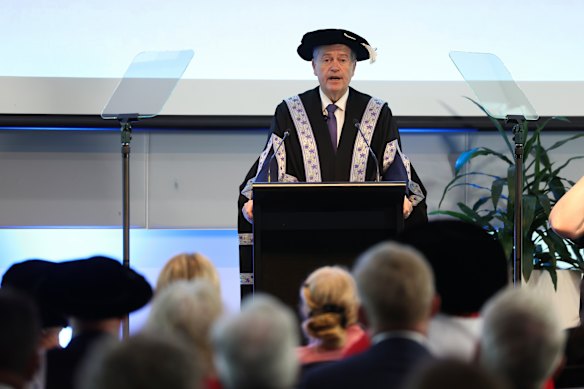
If ex-Labor leader Bill Shorten thinks he’s another Labor visionary by making the University of Canberra a “tradies university”, he is deluded (“Cheaper and shorter degrees: It’s ’tradies university‴, November 7). Why should taxpayers fund universities as surrogate TAFEs to fill the cavernous gaps left by the political destruction of the VET sector through the con of “introducing competition”? Another profound failure that can’t be amended by extending the time and cost of trades training. The last bit of genius along these lines was the Labor Dawkins reforms that abolished the Advanced College of Education sector, which ultimately transformed the higher education sector into the mess we have now. Given higher education is by definition for the development of critical thinking, rather than training a workforce, it seems that current and ex-Labor politicians harbour some deep-seated anti-intellectualism, perhaps driven by their delusion that they represent the “working class”, whatever that is these days. Robyn Dalziell, Kellyville
“People are not buying what we’re selling”: University of Canberra vice chancellor Bill Shorten.Credit: Alex Ellinghausen
While the different approach to education between universities and TAFE is clear – one teaches methods and facts, while the other is supposed to encourage higher thought processes and discovery – even universities have to teach facts before their students can get off the ground. The University of Canberra now giving recognition to trade courses is a sensible step towards encouraging learning in the community. I remember, from years ago, that the school of education was looked down upon at a certain university because it was “just a tech college”, according to some academics. Then there was the snobbery towards higher technical subjects, again years ago, in schools by certain board members of our Education Department and government officials. My own trade course has been a wonderful foundation for anything else I have done, and the perpetual push in schools for all students, many of them probably not yet mature enough to handle it, to go to university is foolish. For some, it is a waste of time – and pointless. The University of Canberra has taken a step in the right direction by breaking down the barriers of exclusion, so common in much of our education establishments, not just in universities. Donald Hawes, Peel
interesting move by the University of Canberra. I always found it challenging to understand where university ended and TAFE began. Some degree courses are more challenging than others, just as some TAFE courses are. Why do we have separate institutions? Why not a seamless learning institution where you can study anything from medicine to trades? Take away the illusion of a university degree being more prestigious than a trade qualification. Neville Turbit, Russell Lea
Violence no more
Where is the outcry, and more to the point, action, with stories of women killed, injured or attacked by men (“Man arrested after partner died fleeing alleged abuse”, “How Tatiana’s fairytale descended into cycle of violence then death”, November 7)? A clear example of how our “justice” system continually fails women. If women attacked and killed men at this rate, it would be declared a national emergency. Lockout laws were implemented for the tragic death of a one-punch victim. Yet hundreds of women are killed by men every year and no equivalent decisive action is taken. Why is this tolerated? Why are women’s lives so devalued? Because misogyny is indelibly entrenched in our society. For all the men who protest “not all men”, defending yourself achieves nothing. This is not about you. Be agents of change. The standard you walk by is the standard you accept. Alexa Wyatt, Redfern
Riven by indifference
It is clear that there is an increasing division in Australian society, and it is not all focused on the Boomer generation. Since the COVID pandemic, there has been an increasingly concerning voice on issues such as housing, cost of living, welfare’s increasing costs, along with domestic violence and the increasing influence of social media, to name but a few issues (Letters, November 7). However, probably the greatest divide is that emerging between government expenditure in cities and the lack of any inclination to spend in rural and regional areas. Massive amounts of money is now being spent digging under Sydney on road and rail projects, but mention a decent upgrade on the western highway over the mountains to the west and a few dollars are promised with little possibility of anything being seen. The greatest division in society is clearly evident in the divide between what government is providing for in Sydney while bugger all for rural communities. Don’t complain about the cost of electricity when all the solar and wind farms are in rural areas, with the cost of transmission lines back to cities. Not one wind farm offshore – close to the major demand markets. It’s the same with food supplies needed to be transported at ever-increasing cost over decaying roads from rural areas back to cities. No, the greatest and worrying increasing divide is that between rural and regional communities and our coastal cities. Bruce Clydsdale, Bathurst
Full speed behind
Only fast thing about high-speed trains is the announcement about them (“Three-stage build of high-speed train from Newcastle to Sydney revealed”, November 7). Then the grim reality of economic viability quickly stops the idea in its tracks. Mustafa Erem, Terrigal
Writer in the wild
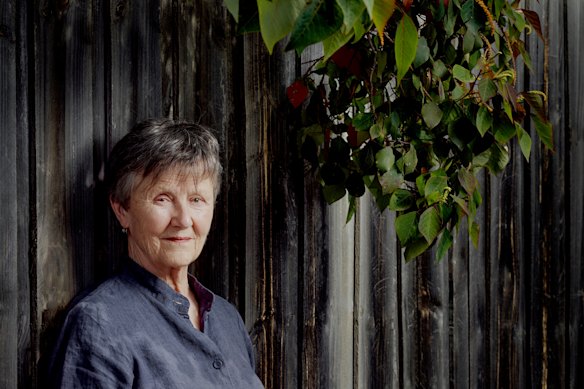
Years ago I spotted Helen Garner at Bondi Junction railway station. Not on a platform, but in a spot where the world rushed past. She was sitting and watching. Ordinary. Congratulations, Helen, on winning the literary award. So well deserved for your extraordinary work (“Garner ‘flabbergasted’ after winning UK literary award”, November 7). Lisa Clarke, Watsons Bay
Australian writer Helen Garner has received the $100,000 Baillie Prize for nonfiction, one of the UK’s top literary awards.Credit: Darren James / Orion Books via AP
Helen Garner’s modest “flabbergasted” reaction to winning the UK Baillie Gifford Prize mirrors her equal surprise at winning the US Wyndham-Campbell Literature Prize some years ago. Garner is the epitome of the quiet achiever, and her published journals and other works stimulate an appreciation of the importance and interest of the seemingly unremarkable life. Her recognition, in Australia and more so overseas, not only values her writing but also values the “ordinary” daily lives most of us live. Congratulations to Garner, and thank you for many hours of engrossing reading and insight into the worth of all of life’s experiences. Heather Johnson, West Pennant Hills
Who can choose?
What’s wrong with parents sending their kid to a high-fee private school they perceive to be a good choice for whatever reason (Letters, November 7), if they can afford to? What’s wrong with it is that these schools use their wealth to attract teachers at the expense of students in schools who need them more, especially at this time of acute teacher shortage. What’s wrong with it is that governments add taxpayers’ money to this wealth, while public schools that are open to all remain under-funded. And what’s wrong with it is that these perennial fee rises outstrip the rate of inflation. Lyndsay Connors, Ashfield

Private schooling: where does fair begin and endCredit: Louie Douvis
Your correspondent believes that “there is nothing wrong with parents sending their kid to a high-fee paying school ... if they can afford it”. True, there is nothing wrong for the parents. However, there is something wrong for all the children who don’t have parents who can afford to exercise this so-called choice. It’s not “choice” if you can’t afford it. Choice is when there are two or more equal options, and we choose one above the others for whatever reason. In our nation, which espouses “fairness” and “a fair go”, children are not given equal access to an education of choice. A fee of $50,000 automatically rules out the vast majority of children from ever attending such a school. This is not “choice”; it is an elitist system built on the wealth and socio-economic situation of the parent – that’s what’s wrong. And maybe we no longer live in a nation that prizes choice and fairness. Warren Marks, Richmond (Tas)
- To submit a letter to the Sydney Morning Herald, email [email protected]. Click here for tips on how to submit letters.
- The Opinion newsletter is a weekly wrap of views that will challenge, champion and inform. Sign up here.