
 4 months ago
75
4 months ago
75
The boy is all long legs and limbs, weaving and dodging past opponents racing to catch him. Shoes squeak on the shiny wooden floor of the indoor basketball court as he glides and floats and lifts his arms upward, the ball spinning and falling through the air and into the hoop. His teammates roar. The boy breaks into a toothy smile, high-fiving everyone, face sparkling with sweat and joy. From the sidelines his coach, professional basketballer Emmanuel “Manny” Malou, claps his hands and shouts, “Let’s go!”
It is a Sunday afternoon at Braybrook College in Melbourne’s hardscrabble inner-western suburbs, and just another training day for the South Sudanese Australian youth basketball team known as the Longhorns, named for the cattle that roam their war-ravaged motherland in East Africa. Founded in 2003 by Manyang “Manny” Berberi, who learned how to play as a boy on dusty courts in Kenya, the Longhorns have since won countless basketball championships, pleasing both their community and Berberi, a lean and wiry man dressed in a black tracksuit and matching Nike hat.
The now middle-aged Berberi created the club after noticing African children hooping in public courts but also struggling at school and falling into petty crime or street gangs. Over the years, he’s coached hundreds of teenagers, including Malou, many securing elite college basketball scholarships in the US. Malou played professionally all over the world but is now home in Melbourne’s western suburbs, offering free weekly training to teenagers, just like Berberi did for him when he was a shy and introverted boy.
“The two Mannys” are giving back because they know what is at stake.
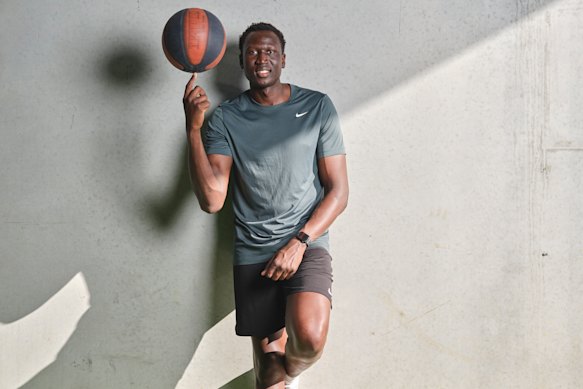
Malou has watched friends end up in jail or dead, lost to the grip of alcohol and drugs, and wants to be a “big brother” who can steer others from that path. “I want everybody to feel comfortable to chat to me about whatever,” Malou says. “As young South Sudanese men, we carry a lot.”
Berberi, a seasoned youth worker, also knows the burden that comes with straddling two cultures. The real danger zone for boys, he says, is age 13 through 19. That’s when sport can make a difference, through discipline and belonging. “If we can get a child through those years without much trouble, then they’re set for life,” Berberi says. “They’re safe.”
Sometimes, though, even that’s not enough, as was the case in September last year, when two South Sudanese children were stabbed to death on their way home from a basketball tournament in Melbourne’s outer west. In one of the worst knife crimes veteran police have ever seen, Chol Achiek, 12, had just got off a bus and was waiting for his mother to pick him up when he was ambushed and murdered. His friend Dau Akueng, 15, had his hand sliced off, before being stabbed and killed metres away. Eight people, aged 15 to 19, were charged with their deaths. Meanwhile, an entire community was left reeling and also, yet again, mischaracterised.
For a community that has called Australia home since the 1990s, the South Sudanese experience has been and remains largely misunderstood – reduced to a tired narrative of hardship or heroism. What’s lost in this simplification, says human rights advocate and lawyer Nyadol Nyuon, is the story of a community only now realising what life can be beyond the shadow of war. They are overcoming old traumas and new tensions, all the while reclaiming their own story: navigating life in their adopted homeland while coming to grips with who they are, and want to be, in Australia.
“What I seek isn’t a story of sanctification or demonisation of South Sudanese people,” Nyuon says. “Being human is complex. It is mistakes and successes. The South Sudanese story that is so often told doesn’t allow for that complexity. It becomes either, ‘Kick them out of this country’ if they fail or they make mistakes or they must be successful to be accepted. What I really want is for people to be curious about South Sudanese people.”
There is much to be curious about.
For a relatively small immigrant diaspora, the South Sudanese are making an outsized and indelible mark on this country: on AFL grounds, fashion runways, concert stages and in parliament. They are smashing athletic records (take Australia’s superstar teenage sprinter Gout Gout, or Tokyo Olympic hero Peter Bol, a middle-distance runner) and dominating basketball courts. It rarely comes easily, many having experienced a long and bloody civil war, notable for massacre, rape and ethnic cleansing, that has killed more than 2 million people, then the concomitant traumas of resettlement, poverty, racism and more.
Official 2021 Census data estimates there are more than 8000 people in Australia who were born in South Sudan, and about 14,000 who claim ancestry there, but community leaders say the true population is closer to double this. The reasons for the discrepancy are myriad, from language and digital literacy barriers to filling out census forms to conflict displacement, meaning birthplaces are often listed as refugee camps in Egypt, Kenya or Ethiopia. (Also, before South Sudan’s independence in 2011, when the population voted to secede from Sudan, they were simply classified as “Sudanese”.)
Melbourne is home to more than a third of Australia’s South Sudanese population, most converging in the outer-western suburbs of Melton and Wyndham Vale, and the city’s south-east including the suburb of Pakenham where, lured by affordable living and ethnic enclaves, they became the backbone of essential work, often employed in aged care, warehousing and commercial cleaning. The South Sudanese are an amorphous group, too, mostly Christian yet hailing from 64 different tribes, predominantly the Dinka and Nuer.
Getting to know the South Sudanese is difficult. I’ve been writing stories about the community for almost 15 years, starting at a local paper in the city’s western suburbs, but there was an ever-present sense of hesitation in those approached by Good Weekend for this piece. For any piece.
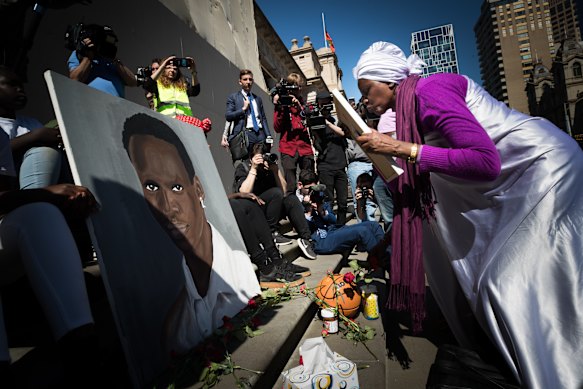
Many have never forgotten the first public firestorm surrounding African youth in Australia, unleashed in 2007 after South Sudanese man Liep Gony was beaten to death with a metal pole outside a Melbourne train station. Days after Gony’s murder, former federal immigration minister Kevin Andrews publicly questioned whether South Sudanese people were properly integrating into Australian society.
Then it emerged in court that Gony’s murder was fuelled purely by racial hatred. The 19-year-old was on the way home from the shops, buying paint for his sister’s upcoming wedding, when he was violently bludgeoned and left in a gutter to die. Minutes beforehand, one of his white attackers was heard yelling: “I am going to take my town back. I’m looking to kill the blacks.”
The scars of the so-called “African gangs” crisis in the lead-up to the 2018 Victorian state election also run deep. A rolling brawl of teenagers in Federation Square one night at the annual Moomba festival in 2016 set the scene for a dog-whistle political campaign focused on law and order. The police described the rioters as more of a “United Nations” of Melbourne youth, but the focus fell on South Sudanese teens anyway. The then-federal home affairs minister Peter Dutton was happy to fuel the flames, declaring Melburnians were too afraid to go out to dinner because of gang violence.
Nyuon recalls the fevered panic vividly, including the day her mum came home from the shops having just been called a “black dog” by a stranger. “She said it so calmly,” Nyuon says, “as if somebody had just said ‘Hi’ to her. She had somehow normalised it.” Days later, her younger sister was knocked back from a nightclub after being told by a security guard, “We don’t allow people like you in here.”
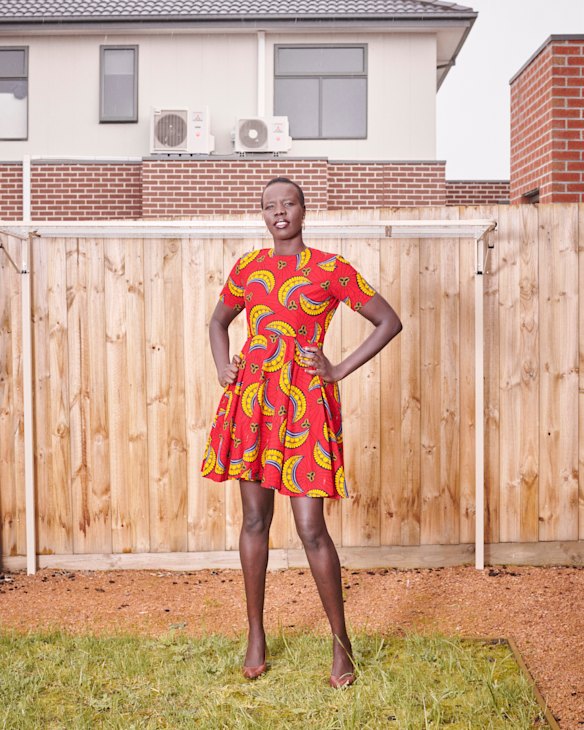
Nyuon finally spoke out after seeing a shift in a young South Sudanese woman she was mentoring, who dreamt of becoming a lawyer but went from lively and vivacious to being afraid to make eye contact on a train. “I remember thinking, ‘This is destroying the self-esteem of so many young people,’ ” she says. “When you destroy that self-esteem, you destroy their capacity to dream of wanting to be something different.”
Nyuon appeared on ABC current affairs shows Q&A and The Drum (often as the only dark-skinned person), and in newspaper articles and government panels, receiving an Order of Australia Medal in 2022 for contributions to multiculturalism. She was trolled mercilessly a barely slept, the curse of being a black woman in Australian leadership. “You get admiration,” she says, “without protection.”
Lawyer Maker Mayek also felt powerless before the news cycle – until one Sunday afternoon in 2018 when he’d had enough of being dehumanised. If mainstream media wouldn’t help, social media could. The father of four got out his phone and began posting on Twitter (now X), starting with a photo of himself working dutifully at his desk with the words: “Another day, another contribution from the gangs’ struggle street. G’day #AfricanGangs.”
“I was really pissed off,” says Mayek, who runs his own law firm in Footscray. “So many of my friends are nurses, doctors, professionals. People making huge contributions.”
Photos of African families from all over Australia – celebrating weddings, births of babies, university graduations and family dinners – flooded social media with the viral #AfricanGangs hashtag. News outlets from all over the world wanted to speak to Mayek. A narrative was reclaimed.
Mayek was only seven when his dad – a tall, kind man and gifted teacher – was forced to fight in the war, dying in conflict. His mother drowned a few years later. Mayek was 18 when he came to Australia in 2004; the following year he was the only Higher School Certificate student of South Sudanese background in the entire Hunter region of NSW.
What he loves most about his community is the way they come together with an abiding sense of service. It’s not uncommon for a South Sudanese wedding to attract 500 people, guests spilling out of a church or reception centre into the street. “Nobody needs an invitation,” Mayek says with a cheeky grin. “Everybody just turns up and they are welcome.”
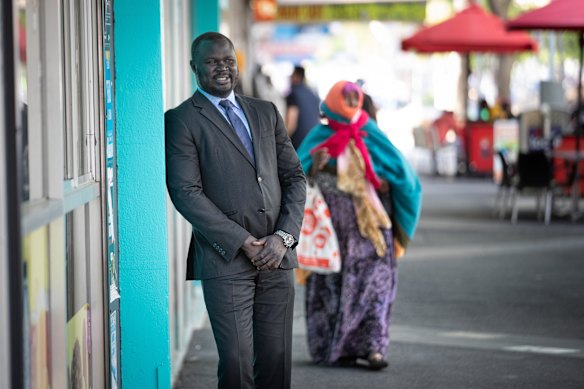
They are there in times of tragedy, too, as when Chol Achiek and Dau Akueng were stabbed to death last year. Chol’s father, Chuti Ngong, was at the funeral home standing next to his son’s body when the young men and teenagers were arrested for the boys’ murders. “We want to be close to him,” he told me at the time. “We came here, from war, for our children to have a better life. I miss his smile the most. He was my best friend.”
‘This community makes sure you are never,ever alone in really sad times.’
Melbourne lawyer Maker MayekHundreds of mourners came to the funerals, all dressed in white, and in the days afterward the women from the community went to the homes of the grieving families, too, staying for days to clean and cook homemade stews. At night the women slept under blankets on lounge room floors. Bags of groceries were left at the front door, with money to help cover the burials. “This is the best thing about this community,” Mayek says. “They make sure you are never, ever alone in really sad times. When something as shocking and terrible as this happens, it shatters us all. We feel it so deeply.”
This is doubly, tragically true for Deng Atem. There’s a heaviness inside his orange brick home in Wyndham Vale, where Atem sits in a plastic chair in the corner, hunched forward, wringing his hands. He has a gaunt face with high, chiselled cheekbones and sad, almond-shaped brown eyes. Two of his boys were also murdered, two years apart, and he now lives an obliterated existence, each day like a solitary confinement of the mind, wrestling with thoughts about what might have been.
The father of eight was staying with relatives in Shepparton in northern Victoria when he lost his son Atem at the age of 29. His phone rang in the early hours of February 11, 2023, and his son Lino was on the line. Panicked and breathless, Lino told his father that Atem had been shot dead at their home. “Lino never lies,” he says softly. “So I knew it must be true.”
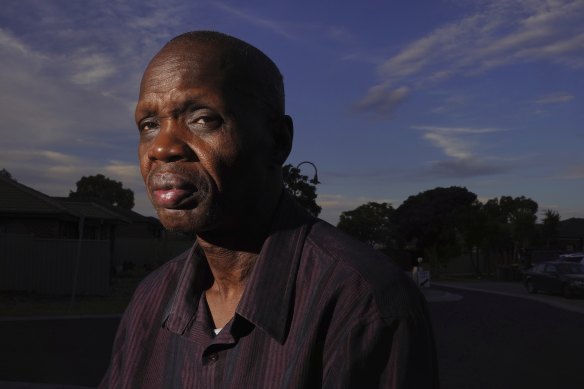
Atem had been sitting in the garage with a friend when a group of young men arrived in three cars. The garage roller door sprang open. There was a glow of headlights. A scream. Raised voices. Then a hail of bullets rang out, killing Atem and his friend. The family’s pitbull terrier, Randy, was also shot dead.
Then, just last year, on a muggy summer’s night, another heartbreak. Lino was stabbed to death at a park mere metres from their home in what police say was a case of mistaken identity. His father took the grim news in another late-night phone call, this time from his son Majok, who had been slashed with a machete after stepping in to protect Lino. Atem remembers the phone slipping from his fingers, stumbling in his darkened bedroom and falling to his knees. “I can’t talk,” Atem says. “I cry. I say, ‘Oh god, why don’t you kill me instead? Better you kill me instead.’ ”
In the corner of the lounge room sits a framed certificate congratulating him on 15 years of long, gruelling hours as a beef boner at an abattoir. A framed photo of Randy with a distinct pink mark on his snout sits on the TV cabinet next to a red velvet urn holding the pet’s ashes. He keeps his favourite tattered photo of his boys in a bag next to his bed, where he can trace a finger over their smiling faces, sitting shyly beside their proud dad in a bright pink shirt. Criminal charges are yet to be laid for either murder.
“I came to Australia for two reasons: safety and education for my children,” Atem says. “But my two boys are dead. My wife still cries most days. I want to know who killed my sons. I want to know why. I am waiting for a solution.”
In some ways, Deacon George Piech Meat is searching for solutions, too. The father of six spent more than a decade ordaining funerals over the primal wailing of bereft mothers. There was no great reckoning when Meat decided instead to work as a youth justice chaplain inside juvenile prisons. It was more of a quiet calling. From God. “I just said, ‘This is my place,’ ” he says. “I wanted to go there and work with them and give them a message of hope. It is about love and trust.”
‘I came to Australia for two reasons: safety and education for my children. But my two boys are dead.’
Deng Atem, whose sons Atem and Lino were both murderedWe meet on a balmy spring day inside a concrete, grey building, home to the CatholicCare outreach service in Dandenong. Dressed in a navy-blue blazer with a silver crucifix pinned to the lapel, we can barely finish a sentence inside the sunlit meeting room without some beaming boy sticking his head in to say hello to “Deacon George”, who now spends his days visiting Cherry Creek and Parkville Youth justice centres, tense, tragic places filled with young offenders.
South Sudanese young people, aged 10 to 24, make up 22 per cent of children and teenagers in youth detention in Victoria, yet represent less than 0.5 per cent of the state’s population in this age group. It is a reflection of an entrenched, long-standing national problem; in Victoria, Aboriginal children aged 10 to 17 still remain more than nine times more likely to end up in prison than other young Australians. (Australia-wide, this figure is far higher: more than 20 times more likely.)
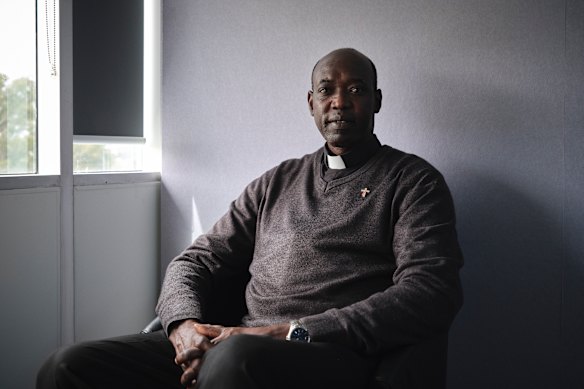
Jail is no place for any child, says Meat, which is why he drives his van all over Melbourne, stopping along the way to pick up the mothers of incarcerated boys, who have no other way of visiting their sons. He pulls a weathered Bible out of his pocket now, and recites a favourite Old Testament reading. “For I know the plans I have for you, declares the Lord. Plans to prosper you and not to harm you, plans to give you hope and a future,” he says gently. “When the young people hear this, they say, ‘Is this for me?’ And I tell them, ‘Yes.’ ”
Sometimes, Meat will just sing the South Sudanese national anthem with them, to remind them of who they are: that they come from courage, and that love is waiting for them. He sees his job as reconnecting these children with their families and preparing them for life. He runs sporting days with the Longhorns, and oversees a landmark educational program that led to five jailed teenagers graduating from high school last year.
For young offenders from single-parent refugee homes, he says, the drift into crime is a collision of unresolved trauma, fractured families, ejection from education and poor employment prospects. Small groups of children are also recruited by predatory older criminals for carjackings and home invasions. “We are a community with a bright future,” Meat says. “But it is a very disadvantaged community that has too often been forgotten and neglected.”
Ashoup “Ash” Atar traces many of these challenges back to the years of 2001 and 2007, when the largest influx of refugees fled to Australia, yet were met without a robust resettlement and integration process. Every new arrival was meant to do a 500-hour language, education and employment program, but Atar says most were left unable to speak even basic English. “It was essentially a box-ticking exercise,” says Atar, whose family was one of the first to settle in Melbourne’s western suburbs in the 1990s. “But there was a big problem. It wasn’t working.”
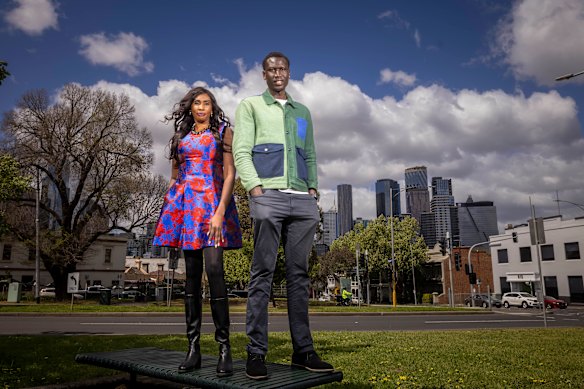
Thousands fell through the cracks as parents – often single mothers, whose partners had been lost to war – tried to raise large families and navigate the nuances of Australian society. Atar says the consequence of this policy failure was a “lost generation” of young people, which is why she founded Kowanj Australasia – a charity and recruitment agency supporting migrants and refugees with education, training and employment – to ensure it never happens again. “For any child, the question should be, why is that happening?” Atar says. “What are their needs that we aren’t meeting?”
Mamuch Chuol – a strikingly tall man who wears a sparkling stud earring in each ear – is cut from the same cloth. Hardly your typical 24-year-old, Chuol is studying an arts-law degree and already runs a not‑for-profit organisation, NextGen Unite, which he founded in 2021 to empower youth through sport, education, arts and employment. He’s also a basketball coach and mentor at Brighton Grammar School.
With little funding or government support, Chuol spends countless hours volunteering his time and running events like the hugely popular South Sudanese Australian football days – the kind of thing he would have dreamt of when he came to Australia as a little boy in 2007, settling in public-housing flats in Hampton East with his single mum. “As young South Sudanese people, we are the ones who understand these kids,” he says. “We know the challenges, and we know what the solutions are.”
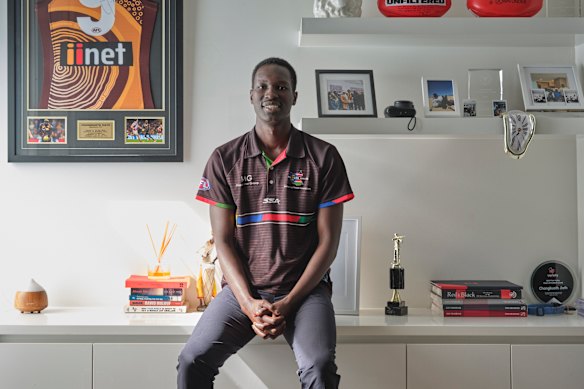
He knows how one opportunity can change the trajectory of a life. In primary school, he became the first Victorian child to receive a scholarship from Team Sports 4 All, a charity that funds uniforms and registration fees, without which he would never have been able to play community sport. Many South Sudanese families have five or more children, and the parents simply can’t afford to pay thousands of dollars in sporting fees every year.
On the day I meet Chuol, Victorian Premier Jacinta Allan has just announced plans that children as young as 14 will be sentenced to jail as adults, in a move condemned by human rights and legal experts. Chuol notes that the Malmsbury Youth Justice Centre reopened recently, too. “You know that’s going to cost $141 million over five years? That’s $77,260 per day to keep kids locked up, and unfortunately at the moment there are a lot of our kids in there,” he says. “What type of message are we sending?”
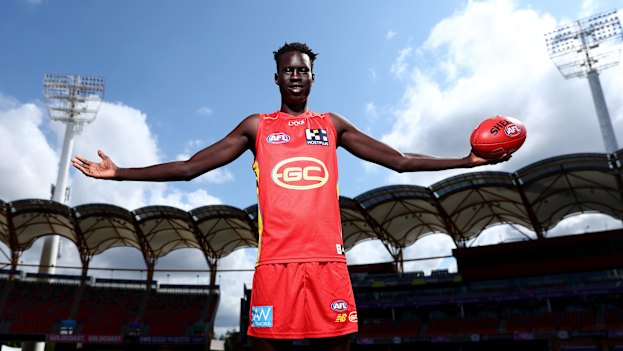
Mac Andrew can’t quite pinpoint the moment he decided he wanted to be a footballer. It was mostly a feeling. A sudden rush he got as a five-year-old boy, on a muddy oval in Melbourne’s leafy eastern suburbs, kicking a Sherrin as far and high in the air as he could. On the way home one day he told his dad, “That’s what I want to do.”
Andrew made history at the 2021 AFL Draft when, at 17, he was the first-ever top-five selection from the South Sudanese community. Moments later the long-limbed defender stood on stage wearing a red Gold Coast Suns singlet and an ecstatic grin. His mother, in tears, planted a kiss on his cheek while his six siblings and father stood smiling in Suns caps and scarves. Three years later, younger brother Riak was drafted to the Sydney Swans. “I felt more excited for him than I did for myself,” Andrew recalls. “I was over the moon.”
Andrew calls after training at People First Stadium at Carrara on the Gold Coast. His parents, Mary and Lual, fled to a refugee camp in Egypt before migrating to Australia in 1999, when he was still a baby. He can’t remember their awe at having a house with running water, electricity and air-conditioning. He can’t remember the first time he noticed his skin was darker than his friends, either, but he felt racism keenly as a young boy – except in sport. His mum, an aged-care worker, ran the canteen at Wantirna South Junior Football Club, in Melbourne’s east. His dad volunteered as a goal umpire and now helps troubled youth get involved in sport and find employment.
People look up to Mac Andrew, partly because, at more than 200 centimetres, the guy towers over everyone – his nickname is “Big Mac” – but also because of his stature. Andrew is one of more than a dozen AFL and AFLW players with South Sudanese heritage, and in 2024 secured what could become the richest deal in AFL history, signing a potential $12 million extension with the Suns. One day, he wants to open his own junior sports academy for disadvantaged kids.
“It is disappointing that a lot of the time you turn on the TV it’s not people celebrating Gout Gout being the fastest kid in Australia, or Peter Bol breaking all these running records, or [former AFL player] Majak Daw kicking goals. It’s always the gang violence stuff,” Andrew says. “The more kids we can inspire to get into sport, the bigger role models we can be and the better it will be for the whole community in general.”
The success of South Sudanese Australians is felt beyond the sporting field, of course. Take Veronica Peter, 24, better known for her stage name “Vv Pete”. In primary school she would beatbox at her desk, improvising lyrics for rap songs. “My teacher, Ms Hooker, was like ‘V, you’re going to be a big star one day,’ ” she says, before bursting into infectious laughter at home in western Sydney. “I remember just looking at her and thinking ‘What you talking about, girl?’ ”
Growing up in Mount Druitt, Peter often felt like she was living in a supportive “mini South Sudan”. When Australian rapper Iggy Azalea released her smash hit song Fancy, Peter wrote her own version, performed it at assembly, “and the whole school went wild”. Occasionally she questioned her physical features, wondering why they were different. “But growing up where I did, made me embrace who I am,” she says, “like the beautiful melanin in my skin.”
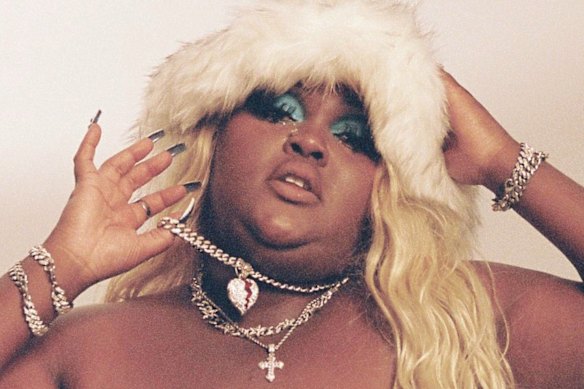
In 2025, she became the first Sudanese Australian to be nominated for an ARIA Award, for the film clip for her single WASSA, which was also played during runway shows at New York Fashion Week. In the video, Vv Pete is draped in pearls and bling and flipping her red, dyed hair while dancing at a construction site. Inspired by rappers Nicki Minaj and Notorious B.I.G., her unique blend of hip hop, rap and South African-inspired electronic dance also tells African stories. The interlude to her song +211 444 444, for example, features a recording of her mum Hawa Joackilo’s voice in Arabic. “I’m very proud of you,” she sings. “Sudan’s very proud of you.”
For others in the creative community, art is necessarily political. Before he would agree to an interview, South Sudanese rapper Gabriel Akon (stage name “DyspOra”) wanted to know more. The angle of the story. Why I became a journalist. And so on. The activist and poet was hesitant to be interviewed because of the “racist shit” he says newspapers have printed in the past, and was swallowed blindly by readers. I ask him how he feels about Australia now.
“Well, when I succeed, I’m Australian,” he says. “When I fail, I’m African.”
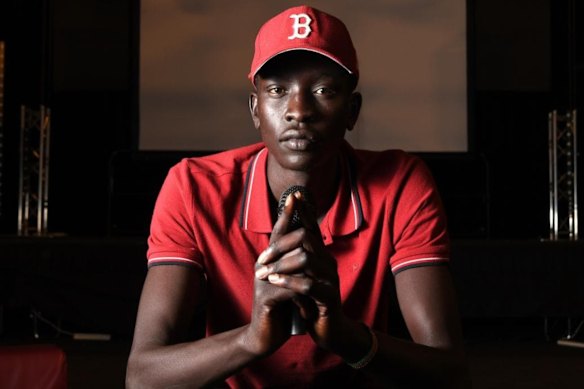
Akon, 33, grew up in South Australia and won a slew of accolades, including Best Male Artist in South Australia and the Governor’s Multicultural Youth Award, and was shortlisted for SA Young Australian of the Year. For years, he ran a highly successful music program in Adelaide’s historically disadvantaged northern suburbs, growing from five teenagers to 70 young people, recognising and redirecting the anger inside disenfranchised youth. “Music is a good way to get those things out,” he says. “It’s like boxing, in a sense.”
‘When I succeed, I’m Australian. When I fail, I’m African.’
South Sudanese rapper Gabriel AkonAkon was left shattered when funding was cut. It reminded him of the barriers to entry in the music industry, too: “We have to create our own table and our own chairs before we get invited to the team.”
He left Australia more than two years ago to return to South Sudan, after his father died and his grandfather fell ill. He departed the country somewhat disillusioned, but still creates music – “the universal language of life” – not only as a form of sonic activism but to bind us all together. “Music is a connector of everybody,” he says, “and every human soul.”
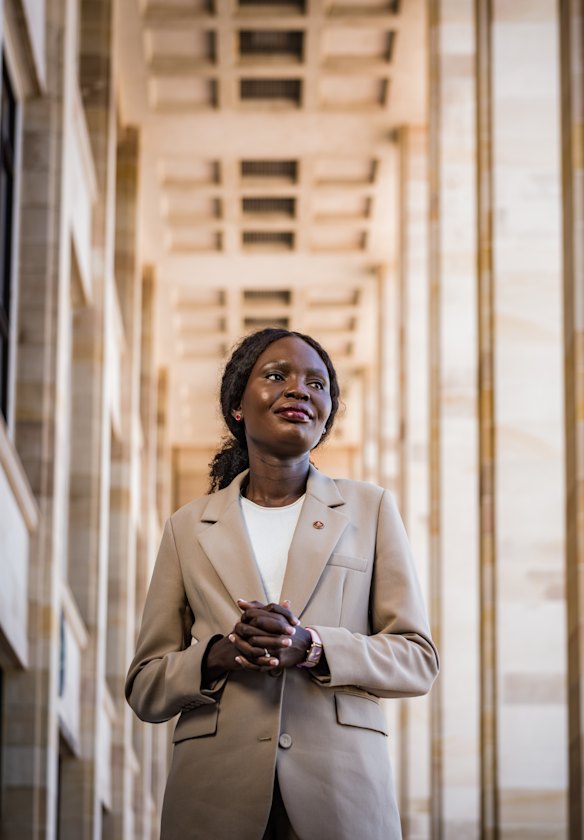
Ayor Makur Chuot’s voice was forged in survival. Before she was born, her pregnant mother Helena walked hundreds of kilometres on a harrowing journey across battlefields in South Sudan and malaria-infested swamp, giving birth in Ethiopia. Her father was murdered by rebels in 1992. It wasn’t until she arrived in Perth as a teenager – with only a plastic bag of belongings – that she finally felt safe for the first time.
Chuot became a mum at 17, then her luminous skin and symmetrical features saw her scouted as a model, leading to a luxury fashion career in London and New York, alongside a rising wave of South Sudanese supermodels including Adut Akech and Malaan Ajang. Chuot started her own beauty pageant for aspiring South Sudanese models in Perth. Then, in 2021, she became the first person of South Sudanese descent to be elected into any parliament in Australia when she won a seat in Western Australia’s state upper house.
She’s a reluctant politician. It took serious convincing from former Mirrabooka Labor MP Janine Freeman, a friend and mentor, before she even considered running for the upper house. “I was very scared,” she says. “I said no a few times, then I went away and reflected about it for a week.”
Chuot thought of her mother, who had started her own restaurant at the refugee camp where they lived in Kenya. Each day she would cook extra food for the “lost boys”, a group of orphaned and displaced children so malnourished and sick they could barely move.
‘If I can make it in parliament, what excuse for our children to not make it anywhere?’
Australian politician Ayor Makur Chuot“I was a child that came here with nothing,” she says. “If we want the kids of colour, the migrant kids, to thrive in the country, we need to create opportunities for their people at the table, so they can see themselves represented. If I can make it with my broken English in parliament, what excuse for our children to not make it anywhere in Australia?”
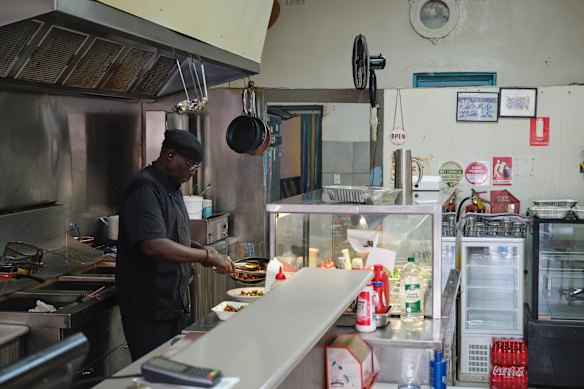
That’s the Australian dream, for some. For others, it’s a fish and chip shop. Ask anyone in the South Sudanese community in Melbourne where to get the best traditional food, and they won’t hesitate – Deep Blue Fish & Chips in Noble Park – and on this late weekday afternoon, the tiny Ian Street shop is heaving. It sits alongside a traditional dress shop, a hair salon specialising in braiding, and an African and Caribbean grocery. South Sudanese men – dressed in crisp white shirts and slacks or hi-vis work gear – are sitting at tables drinking masala tea and chatting in Dinka.
The air smells like cinnamon and hot chips as a young boy batters fish behind the counter at breakneck speed. He calls out to his father, Stephen Lual, who emerges dressed smartly in a buttoned-up chef’s jacket and matching hat. Lual has been in Australia for almost 25 years, and proudly lists all the cuisines they make: Aussie, African, Italian, Middle Eastern. Everything from battered barramundi to mushroom fettuccine. “We’ve got people from all over the world living in Noble Park,” says Lual, his smile crinkling the skin around his eyes. “You have to have something for everyone.”
But his most popular dishes by far hail from his native land of South Sudan. People come from all over to get a steaming bowl of his akelo. The dish looks a bit like porridge, mixing tiny balls of dough with sauces, steamed fish and plenty of spinach, topped with sweetened yoghurt. The taste reminds the 67-year-old father of five and grandfather of seven of being home in Africa as a boy, his mother’s fingertips working “like a machine”, kneading the cornflour. “It was magic,” he says. “I ate it for breakfast, and I was full for the rest of the day.”
It’s one of the signature staples served during annual festivities, including South Sudan’s Independence Day, which marks the liberation anniversary of the world’s youngest nation on July 9. Such festivities are filled with dancing and singing, storytelling and food.
“We are resilient, we are hard-working, we are a community who is there for one another,” Lual says, tending to his customers. “We come for safety and for a better life. That is always the hope. If you work hard, if you use your mind here, you can reach your potential. Australia is a place where your dreams can come true.”
Get the best of Good Weekend delivered to your inbox every Saturday morning. Sign up for our newsletter.
Read more from Good Weekend:
How Luke Bateman became Australia’s most unlikely book influencer
‘I gave up being reactionary a long time ago’: How Khaled Sabsabi weathered a political firestorm
Michelle Payne’s rise to the top was swift – then came stalkers, the agony and the heartbreak
Inside the world of ABC chair Kim Williams

















































