3 months ago
7
3 months ago
7
Australia’s longest waterway is under such dire threat of collapse that the entire lower Murray River ecosystem, which stretches nearly 1000 kilometres from western NSW, through Victoria and to the sea in South Australia has been classified as critically endangered.
The new designation was announced by Environment Minister Murray Watt on Thursday, sounding the alarm on the river’s health and setting up a potential conflict with big agribusiness and a political battle with the federal Opposition, as the Albanese government blames their predecessors for a decade of inaction on conservation.

The new designation sets up a potential conflict with big agribusiness and a political battle with the federal Opposition.
“Ecosystems are threatened by over extraction of water, feral animals, habitat loss, weeds and salinity and those threats are, of course, made worse by increasingly severe droughts and floods caused by climate change” Watt said on Thursday. “This listing will guide future government action to protect and restore the lower Murray.”
A critically endangered designation, the highest risk rating, will apply national environmental protections to the lower Murray River, the plants and animals in it as well as surrounding floodplains and wetlands.
This means major project proposals, such as expansion of the wide-scale irrigation operations in the region to grow almonds, cotton, wine and citrus, will be subject to tougher tests over their impacts to native flora, fauna and the river system.
Humane World for Animals Australia made the application to classify the lower Murray as critically endangered. The group’s campaign director, Nicola Beynon, welcomed the announcement.
“These ecosystems have been so deteriorated by catchment degradation and water extraction, exacerbated by climate change, they have been identified as being at risk of ecological collapse,” Beynon said.
The critically endangered classification was recommended to Watt by the federal government’s committee of expert conservation advisers and applies to native ecosystems and excludes existing farmland and urban development.
A submission by the National Farmers Federation to the committee in 2024, as it consulted on the critically endangered designation, argued the move was driven by lobby groups with “activist views”.
The designation is a significant win for many South Australian residents, where the marine algal bloom choking waterways has heightened public awareness of environmental management.
Labor campaigned in the past two federal elections on boosting the health of the Murray River, promising Adelaide residents who live at the end of the catchment that they would “restore balance” to management of the system.
The area was listed as critically endangered in August 2013 by the Rudd Labor government, a status repealed four months later when the Abbott government was elected.
South Australian Senator Penny Wong, who was environment minister in the Rudd government from 2007 to 2010, said the Coalition had “shamefully scrapped” protections for the river and ignored the needs of her state.
Loading
“South Australians know that the Liberal and National Parties have been focused on upstream states and have never done the right thing by South Australia when it comes to the Murray River,” Wong said on Thursday.
Murray Darling Conservation Council campaigns co-ordinator, Char Nitschke, said the critically endangered listing recognised the river was in crisis.
“When Abbott overturned the listing it was a triumph of politics over science, and today we are finally seeing his sabotage undone.” Nitschke said.
In its first term, the Albanese government rebooted the nation’s water wars for the first time in nearly a decade when in 2024 it opened a new round of controversial large-scale water buybacks in NSW and Victoria to boost flows in the Murray.
Governments started buying back farmers’ water entitlements in 2007, and water recovery ramped up in 2012 after creation of the $13 billion Murray-Darling Basin plan.
However, the former Coalition government paused buybacks in 2015 after furious campaigns from irrigation communities up and down the river system in communities such as Shepparton in Victoria, Griffith in NSW and Dirranbandi in Queensland.
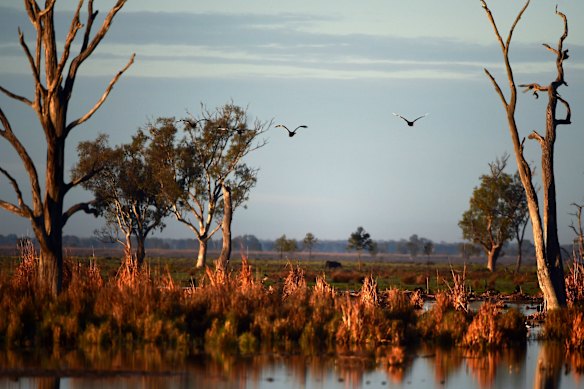
The world-famous Macquarie Marshes depend on closely managed environmental flows in the Murray-Darling Basin.Credit: Nick Moir
Watt said on Thursday that the former Coalition government had for nine years failed the river system with a lack of conservation action.
“Past activities and decisions regarding the Murray-Darling Basin have consequences and it’s why the Albanese government has been so determined to change course,” he said.
Most Viewed in Politics
Loading