3 months ago
22
3 months ago
22
Apple hasn’t got a good answer to that question, at least not yet. Neither has Meta with its considerably cheaper Quest 3S, nor Sony with its PSVR 2. They’ve all built impressive hardware in search of a reason to exist.
The missing killer app
Every transformative technology needs its killer app. Think a use case so compelling it justifies the hardware’s existence. The smartphone had instant messaging and mobile internet. The personal computer had spreadsheets and word processing. The television had, well, television.
VR has … Beat Saber?
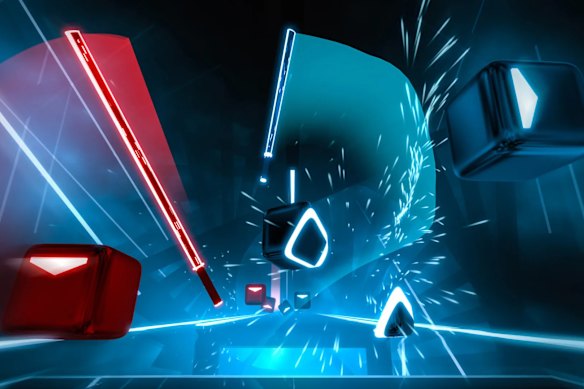
VR has... Beat Saber? Don’t get me wrong. Slashing virtual blocks with lightsabers to thumping electronic music is fun! For about 20 minutes.
Don’t get me wrong. Slashing virtual blocks with light sabres to thumping electronic music is fun! For about 20 minutes. Then your face is sweating, the headset is slipping, and you remember you could be playing a proper game on your PlayStation without looking like a goober. Half-Life: Alyx is a truly great shooting game, as is Superhot VR. But they aren’t great enough to tell your wife: “Excuse me for 30 minutes while I sit in my room alone with a headset on.”
Loading
The most honest review I’ve read was from a T3 writer who admitted that after months of owning a Quest 3S, he simply doesn’t use it. “The reality is that even the most enthusiastic of tech reviewers only has so many hours in each day,” he wrote, “and if a device doesn’t manage to eat some of those up, that’s no shameful thing.”
That’s damning with very faint praise. Tech reviewers are paid to be enthusiastic about technology. We love to excited about flashy new things, especially when they’re – pun fully intended – game changers. When even we can’t find a reason to strap on a headset, what hope is there for regular consumers?
And where VR once commanded billions in venture capital and dominated tech conference keynotes, ChatGPT and its competitors have sucked up all the investment, and most critically, conversations at BBQs and dinner parties. People are talking about AI writing their emails and generating images from text prompts – things they can actually use on devices they already own. Nobody’s asking about the best VR headset to buy.
VR’s fundamental problem isn’t just that it hasn’t found its killer app, it’s that AI found dozens of them first, and it runs on hardware people already have in their pockets. Hard to compete with that.
The physics problem
There’s also a fundamental hardware challenge that no amount of Moore’s law improvements can solve: VR headsets are face computers, and face computers are inherently uncomfortable.
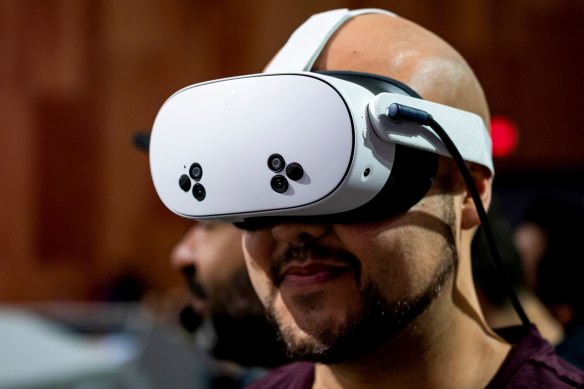
Meta has released a cheaper version of its Quest 3 VR goggles.Credit: Bloomberg
The Vision Pro weighs 725 grams. That’s nearly the same as an iPad Mini, except it’s strapped to your head. Apple’s engineers worked miracles with the new dual-knit band that redistributes weight, but physics is physics. After an hour, your face knows it’s been wearing something.
Meta’s Quest 3S is lighter at 515 grams, but adds the indignity of being tethered to a battery pack in your pocket. Either way, you’re essentially mounting a small computer inches from your eyeballs and asking your neck to pretend everything is fine.
Compare this to regular glasses, which weigh around 20 to 30 grams. That’s the difference between something you forget you’re wearing and something you’re constantly aware of.
Then there’s the resolution problem. To achieve human-level visual fidelity, VR displays need 7100 to 10,000 pixels per square inch. Current headsets manage around 2000. The iPhone 13 had under 500 pixels per square inch, and that screen sits at arm’s length, not millimetres from your eyes.
You can see the pixels if you look for them. You can see the limited field of view. And you can see where the lenses create distortion at the edges.
These aren’t dealbreakers, but they’re constant reminders you’re using technology rather than experiencing reality.
The isolation chamber
Perhaps VR’s most fundamental flaw is philosophical: it requires you to actively block out the real world.
Loading
Every VR headset manufacturer now includes pass-through video so you can see your surroundings without removing the device. Apple calls this “spatial computing” and acts like it’s revolutionary. It’s not. It’s a Band-Aid for the fact that you’ve voluntarily made yourself blind.
It’s socially awkward to game in VR compared to say, sitting on the couch playing PlayStation, which feels much more normal.
This isolation isn’t incidental to VR – it’s the entire point. You’re meant to be in the virtual world, not partially in it. That works fine for entertainment (watching films in VR can be spectacular) but makes VR fundamentally unsuited to most real-world tasks.
Some of the most successful VR applications I found while researching this piece have nothing to do with gaming or entertainment. They’re in the workplace. Take this example: Australian sheep farmers are using VR training platforms to learn climate-resilient farming practices.

Vantari VR uses virtual reality headsets to train doctors, nurses and students.
Start Beyond’s “Your Season Your Success” program delivers over 10,000 training sessions monthly to Australian farmers, teaching them to experiment with different management practices in virtual environments before implementing them in real paddocks. It’s practical, effective, and solves a real problem.
Notice what’s different? These are users who need the technology for something important, who use it for specific training sessions then take it off, and who have institutional support to adopt it. They’re not being asked to integrate VR into their daily lives – they’re using it as a tool for a specific job.
Vantari – an Australian start-up letting surgeons virtually practice complex procedures in a zero-risk environment – is impressive, as is Viewport XR, a Perth-based company that is building high-stakes, high-risk training simulations for the mining and resources sector.
That’s probably VR’s future: a professional and enterprise tool rather than a consumer revolution. Flight simulators, medical training, architectural visualisation – use cases where the value clearly justifies the friction.
The AR alternative
Here’s what does get me more excited: augmented reality in a glasses form factor.
Meta’s Ray-Ban smart glasses don’t have displays yet, but they already feel like the future in a way VR headsets never have. They’re lightweight, look relatively normal, and enhance rather than replace reality. Snap and Google are working on proper AR glasses with displays. Apple is rumoured to have an AR glasses project in development.
The key insight is that people are fine wearing glasses. Billions of people already do. Glasses are socially acceptable, comfortable for all-day wear, and don’t require you to opt out of reality.

Meta chief executive Mark Zuckerberg wears a pair of Meta Ray-Ban Display AI glasses during the Meta Connect event in California.Credit: AP
It’s not difficult to imagine glasses that can display notifications, navigation arrows, or information about what you’re looking at.
Think hands-free video calls where the other person appears life-sized in front of you, or subtitles appearing automatically in foreign countries, or instant translation during conversations.
These applications augment reality rather than replacing it. They’re useful in everyday situations rather than requiring dedicated VR time. They work with how humans actually want to interact with technology.
The future
Virtual reality works, and it’s technically impressive. In the right circumstances, it’s even magical. But not really for everyday use, and not for most people.
After a decade of “next year will be the year of VR,” I’m calling it: the technology has missed its window. Consumers don’t want to voluntarily blind themselves and strap computers to their faces, no matter how impressive the technology becomes.
I think the future of immersive computing isn’t virtual reality – it’s augmented reality delivered through devices that look and feel like regular glasses. When someone cracks that problem (and someone will), we’ll look back at today’s VR headsets the way we look at Google Glass: impressive technology ahead of its time that solved the wrong problem.
Until then, my Meta Quest will sadly continue its primary function: making me feel guilty about spending hundreds of dollars on something I rarely use.
Get news and reviews on technology, gadgets and gaming in our Technology newsletter every Friday. Sign up here.