3 months ago
40
3 months ago
40
Danielle Malgwiand Tanya Gupta,South East

 UEA
UEA
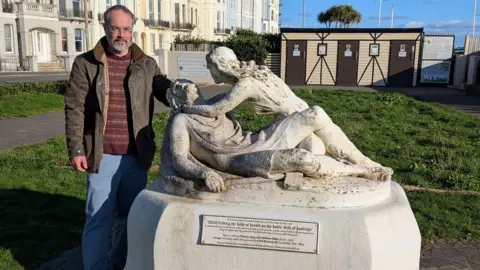
Hastings has a statue showing King Harold's wife Edith finding his body on the battlefield
The tale of one of the most famous battles in English history could be rewritten after an expert claimed he had discovered a missing piece of the story.
The Battle of Hastings, fought on 14 October 1066 on the Sussex coast, saw William the Conqueror defeat King Harold and seize the English throne.
It has inspired works from the iconic Bayeux Tapestry to an eight-part BBC drama last year, but Prof Tom Licence, an expert in medieval history and literature at the University of East Anglia, said he has found 19th Century historians missed an important detail.
Experts from the British Museum and English Heritage said the research – which claims Harold's troops did not march across land but arrived by sea – was exciting.
Licence will put his findings to the test when he presents them to experts at a conference at the University of Oxford on Tuesday.
It comes amid preparations for the Bayeux Tapestry to go on display at the British Museum, on loan from France, following a historic agreement.
 UEA
UEA
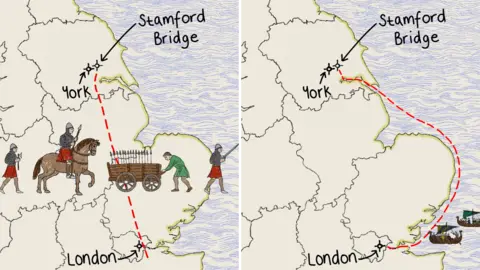
Research has said troops went by sea rather than making a dash over land
Licence's work disputes a claim that Harold forced his men to march nearly 200 miles from Stamford Bridge in Yorkshire to Hastings to defend the country.
He said they arrived at Hastings with a large, active fleet.
For more than two centuries, historians had repeated a misinterpretation of the Anglo Saxon Chronicle – one of the earliest written records of English history, he said.
The earliest editions were assembled in the 9th Century but continued to be updated with one version containing an account of the year 1154.
Licence re-examined the chronicle, which survives today in nine manuscript editions, alongside other 11th Century sources, to correct an error he said was popularised by the Victorians.
"Harold was not a reactive, exhausted commander," he said. "He was a strategist using England's naval assets to wage a coordinated defence."
The expert said: "The idea of a heroic march is a Victorian invention that has shaped our understanding, or misunderstanding, of 1066 for far too long."
He said it was not a "desperate dash over land" and was instead a sophisticated land-sea operation.
Nothing in the Bayeux Tapestry had been found wrong in light of his findings, he said.
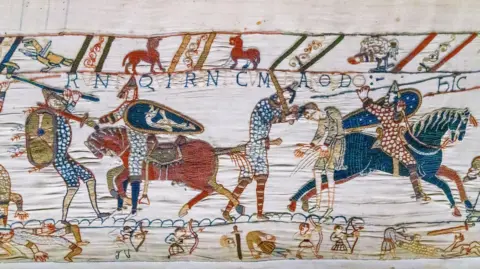 Getty Images
The Bayeux Tapestry goes on display in London this September
Roy Porter, who oversees Battle Abbey and the Hastings battlefield for English Heritage, said Licence's work showed the "immense" value of testing received wisdom.
He said: "It's exciting to consider that Harold's response may have been far more sophisticated than previously understood, and William's awareness of this may have informed when he chose to fight."
At the British Museum, Prof Michael Lewis, curator of the Bayeux Tapestry Exhibition, said Licence had come up with a "fascinating discovery", that Harold took "an easier, more logical, trip south by ship to meet Duke William in battle".
He said he hoped it would inspire people to see the Bayeux Tapestry while it is in London.