3 months ago
7
3 months ago
7
A major battle dividing the electric vehicle sector in Victoria has been exposed, as a state parliamentary inquiry considers how to build the charging network required to keep the next generation of cars on the road and who should foot the bill.
The Victorian inquiry into the electricity supply needed for the EV network is currently considering who should own and operate publicly available pole-mounted chargers across the state, assessing the rate at which public chargers are being installed and what role the companies who own the state’s poles and wires must play.
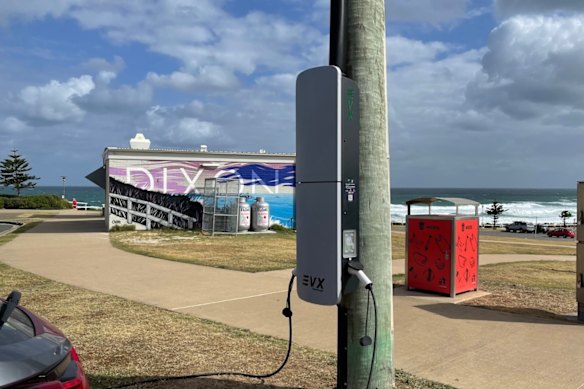
Australia’s first power pole-mounted EV charger in Merewether, NSW.Credit: Facebook
Another key aspect being hotly debated is how to pay for the expanding network. Though publicly available pole-mounted chargers could soon become one of the most common ways to charge EVs outside the home, both sides warn that higher bills for customers and the availability of chargers are at stake.
One suggestion being considered by the inquiry is to slug consumers with higher energy bills, even if they do not drive an EV.
Over the past two years, the number of battery or fuel-cell electric cars in Victoria grew by almost 240 per cent, from 20,125 in January 2023 to 68,370 in 2025.
Loading
Electricity distributors say they want to help expand the EV network by building public chargers along the poles and wires they currently own. But doing so will require the Australian Energy Regulator to decide how this is policed, including whether these devices should be counted as part of the companies’ official infrastructure, also known as their “regulated asset base”.
If this were the case, it would potentially allow them to recoup costs through consumer energy bills or to charge the government.
Similar proposals in New South Wales have sparked a backlash, where the Australian Financial Review revealed electricity networks had proposed a model where taxpayers would pay $135 million for 22,500 chargers across the state. They would not initially be charged for maintenance but could pay up to $1 on their energy bill by 2034.
An alternative proposal was charging households between $1 and $2 per year, irrespective of whether they drive an EV.
The National Electricity and Communications Association, the peak body for electrical contractors including those installing private charging systems, has used the Victorian inquiry to oppose the NSW model, saying it would strengthen existing monopolies and drive up bills.
In their submission, provided to The Age, the peak body argued there are enough private investors willing to build the public equipment at their own expense which, combined with improvements to charging at home, made it unnecessary to charge for them on household bills.
“Whilst kerbside charging is definitely part of the solution to EV uptake, the urgent mass deployment of monopoly owned equipment is not an effective response,” their submission said.
Kent Johns, NECA’s head of government relations and policy, told The Age regulatory failures were holding back efforts by the private sector to boost EV charging, damaging investment and pushing up costs for consumers.
Loading
By comparison, electricity networks have alleged they are being hindered by national “ring-fencing” rules – which govern what activities are regulated and what can be competitive.
In Victoria, CitiPower, Powercor and United Energy [CPU] have successfully applied to the Australian Energy Regulator for a waiver of these rules to run a trial that will allow it to own, install and maintain 100 kerbside EV chargers.
But the regulator did not approve making these chargers part of their regulated asset base, meaning the companies must fund the $1.2 million trial alone and without passing the cost on to customers.
CPU head of customer connections Daniel Bye said the trial would help inform their preferred approach and leave open the option of a model where users pay for the infrastructure. He also said they had proposed rolling out one type of standard charger across the network, then companies could compete “at the socket level” to drive down consumer costs.
But Sean McGinty, the co-founder of private charger company EVX, said distributors already controlled 90 per cent of costs involved in charging and there was a good reason they were not currently allowed to own and compete on infrastructure involved.
“The private sector has delivered kerbside charging in NSW in spades, and can do the same in Victoria if the DNSPs [distributors] work with us rather than being obstructive,” he said.
Emma Shanks, chief external affairs officer for Energy Networks Australia, said some NSW modelling showed improving use of the energy grid could save households $16 a year, offsetting additional annual costs.
She said every state would be different, and any proposal would have to stack up financially and be approved by the regulator.
“It’s not a free-for-all. It’s not like, all of a sudden, we flick a switch, change a rule, and they’re just going to be able to put them everywhere,” Shanks said.
“They actually have to use the regulator in a way in which it gets endorsed and has really good oversight.”
The Morning Edition newsletter is our guide to the day’s most important and interesting stories, analysis and insights. Sign up here.
Most Viewed in Politics
Loading