
 5 months ago
76
5 months ago
76
11 minutes ago
Lucy Hooker,Business reporterand Esyllt Carr,Business reporter

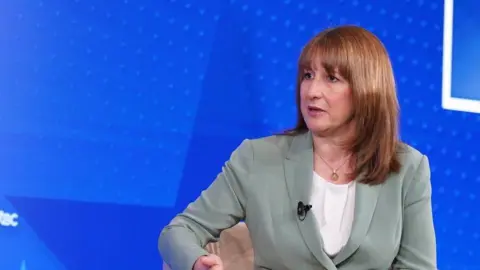 CNBC / Aaron Clamage
The US made a "mistake" by ending diplomatic negotiations with Iran and entering into military conflict, Chancellor Rachel Reeves has said, voicing sweeping criticism of the war..
"The best economic policy now, not just for the UK, but globally, is to de-escalate," the chancellor told CNBC's Invest in America forum.
The UK government has said it will not play any role in the US's military blockade of the key Strait of Hormuz, designed to put additional pressure on Iran.
Asked whether the UK and US's growing differences over the conflict had affected the "special relationship" between the two countries, Reeves said no, but added: "Friends are allowed to disagree".
Reeves said she was "not convinced that this conflict [had] made the world a safer place" adding that as well as the immediate impact on the UK economy, there would be long-term economic pain globally, because of the damage done to oil and gas facilities in the Middle East.
Energy prices have soared since the war began more than six weeks ago, causing a sharp reduction to traffic through the key Strait of Hormuz shipping route.
Reeves told an audience at the Invest in America Forum in Washington DC where she's been attending the IMF's annual conference, that while she shared the Trump administration's strong dislike of the Iranian regime, it was a question of how best to achieve change.
She said Iran did not currently have a nuclear weapon and the best way to stop them was through diplomacy.
"There was a diplomatic channel open, conversations, formal discussions were happening," she said.
"I think it was a mistake to end those and to enter into conflict, because I'm not convinced that we are safer today than we were a few weeks ago," she added.
There had been no clarity over the last six weeks over the US's objective in pursuing the conflict, she said, whether it was to prompt regime change, ending any Iranian nuclear weapons programme, or prompting diplomatic negotiations, which were already taking place before the conflict.
The US has recently focused its rhetoric on reopening the Strait of Hormuz to shipping, so that oil and gas exports can get through.
"If that's the aim, well it was open a few weeks ago," she said.
She said the UK prime minister, Sir Keir Starmer, and French President Emmanuel Macron would be hosting talks on Friday to discuss how to help navigation through the Strait of Hormuz in the event of a "proper ceasefire".
"We are ready to play our part. But the Strait of Hormuz was open, there was no tolling, a few weeks ago," she said.
Despite her outspoken criticism the chancellor said she believed the US and the UK had "a very good relationship" and pointed to the upcoming visit of the King.
Pressed further on the relationship, Trump said it had "been better, but it's sad".
"It's the relationship where when we asked them for help, they were not there. When we needed them, they were not there," he said.
"And we gave them a good trade deal. Better than I had to. Which can always be changed."
In its latest World Economic Outlook, the IMF cut its estimate for UK growth this year to 0.8%. In January, before hostilities began, it had forecast growth of 1.3%.
Reeves acknowledged the significant impact of the conflict on the UK as a net importer of gas, saying: "Our growth will be higher and inflation will be lower if the conflict comes to an end."
However she added: "We beat the forecasts for the UK economy last year. I'm confident we'll beat them again."
On Tuesday, Reeves told the Mirror she was feeling "very frustrated and angry that the US went into this war without a clear exit plan, without a clear idea of what they were trying to achieve".
Asked why, she told the paper it was because of the economic impact on UK families and businesses.
US Treasury Secretary Scott Bessent earlier told the BBC a "small bit of economic pain" was worthwhile for long-term international security.
Bessent told the BBC he was less concerned about the economic hit than the risk Iran posed to global security, adding that US and Israeli action had removed the "tail risk" of Iranian nuclear strikes against Western countries.
The UK government has said there is "no assessment" that Iran is trying to target Europe with missiles.
Additional reporting by Jemma Crew

















































