
 3 months ago
64
3 months ago
64
53 minutes ago
Ella Kiplingand Sima Kotecha,Senior UK correspondent

 Getty Images
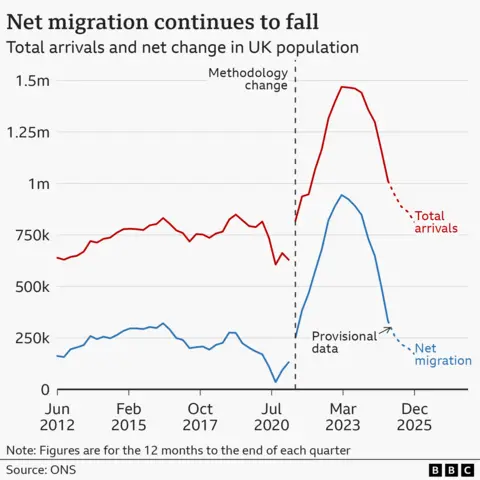
Migration added 171,000 people to the UK's population last year, almost half the number seen in 2024, according to new Home Office data.
The figure is at its lowest level since 2012, excluding the Covid pandemic - but Prime Minister Sir Keir Starmer has said there was still "more to do".
The data also reveals that 93,525 people claimed asylum in the UK in the year to March 2026 - down 12% on the year prior, but still more than double that seen just before the pandemic.
Home Secretary Shabana Mahmood said the statistics showed the government was "restoring order and control to our borders", while her counterpart Chris Philp argued that Labour needed to "go further".
The Office for National Statistics (ONS) said net migration continued to fall to levels last seen in early 2021 - when a new immigration system was introduced and Covid travel restrictions were in place.
Sarah Crofts, the body's deputy director, said: "The recent decrease is driven by fewer people arriving from outside the EU, particularly for work."
Following the release, the Home Office wrote on X: "We are ending Britain's reliance on overseas labour, ensuring migrants contribute more than they take and are increasing the removal of illegal migrants and foreign criminals."
Sir Keir said the data showed that his government was "delivering", adding: "I know there's more to do, we're introducing a skills-based migration system that rewards contribution and ends our reliance on cheap overseas workers."
Policy changes from early 2024 under the former Conservative government are likely to have made an impact on the net migration figures. The Labour government has retained the measures and in some cases expanded on them.
They include most overseas students being restricted from bringing family members to the UK and care workers being restricted from bringing dependents with them.
Ministers also increased the general salary threshold for those arriving on skilled visas from £26,200 to £38,700, and increased the minimum income requirement to sponsor someone for a family visa by more than £10,000.
After Brexit, there was a large increase in immigration. Conservative ministers relaxed salary thresholds and some other routes for health and social care workers to plug shortages in the workforce.
Critics of the previous government dubbed it the "Boriswave", with some insiders telling the BBC that the 2024 measures helped bring down those numbers.
The current government has recently announced further plans to reduce net migration even further, including migrants being required to speak English to A-level standard.
It has also announced another increase in the income threshold for a skilled worker visa to £41,700.
Last summer, asylum hotels became a key political talking point, sparking protests around the country in areas such as Norwich, Epping and Mold.
The Home Office's new figures show that the number of asylum seekers living in hotels while waiting for their claims to be processed fell to 20,885 as of March 2026.
This is down from 30,657 people in December 2025 - and the highest monthly figure of 56,000, recorded in September 2023 under the previous Conservative government.
The home secretary said the statistics showed that "real progress has been made" but that there was "still work to do".
Mahmood added: "That is why I am introducing a skills-based migration system that rewards contribution and ends Britain's reliance on cheap overseas workers."
Home Office figures reveal that 93,525 people claimed asylum in the UK in the 12 months to March 2026, down by 12% on the year before.
But this is still more than double the number just before the pandemic.
In the year ending March 2026, there were 43,806 detected arrivals via illegal routes, with small boat crossings accounting for 90% of these arrivals.
Ben Brindle, a researcher at the University of Oxford's Migration Observatory, said the economic effects of net migration depended on who was and was not migrating.
He said migration of groups "that make positive or broadly neutral economic impacts" was down, whereas "asylum-related migration remains high".
"Since refugees have lower employment rates and often need a lot of support from the state, this means that the composition of recent migration has probably become less favourable from an economic perspective," Brindle added.
In total, the ONS said that just over 800,000 people immigrated to the UK in 2025, down by 20% on the year before.
Meanwhile, the ONS found an estimated 642,000 people left the UK to live in another country long-term in the year to December 2025.
Its deputy director explained that, while the number of those emigrating had been increasing, there were "early signs it may now be starting to fall, though it is too soon to say whether this will continue".
Shadow home secretary Chris Philp said: "British citizens are leaving the UK on a massive scale, driven away by Labour's high taxes. Yet non-EU immigration, mainly from low-income countries, remains far too high."
He said Labour must "go further" by reforming indefinite leave to remain - or permanent residency status - "before their hard-left flank forces them to abandon it altogether".
Philp added that a Conservative government would introduce measures such as a binding annual immigration cap at a very low level, as it wanted a "small number of highly skilled migrants and no low-skilled migration at all".
Reform UK MP Robert Jenrick, who defected to the party from the Conservatives, branded the emigration of 246,000 British nationals "the Starmer exodus".
In the year to December 2025, 110,000 British nationals arrived in the UK, meaning the net difference between emigration and immigration was 136,000.
"Many are entrepreneurs, investors, small business people. It's the Starmer Exodus," he said in a post on X.
Despite claims of a "Starmer exodus", the ONS said the number of British nationals emigrating has been "broadly stable" in recent years - with 257,000 leaving the UK in 2024 and 255,000 in 2023.
The Liberal Democrats meanwhile pinned the number of British nationals leaving the UK on Brexit, calling for the government to work more closely with its European allies.
Max Wilkinson, the party's home affairs spokesperson, said: "It's no surprise that Brits are leaving thanks to the threat of Reform and the Tories' disastrous Brexit, which has wrecked our economy and put pressure on public services.
"The government urgently needs to get a grip - not least by working more closely with our European partners - to ensure we have an immigration system that is fair, controlled, and delivers prosperity too."
Additional reporting by Robert Cuffe and Rob England, BBC Verify

















































