
 5 months ago
77
5 months ago
77
10 minutes ago
Jemma CrewBusiness reporter

 EPA/Shutterstock
The UK economy saw its biggest monthly rise in February in more than two years, official figures show.
The Office for National Statistics (ONS) said the economy grew by a faster-than-expected 0.5%, while it revised its estimate for January up to 0.1% after previously saying the start of the year had seen no growth.
The figures cover a period before the outbreak of the US-Israeli war with Iran on 28 February, which has caused a major energy shock and experts warn risks a global recession if it is prolonged.
This week the International Monetary Fund (IMF) cut its estimate for UK growth this year, warning it was set to be the hardest hit of the world's advanced economies.
Most economists had forecast GDP to rise by just 0.1% in February. The monthly increase is the biggest in just over two years - January 2024 also saw the economy grew by 0.5%.
The ONS said the key services sector - which accounts for more than three-quarters of the economy - grew by 0.5%, which was the fourth consecutive monthly rise.
Production output also grew by 0.5% in the month, and construction rose by 1.0%.
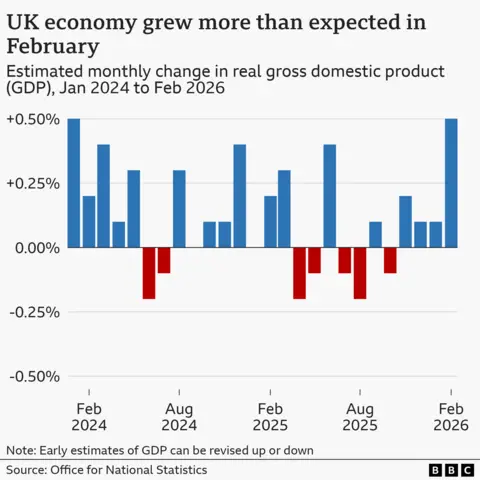
In the three months to February, a less volatile measure in comparison to the monthly numbers, GDP also grew by 0.5% - up from 0.3% in the three months to January.
The National Institute of Economic and Social Research called the latest expansion in the economy "sizeable" but said it expected slower growth in March.
Associate economist Fergus Jimenez-England said: "Unfortunately, the latest energy price shock has likely pulled the rug on this momentum, with another year of above-target inflation and a softening labour market likely to come."
Ruth Gregory, deputy chief UK economist at Capital Economics, said the "bumper" growth in February was "probably already extinguished" by the Iran war.
But she said it was encouraging that some of the sectors most exposed to the rise in energy prices had performed well, such energy-intensive mining, transport and retail.

















































