3 months ago
25
3 months ago
25
By Tom Sharpe
December 28, 2025 — 1.37pm
On December 22, at his Mar-a-Lago resort, US President Donald Trump unveiled plans for a new “Trump-class” battleship as the centrepiece of his “Golden Fleet” initiative. We now have renderings of the proposed USS Defiant – a 30,000 to 40,000-ton behemoth, possibly nuclear-propelled and armed with hypersonic missiles, railguns, lasers and nuclear-tipped cruise missiles. Trump declared these vessels would be “the fastest, the biggest, and by far 100 times more powerful than any battleship ever built”.
Starting with two ships, the goal is to have 20 to 25. Timelines for completion are not clear, but the first hulls in the “mid-2030s” is suggested.
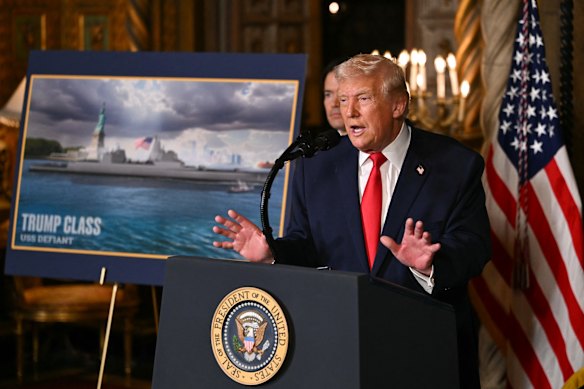
Based on the renderings and descriptions, this new proposal by US President Donald Trump resembles a large guided missile cruiser.Credit: AFP
Reactions have been enthusiastic from the President’s personal MAGA base, generally with some caveats. Others have shown bemusement, given the other more obvious priorities for the US Navy, and still others have ridiculed the plan. Trump talking about it in terms that an eight-year-old would find patronising and calling it after himself led many into the third camp. I’m trying my best to remain in the middle group.
Historically, the word “battleship” is derived from the “line-of-battle ship”, the “ship of the line” of the days of sail. These sailing ships, with two or three decks of cannon – HMS Victory, still preserved in commission at Portsmouth, is an example of the class – were deemed powerful enough to stand in the line of battle during a major fleet action. Smaller warships such as frigates (sometimes known as “cruisers” back then) could not stand in the line and were not battleships.
Then came the days of steam, armour and gun turrets. The new battleships now carried heavy armour and came to devote most of their carrying capacity to the biggest guns possible – they were “all big gun” designs, the first being the British Dreadnought class of 1906. This same design philosophy lasted into World War II, with gun calibres escalating from 12-inch to 15- and 16-inch and finally to the enormous 18-inch weapons mounted in the Japanese super-battleships Yamato and Musashi.
Not every detail of the Trump class is clear, but it seems the two main features of that last generation of battleships – armour and big conventional guns – will be lacking, which is reasonable enough as they aren’t much use in the modern world. Based on the renderings and descriptions, this new proposal actually resembles a large guided missile cruiser, probably closer to Russia’s Kirov class rather than an Iowa.
The Iowa class (which Trump seems to have in mind) and the Kirov class are two of the best-looking warships ever built. You can see why a mash-up might appeal to someone striving for form over function. It’s the function that is the problem.
This mega-cruiser/battleship concept flies directly in the face of all that.
Nearly all modern naval doctrine and thinking is heading in the direction of dispersal over concentration. Proliferating high-speed missiles, drones – above, on and under the water – alongside advanced sensors and communications all push us towards a dispersed, distributed force. This also increases redundancy and our ability to be in multiple places at once. Combine this with universal budget constraints, yard shortages for building large hulls and crewing leanness, and the direction of travel is obvious. This mega-cruiser/battleship concept flies directly in the face of all that.
The other issue is fleet balance. For this, a navy needs a combination of high and low-end capabilities, both crewed and uncrewed. It’s ironic that one of the first US strategists to openly discuss this hi-lo mix was Admiral Elmo Zumwalt whose name was given to a class of large, high-end destroyers which became so complex it had to be cancelled after just three were built. You have to be very optimistic not to see how the Trump class could go the same way.
At the high end, the US Navy excels with its huge aircraft carriers and amphibious ships – although by hull numbers at least, the Chinese Navy is becoming a serious adversary. Then there are surface warships and attack submarines. Here, again, the US Navy is leagues ahead, although some of their destroyers, whilst still excellent, are ageing, and their ancient missile cruisers are on the way out. These old Ticonderoga-class cruisers are essentially larger destroyers with more Vertical Launch Systems (VLS) and a refined ability to direct area air defence. Destroyers and dispersed systems can handle these tasks, and for me, that would take priority over a new class of cruiser or battleship.
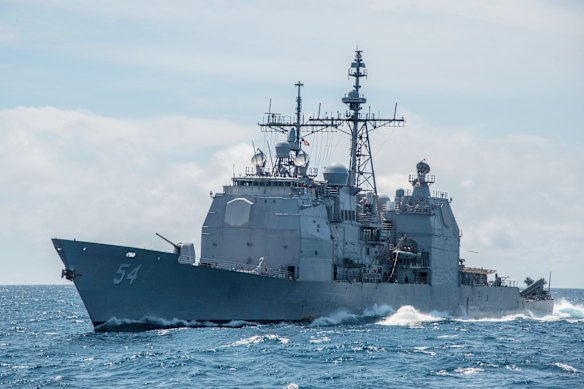
A Ticonderoga-class guided-missile cruiser USS Antietam sails in the South China Sea.Credit: US Navy/AP
Below this, the US Navy starts to look thin. They don’t have a frigate – a specialist anti-submarine warfare (ASW) ship – and the Russian, Chinese and rogue conventional and uncrewed threat demands this now more than ever. The US Navy does need a large number of lower-end cutter-type ships, but it also needs dedicated submarine hunters. This large and important gap in the US Navy remains.
Navies and often external analysts tend to obsess over high-end roles, writing off anything that isn’t peer-combat capable. But this ignores the fact that naval forces spend nearly all their time setting the conditions to avoid conflict. This is why mass and presence are so important. It has to be backed up by the high-end stuff if the deterrent effect is to be maximised, but it’s frustrating to see how many people write off things like the cutter plan as useless before seeing what it can do.
Against all this, can a case for an American battleship/cruiser be made? Yes, it can. This ship represents ambition, presence, and symbolism – all good, positive things. At a more operational level, it would house a vast quantity of missile launch tubes and large radars optimised for hypersonic missile tracking. It would have lots of room for useful guns in calibres suited to anti-drone use – and maybe one day electrically powered railguns, if that technology ever matures. The US has given up trying to build railguns, but Japan is still working on them.
If nuclear propulsion is chosen, the new battlewagon could have near-unlimited range and massive power generation. The power would not be for greater speed, but for data processing, electronic warfare, laser weapons and possibly railguns. New battleships could take on the fleet Command and Control function currently provided by the ageing Mount Whitney class.
Loading
However, I sincerely doubt that any new battleship could survive a hit from the champion ship killer, the heavyweight torpedo. After all, the old armoured battleships could be sunk by torpedoes. They could also be sunk by aircraft bombs, and there are plenty of anti-ship missiles out there that hit just as hard as bombs. So the Trump class ships would need layers of defence like those provided for aircraft carriers: and the outer layer is provided by the carrier’s fighter jets, which the battlewagon would not have.
And while it is true that the proposed battleships would have useful things, it would usually make more sense to break them up across smaller, more numerous platforms. So that leaves us with presence and prestige as the only unique things the battleships would bring to the party.
Then, estimates suggest these ships will cost $US9 billion per hull if made in numbers: $US14 billion for the first one. That’s the same as a Ford class supercarrier, even more if nuclear propulsion is chosen. That’s a lot of money in one hull when most of what you want it to do can be done better and more cheaply by something else. What price prestige? This before the matter of yard capacity to build it is discussed, which has even the most ardent optimists scratching their heads. Or pulling their hair out in frustration at what has become of US shipbuilding.
Meanwhile, China, with impeccable and probably not coincidental timing, has just permitted the circulation of images of a container ship – Zhong Da 79 – fitted with containerised VLS (around 60 missile tubes), radars and close-in weapons systems (CIWS – auto gun systems that can take out incoming missiles and drones). The Chinese have got the dispersal memo. The weight of fire, deception and sheer numbers this option could provide is deeply worrying. Their direction of travel is clear, albeit they are also continuing with high-end warship design and build at a high rate. As a concept, arming merchant vessels has been around for decades and has been trialled by both US and British navies. Until now, no one has taken it seriously.
Loading
The Chinese threat and the good health of the US Navy concerns us all. The mistakes of the Zumwalt, Littoral Combat Ship and Constellation classes made us all less safe, not just the US Navy. All three were actually needed to a greater or lesser degree. All three were botched in the delivery to the point of early cancellation, and billions were wasted.
The trouble with the Trump ship is it feels like a fourth mistake waiting to happen. If their yards were churning out frigates and patrol vessels and had plans for the replacement destroyer, and the President wanted battleships as a status symbol on top of that, that would be fine. The problem is that this project is likely to divert money and yard capacity away from things that are needed more.
Sipping deep from the Christmas cup of optimism, maybe this idea, and the presidential impetus behind it, will breathe new life into the US shipbuilding system, even if the golden mega-ship never materialises. I hope so, because that is everyone’s business.
Tom Sharpe was a British Royal Navy officer for 27 years, commanding four warships.
Telegraph, London
Get a note directly from our foreign correspondents on what’s making headlines around the world. Sign up for our weekly What in the World newsletter.
Most Viewed in World
Loading