3 months ago
15
3 months ago
15
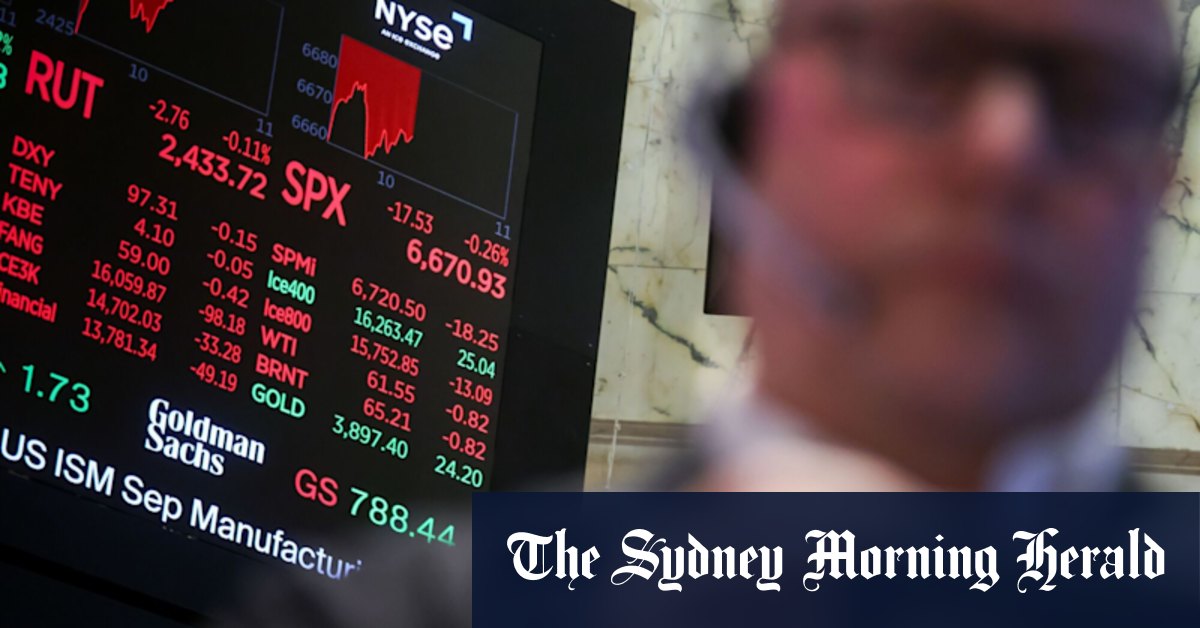
Massive bets on an artificial intelligence (AI) revolution have driven rapid growth in US tech giants, record stock market highs and a “wealth effect” that is driving spending among the nation’s wealthiest households.
Signs of trouble
But underneath the AI sheen, much of America’s real economy is on the rocks. Lay-offs have soared, consumer confidence has plummeted and poorer households are becoming increasingly overburdened with debt.
The University of Michigan’s index of consumer confidence dropped to 50.3 in November, down from 71.8 a year earlier, when Trump had just won the election, and close to the all-time record low of 50 seen in June 2022, during the worst of the post-pandemic inflation surge. The lowest the mark fell during the global financial crisis was 55.3.
Federal Reserve governor Christopher Waller last week pointed to the slump in confidence as a possible harbinger of recession, amid what he called “eye-popping” lay-off announcements.
More than 1 million US workers were laid off in the first 10 months of the year, up 65 per cent on the same period in 2024, according to a report by Challenger, Gray & Christmas, a firm that helps laid-off workers find jobs.
In October alone, job losses totalled 153,000. That number was up by 175 per cent year-on-year and was the highest figure for any October since 2003.

American consumers are grappling with cost-of-living pressures.Credit: Bloomberg
“We’re very busy. We’re anticipating continued increased lay-offs, at least through the end of the year and the first quarter,” says Andy Challenger, chief revenue officer at Challenger, Gray & Christmas.
“Whether that turns into a full-blown recession is a question that I don’t have the same answer for, but it is clearly a possibility. And there’s enough data, I believe, being presented for that to be a serious possibility.”
Major companies that have announced job cuts include Paramount, retailer Target, FedEx, Amazon – which is getting rid of 14,000 workers – and UPS, which has cut 48,000 jobs so far this year.
Loading
Waller warned that job losses could mean “more acute” problems for the US economy as a whole, given many of those at the sharp end are lower-income households which are increasingly struggling with debt.
The share of student loans that became 90 days delinquent between July and September soared to a record 14.26 per cent, according to data from the Federal Reserve Bank of New York. The share of seriously delinquent car loans is at a 15-year high.
In the subprime “auto loan sector” – meaning car loans to people with poor credit ratings – delinquencies have hit their highest level since at least 1993.
If borrowers lose their jobs, they will find it even harder to pay back their loans.
“Financial stress, down market is my first concern,” says Joe Brusuelas, chief economist at RSM US. “Everyone’s going to be watching delinquencies and on auto loans in particular.”
New figures from the Bureau of Labor Statistics on Thursday provided some relief, showing the economy created 119,000 jobs in September, more than double the 50,000 economists were expecting.
However, July and August payrolls were revised down from 79,000 to 72,000 and from 22,000 to -4000, respectively. The unemployment rate also edged up to 4.4 per cent, up from 4.3 per cent.
Goldman Sachs believes the US economy lost 50,000 jobs in October, as government workers laid off as part of Department of Government Efficiency (DOGE) cuts hit the end of their deferred resignation periods.
Job numbers are first warning
Brian Coulton, chief economist at Fitch Ratings, argues jobs have traditionally always been the most important indicator of the US economy’s health.
In Europe, where workers have more employee protections, job numbers are typically a delayed indicator. But in America, where employers can respond much more quickly to the economic environment, bad job numbers are normally one of the first warning signs for a downturn.
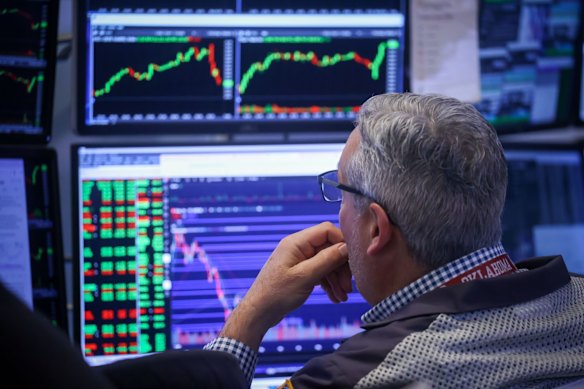
Fears of an AI bubble are hovering over Wall Street. Credit: Bloomberg
Yet much of the US economy seems somehow immune from the downturn. Consumer spending has slowed but is still rising. Goldman Sachs says GDP is on track to rise by 3.8 per cent on an annualised basis in the third quarter.
In August, Barclays’ models showed a 50 per cent chance of a US recession by 2027 – a reading that is unchanged because the shutdown has meant there has been no new government data to update it with.
Loading
However, Jonathan Miller, senior US economist at Barclays, said the model might be overestimating the significance of the jobs data because it did not account for a dramatic slowdown in labour supply.
This is happening because of Trump’s immigration crackdown. Jobs growth may be slower partly because there are fewer new workers coming into the labour market, rather than because firms are simply not hiring.
“In isolation, if I saw as much of a slowing in labour income as I’ve seen over the last half year or so, I would definitely be worried about a recession,” says Miller. “But it’s not obvious that this is something that pulls the overall economy into weakness.”
AI sheen
Weakness in the jobs market is also being concealed by the AI-fuelled stock market boom.
Even after the share price falls this month, the US benchmark S&P 500 is still up by more than 13 per cent since the start of the year. Rich households have much of their wealth in shares and these people feel richer.
“That helps to explain the disconnect between slowing labour income and actually still decent consumption. It’s a slightly uneasy narrative, but I do think that’s what’s going on,” says Coulton.
Jonathan Pingle, chief US economist at UBS, wrote in a client note this week that the only things growing in the US economy are investment in AI and spending by higher earners, which in turn is supported by the AI-fuelled stock market surge.
Without these two factors, American GDP would have climbed by just 0.2 per cent in the year to June instead of the 2.1 per cent GDP growth recorded.
Loading
“Real residential investment has been declining outright. Real non-residential construction has been declining outright. Real government spending and investment have been declining outright, and before the government shutdown,” Pingle wrote.
“A decent chunk of the US economy is in recession.”
The narrow nature of US growth also means the country is particularly vulnerable to any slump in the AI market, fears of which have wiped more than $US1 trillion off US equities last week.
Pingle added: “If there is an equity bubble, and it bursts, for the real economy, look out below.”
Telegraph, London
The Business Briefing newsletter delivers major stories, exclusive coverage and expert opinion. Sign up to get it every weekday morning.