3 months ago
35
3 months ago
35
Opinion
January 24, 2026 — 5.37am
January 24, 2026 — 5.37am
Australian Open with 4K on Stan Sport.
Every match, live & on demand.
Thursday night and there was Stan Wawrinka, 40, peeling off one single-handed backhand after another to defeat a rival young enough to be his son. France’s Arthur Gea, 21, wilted with cramps in the fifth-set tiebreaker. Stan looked fresh as an Edelweiss. He jokingly promised the crowd he would share a beer with them. And that backhand, what a thing of beauty.
Wawrinka’s dad is a social worker and his mum is a biodynamic farmer. He grew up on the farm they run with a staff of people with intellectual disabilities and drug and alcohol addictions. A late maturer, he won three grand slam tournaments including the Australian Open in 2014, beating Novak Djokovic in the quarters and Rafael Nadal in the final.
His persistence in 2026 is a reminder that the great rivalries in tennis aren’t isolated duels; their greatness depends on what lies beneath, who constitutes the next level down, who the greats have to beat before they get to the top.
Will the Carlos Alcaraz-Jannik Sinner rivalry in men’s tennis ever put the hook in fans the way previous rivalries did? It’s too soon to tell and maybe too old and crusty to ask, but so far all it has going for it is sheer excellence, tennis raised to the highest level, and that’s not enough.
A great rivalry needs more than just two weeks of everyone waiting to see another Alcasinner final. Amazing – there’s no other word – as those matches have been, a grand slam needs more turns and surprises on the way there.
Between 2003 and 2023, the Djokovic-Rafael Nadal-Roger Federer cartel won 66 of 81 grand slam finals, or 81 per cent of the tournaments played. It was as astonishing a dominance as any individual sport has ever known.
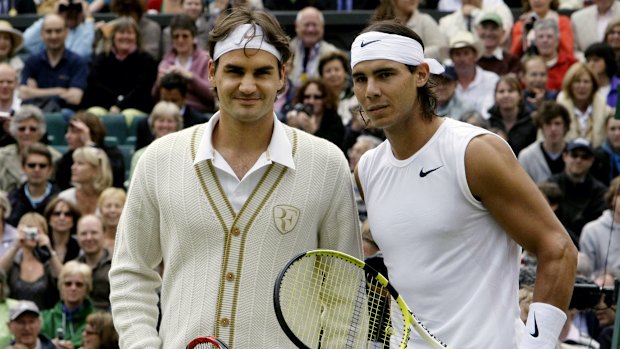
Roger Federer with Rafael Nadal before the Wimbledon men’s singles final in 2008.Credit: AP
In their prime, Pete Sampras and Andre Agassi won 44 per cent of the grand slams; Bjorn Borg and John McEnroe 41 per cent; the four men who dominated the period in between, Ivan Lendl, Mats Wilander, Boris Becker and Stefan Edberg, won just over half the grand slams between them.
Even Serena Williams, the GOAT of women’s tennis, won 32 per cent of the grand slam finals between her first in 1999 and her last in 2017.
By contrast, Alcasinner have won 100 per cent, every grand slam final, of the past two years. Where one has won, the other has mostly been at the other end.
Even in a short period, tennis has never seen anything like it. They have raised tennis to an unknown level. But there’s the rub. The flipside of supremacy is unpredictability. Do Alcasinner threaten to crush the glorious uncertainty out of their sport?
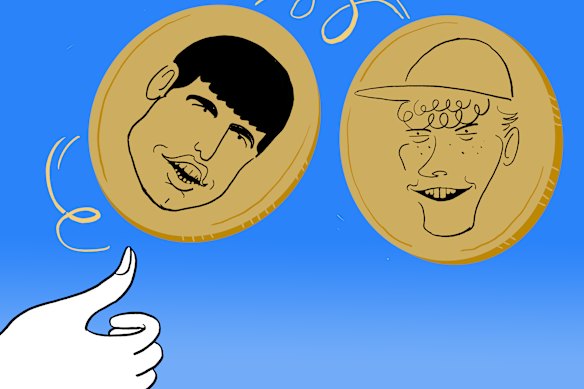
Jannik Sinner and Carlos Alcaraz have dominated men’s tennis – but is their rivalry as compelling as those that came before?Credit: Simon Letch
The Federer-Nadal-Djokovic hegemony was interrupted by players who would have been megastars in any other era. Wawrinka and Andy Murray each won three slams; Juan Martin del Potro and Marin Cilic must have cursed their stars to be born at the wrong time; Daniil Medvedev, no doubt, still is. No sooner had he outlived Djokovic than he was overwhelmed by Alcasinner. Little wonder he thinks the world’s against him.
There was repeated tension, drama and personality in the Federer-Nadal-Djokovic era. Federer had to overcome his ferocious perfectionist’s temper before it derailed him. Djokovic always seemed down and out with injury by the third round, and triumphed with the best defensive game of all time. Nadal was the ultimate grinder, sandpapering from the back court, an overdog in achievement but an underdog by temperament.
Everyone had their favourite of the Three, preferences formed as their personalities revealed themselves during struggle. Struggle was the key ingredient. Aside from a brief Federer golden age before Djokovic arrived, even for the Three nothing ever seemed to come easy. They owed their popularity to the high quality of what and who they had to overcome.
We’re still waiting for Alcasinner to find this personal definition. They can only be as good as who they need to beat, but who have they beaten? The next stratum seems sunk in despair.
Men’s tennis is suffering such a personality deficit that Nick Kyrgios’s confections still rate.
Alexander Zverev, already hard to sympathise with after his domestic violence case, gets more hangdog the closer he gets to Alcasinner. The rest of the top 10 are filled by Alcasinner debris. Beneath them are faces like Stefanos Tsitsipas and Casper Ruud, once great hopes, now with the stuffing knocked out of them.
Much as Australians wish for Alex de Minaur, for him to beat Alcaraz and then Sinner to win a grand slam is a test of hope that has no previous evidence to justify it. De Minaur is an entrenched world top 10 player but, like nearly everyone else in the top 10 or 20, he has not played in a grand slam final, never mind looked like winning one.
The exception here is Djokovic. But if, at 38, he’s still the best bet to beat the duopoly – just like Stan Wawrinka showing greater endurance than a 21-year-old – isn’t that a cause for worry?
Heavily curated social media and “behind the scenes” documentaries like Break Point have also failed on their promise to add personal texture. The women’s game at least has a bit of friction, on and off the court; the women’s side of the Australian Open doesn’t feel like two weeks of waiting for the obvious final.
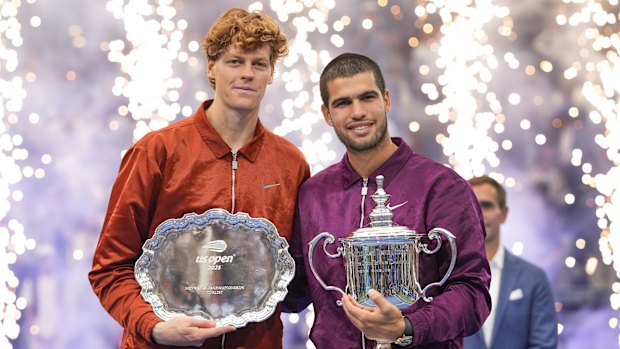
Dominant duo: Jannik Sinner and Carlos Alcaraz.Credit: AP
Meanwhile, men’s tennis is suffering such a personality deficit that Nick Kyrgios’s confections still rate.
Thanks to social media, we can see that Alcaraz dyed his hair and is a good golfer. Sinner went to a restaurant. He probably could have been an Olympic skier. Even his drugs case has been litigated into a beige blur, depriving us of the stirrings of villain-hatred. The most interesting thing about him in the first week of the Open has been the skidmark tones of his outfits.
Loading
All that’s left is the tennis, and as the purists will ask, shouldn’t the tennis be enough? Well, yes. The tennis is supreme. Maybe just too supreme for its own good.
To the male challengers: please do something. Save your sport from the inevitable. Tennis needs you. And in the long run, Alcasinner need you too.
Most Viewed in Sport
Loading