3 months ago
20
3 months ago
20
When it comes to saving lives from heart disease, every minute counts.
This is a fact Charles Zhao knows too well. His grandfather, a neurologist, had a heart attack when Zhao was 10 years old. Then, while Zhao was an engineering student, his father was diagnosed with a chronic heart condition needing daily medication to avoid the same fate.
“My grandpa is my role model … I admire him a lot,” Zhao said. “When I saw him just lying on the bed, I [decided] that I needed to do something about it.”
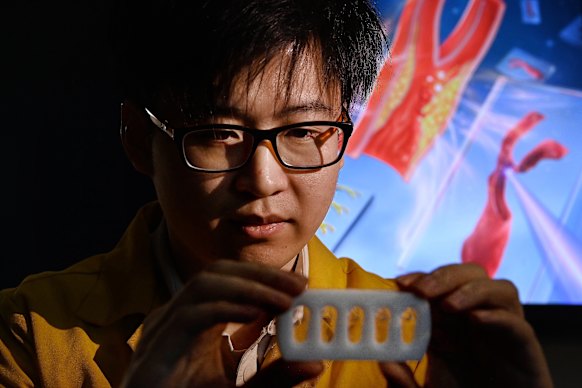
University of Sydney researcher Charles Zhao with his patented chip that can help doctors predict and treat stroke. Credit: Kate Geraghty
Fifteen years later, Zhao has devoted his PhD studies to investigating the microscopic cardiovascular changes that cause 42,000 deaths and more than half a million hospitalisations in Australia every year.
Zhao focused on the carotid arteries supplying blood to the brain. Blockages in these vessels can lead to stroke when clots or loose plaque reach the brain, but the cause can differ dramatically from patient to patient, and finding an answer quickly is essential to avoid death or lifelong disability.
By recreating the arteries of individual stroke victims on 3D-printed chips, Zhao and his team can pinpoint the exact cause of a stroke event, and find the right treatment to prevent it from happening again.
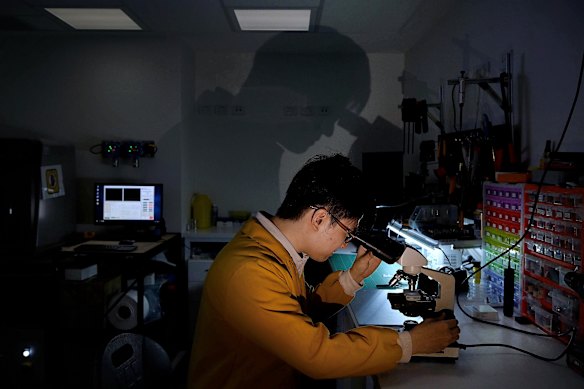
Zhao inspects 3D-printed arteries under a microscope at his University of Sydney lab. Credit: Kate Geraghty
The process involves taking a CT scan of the patient’s carotid arteries, shrinking them down to scale, and printing them directly onto glass slides (it took Zhao half a year to find a way to get them to stick).
The vessels are also treated with cells mimicking the natural lining of arteries, fixed into cassettes, and placed under a microscopic camera.
The channels are then pumped with a drop of the patient’s own blood to simulate natural blood flow over weeks and months, predicting if and when their next stroke would occur without treatment.
Zhao said his method would allow researchers to test treatments such as stents and blood thinners before they are given to the patient, avoiding invasive or potentially unnecessary treatments.
In a study published this month, Zhao mapped the arteries of three patients, including a 67-year-old man who suffered repeat strokes on the left side of his brain. This allowed Zhao to test tiny samples of the man’s blood with clot-busting and blood-thinning drugs to see which was most effective for preventing another stroke.
“He was already taking a blood thinner, but it was the wrong one, and he got three strokes within three months,” Zhao said. “Normally, the second one is deadly.”
Other scientists have deployed 3D-printed arteries, but traditional models are made with resin which can take up to a week to form a single chip. Zhao’s method cuts hours of manufacturing time by printing the vessels directly onto a glass slide. The whole process, from CT scan to computer analysis, takes less than two hours.
Loading
Zhao said this opens up the possibility for the technology to be used in real-world emergencies, when paramedics and doctors only have hours to restore blood flow to the brain.
“When a heart attack or stroke happens, patients cannot wait for a week,” Zhao said. “In two hours … we can quickly determine which treatment is best.”
A 2023 Stroke Foundation analysis found about a quarter of strokes in Australia affected patients who had already suffered one. Ischaemic strokes, those caused by a blockage of a blood vessel supplying the brain, account for about 85 per cent of all cases.
Dr Lisa Murphy, the foundation’s chief executive and a former intensive care and emergency physician, said Zhao’s technology was one of several Australian innovations improving treatment and rehabilitation prospects for stroke survivors.
“Every minute after a stroke strikes, 1.9 million brain cells die,” she said. “Any way we can save time from stroke impact to treatment, the better.”
Two patients in the study suffered strokes despite having arteries wide enough to be classified low-risk.
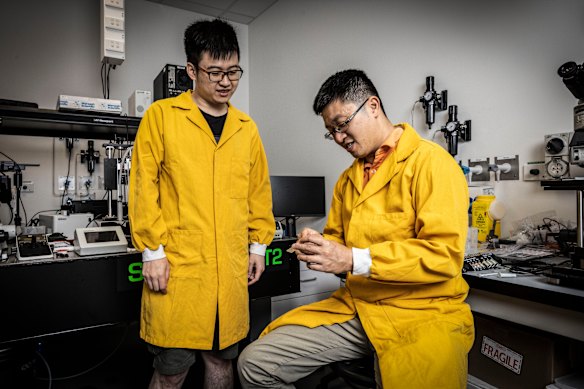
Charles Zhao with PhD supervisor Professor Arnold Ju (right) in 2023.Credit: Jessica Hromas
Zhao’s PhD supervisor Professor Arnold Ju, who was also inspired to research heart disease after a family tragedy, said analysing the data generated by the technology with artificial intelligence could help doctors develop more accurate measures for predicting stroke.
“There’s a paradigm shifting from the traditional ways to do clinical testing to a future that’s more predictive – like a better forecast,” Ju said.
The University of Sydney team is recruiting patients for pre-clinical trials with the hope of progressing towards trialling the technology in hospitals. Long-term, Zhao and Ju aim to develop test kits resembling rapid antigen tests that can help people assess their cardiac health with a single drop of blood.
“I’m trying my best to push this forward for my family, and hopefully, for anyone suffering from blood clot-related diseases,” Zhao said.
Start the day with a summary of the day’s most important and interesting stories, analysis and insights. Sign up for our Morning Edition newsletter.
Most Viewed in National
Loading