3 months ago
17
3 months ago
17
By Peter McCallum, Kate Prendergast and Rod Yates
November 25, 2025 — 12.07pm
THEATRE
Cowbois
The Seymour Centre, November 22
Until December 13
Reviewed by KATE PRENDERGAST
★★★½
This is a noble-hearted, gun-twirling yet dismayingly middling Australian premiere of Charlie Josephine’s 2023 queer western comic fairytale that rides into Sydney town. Making too much of its saddle of progressive morality, this Siren Theatre production of Cowbois stints the energising camp and soaring spirit needed to vindicate its overlong runtime, going down like slow service on watery whisky.
For all of director Kate Gaul’s good intentions, it only occasionally comes into itself as a radical, celebratory, liberated reimagining of a genre that traditionally loves a binary.
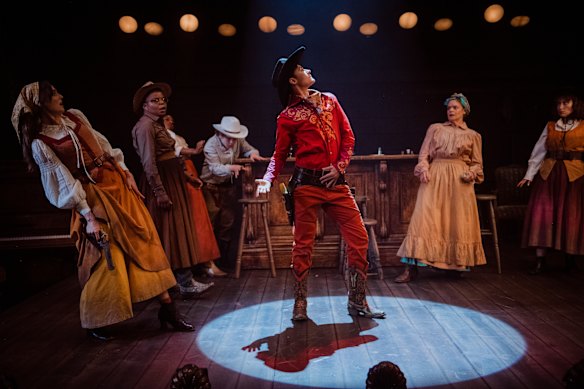
Emily Cascarino, Faith Chaza, Branden Christine, Rory Spinks, Jules Billington, Jane Phegan and Amie McKenna. Credit: Alex Vaughan
The play is set, naturally, in a small-town saloon. Unnaturally – some could say “queerly” (an overused joke) – there are almost no menfolk here. Aside from the liquor-shaky sheriff and a precocious boy (referred to as “kid”), the husbands all up and left to join the gold rush a year ago, valiantly promising their wives they’d return with a fortune.
Another unnatural thing: the town was built to be an exceptional forward-thinking haven, its two founding principles “no guns, no politics”. However, neither of these are upheld.
And when fugitive outlaw Jack Cannon swaggers into town, a new kind of man wanted for murder and wanted in a second, sacrilegiously biblical way, its petticoated inhabitants are left weak-kneed, round-eyed and fundamentally shook. New lawless awakenings are about to happen – and not even the returning wave of toxic masculinity that crashes down when the boys get back can reinstate the old oppressive “normal”.
Jules Billington is our gunslinger in red, infusing as much tender kindness as cocksure masc into the trans baddie. There’s not a whole lot of substance behind the performativity of their character, though, and Jack’s romance with married Miss Lillian (Emily Cascarino) seems to gallop on subversive lust alone (do they have one intimate exchange before professing love to one another?). An impossible event between them confirms the British playwright’s story to be a wistful, better-world fantasy.
A live band in the rafters provides subtle atmospherics, comic sound effects and backing for a few song and dance numbers. The actors weren’t cast to excel in this form of entertainment, with a lack of talent and gusto in throat and on hoof making you wonder why what’s billed as “feel good” so often feels bad. Brockman’s dramatic lighting and Emelia Simcox’s set, featuring clamshell footlights and enormous yellow drapes with purple tassels, battles the underwhelm with immersive aesthetics.
One’s heart can’t help but clench in gender-affirming plot moments, too, particularly those involving vulnerable transformation. The sweetest is when “Miss Lucy”, inspired by Jack, shucks off her long skirts to become Lou (Faith Chaza), brave and beaming in jeans and necktie. Sheriff (Matthew Abotomey) also gets a cheer for self-expression of repressed femininity with silk.
Clay Crighton (previously on piano and violin, who also contributed original music and lyrics) is a second-act show-stealer as Charley Parkhurst, a hilarious drag caricature of a rival outlaw. His entrance interrupts a long and scattered argument between the townsfolk about new and old values. The most conservative voice is then conveniently shot by dainty hand, and his death promptly passed over by a hammy, action-packed shoot-out.
Lord knows the messages of Cowbois are important in a backsliding world. But this desperado could do with more fire in the belly, their steed a swift kick with sharp spurs.
MUSIC
Bach Mass in B minor
Sydney Chamber Choir
City Recital Hall, November 22
Reviewed by PETER McCALLUM
★★★★½
With his genius for contrapuntal combinations carrying deep musical and symbolic significance, Bach constructed the great four-part fugue, Donna Nobis Pacem, which concludes the Mass in B minor, so the pleas for peace pile harmoniously on top of one another, each beginning before the previous one has ceased and overreaching it (a “stretto” in musical terms) to create a sonic image of collective yearning.
The swelling sonority and translucent texture of the Sydney Chamber Choir and the Muffat Collective orchestra under Sam Allchurch in this number encapsulated all the virtues of the performance that it brought to such a glowing close: clarity, balance, judicious tempi and an absence of unwanted accent or distortion.
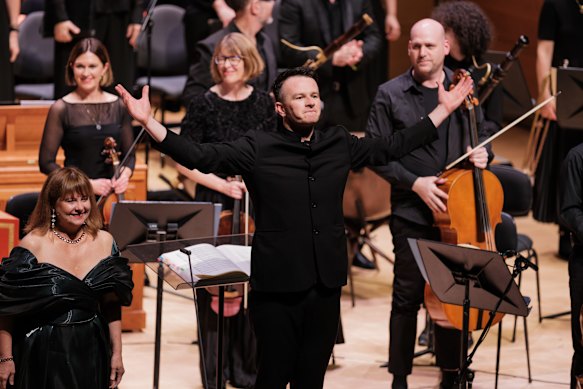
Conductor Sam Allchurch. Credit: Robert Catto
The striking opening chords that begin the Mass were sung with an unforced, open sound, allowing pure vowels and the music’s harmonic richness to convey the necessary emphasis. The ensuing expansive five-part Kyrie fugue flowed with a deeply embedded, unhurried pulse.
For the Christe, soprano Sara Macliver and alto Sally-Anne Russell created a nicely edged duet sound and their pealing imitation in the second theme was like the playful eddies of running water.
For the second Kyrie, the choir returned with a tone of measured seriousness. The choruses of the Gloria and the addition of a brilliant battery of three trumpets require, of course, more animation, but Allchurch’s broad metric direction ensured the music was emblematic of joy rather than over-excitement.
Concertmaster Matthew Greco led with light precision, aptly demonstrated in the nimbleness of his and Macliver’s ornamentation in Laudamus te. Illustrating the two-in-one theme implicit in the text of the Domine Deus section, flute players Melissa Farrow and Mikaela Oberg wove threads of silvery filigree against Macliver and tenor Andrew Goodwin, the latter singing with smoothly tanned finish and blooming projection.
Russell sang the Qui sedes ad dexteram Patris aria with full sound and rich colour, memorably bringing the same qualities to the darker depths of the penultimate Agnus Dei just before the final chorus. Bass David Greco enlivened the Quoniam and Et in Spiritum Sanctum arias with pointed, elastic articulation that accentuated the natural rhythmic emphasis of the complex melodic line.
While the orchestra retuned after the Credo, Allchurch regrouped the chorus to facilitate the double-choir format Bach uses for the Osanna. The regrouping also highlighted the broad antiphonal strokes of the Sanctus, which swayed majestically like great tolling bells and gave the music of the Donna nobis pacem (which had been heard earlier in the Gratias agimus fugue with the former grouping) a more focused, brilliant finish.
When performed as well as it was here, Bach’s Mass inevitably creates a sense of awe and wonder at the extent of human imagination and craft. What better way for Sydney Chamber Choir to end its 50th anniversary season.
MUSIC
Sam Fender
Showring, Entertainment Quarter, November 21
Reviewed by ROD YATES
★★★★
In 2019, British singer-songwriter Sam Fender played his debut Sydney show at the 500-capacity Oxford Art Factory.
Fast-forward six years – during which he’s amassed three UK No.1 albums, a Mercury Music Prize for this year’s People Watching LP and, in June, a sold-out show at the 80,000 capacity London Stadium – and his star has risen significantly.
Among the 15,000 people flowing through the gates of the Showring, the constant stream of Newcastle United shirts suggests his expat appeal remains strong.
However, when the North Shields-born artist asks how many in the crowd are British and how many are Australians, the loudest cheer comes from the locals, affirmation that his songs of everyday life and blue-collar tribulation have resonance beyond his home country.
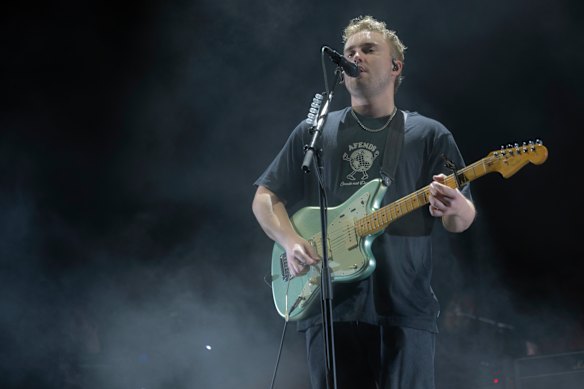
Sam Fender’s star has risen significantly. Credit: Georgia Griffiths
On this night, those songs sound majestic.
That Fender opens his biggest-ever Sydney show not with a mainstream hit but the deep cut Angel in Lothian suggests this is a man not tied to the staid old traditions of arena rock but one who has faith in his material and his band to make it a convincing opener.
His backing group has swelled to a seven-piece over the years, a younger, northern English answer to Springsteen’s E Street Band, and they look like they’re having the collective time of their life.
That they can pull off the howling noise-punk rock of Howdon Aldi Death Queue – introduced by Fender as a “stupid song”, and arguably the only set-list misstep of the evening – and follow it with a track as nuanced and elegant as Spit of You is a byproduct not only of the hundreds of shows they’ve played together but their history as friends stretching back to their teenage years.
The real stars, though, are the songs themselves. Anthems such as Seventeen Going Under, People Watching and triumphant closer Hypersonic Missiles blend wildly melodic hooks with Fender’s lyrical talent for making his deeply personal experiences resonate with the masses.
He begins The Dying Light – a song that addresses suicide and those “who didn’t make the night” – solo on piano before shepherding it to a triumphant, hopeful, full-band climax. The Borders delivers an additional element of joy when a fan is invited onstage to play guitar; recent single Talk to You (the recorded version of which features Elton John) sits as comfortably in the set as older songs such as Will We Talk?
Fender says he’s about to disappear for a while to concentrate on his fourth studio album. When he returns we’ll likely all be heading out to Olympic Park.
Must-see movies, interviews and all the latest from the world of film delivered to your inbox. Sign up for our Screening Room newsletter.
Most Viewed in Culture
Loading