3 months ago
18
3 months ago
18
As a child, Celia Pacquola desperately wanted a cat. It never came to be, largely because she lived in the Yarra Valley bush and her mother loved birds too much, but her feline dream never went away.
So it surprised even her when years later she and a housemate – fellow comedian Kelly Fastuca – decided to adopt a dog shortly before the COVID-19 lockdowns. Jimmy Chocolate Chip, a rescue somewhere between a terrier and a chihuahua, came first… followed by Deirdre Chambers (another rescue dog, not the beautician from Muriel’s Wedding). Suddenly, life was all about the dogs.
“I just love them. If someone says, ‘I hate dogs’, I don’t want to hang out with them,” says Pacquola, a comedian and actress best known for Rosehaven and Utopia. “If you walk into a shop and there’s an unexpected dog there, it’s like, ‘My day just got 20 per cent better.’ ”
Much has changed since those early days. Pacquola met her partner, moved out of her share house and had a child. Jimmy went to live with Fastuca, and Deirdre – a “beautiful but troubled dog” known for occasionally eating candles – died about two years ago. Pacquola didn’t feel ready to get another dog after that, but she still yearned to be around them.
Then came Dog Park. Co-created by Leon Ford (Love Me) and Amanda Higgs (The Secret Life of Us), the six-part ABC comedy-drama series follows Roland, a grumpy middle-aged man who gets sucked into a mismatched dog park group while his wife is working overseas. Not only was it co-written by Ford – someone Pacquola enjoyed working with on Love Me – but it was also filmed just up the road from her Melbourne home and involved playing with dogs all day.
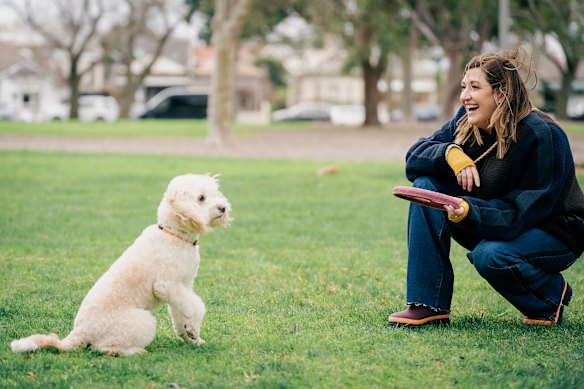
“It was kind of like having a friend with a boat,” she says. “I got to play with the dogs and then go home and not clean them or feed them, or do any of the responsible stuff. It was absolutely a no-brainer to do this job.
“I wasn’t even asked to audition – I asked to audition … I don’t know if I manifested it, but if I did, good on me.”
Dogs are, of course, the heart of this show. All kinds of breeds, from whippets and border collies to bulldogs and great danes, are shown in full glory running through parks in slow-motion, jowls flapping in the wind. There’s far more beyond the cuteness, though.
“It there’s anything a grumpy middle-aged man can learn, it’s to be more like a dog.”
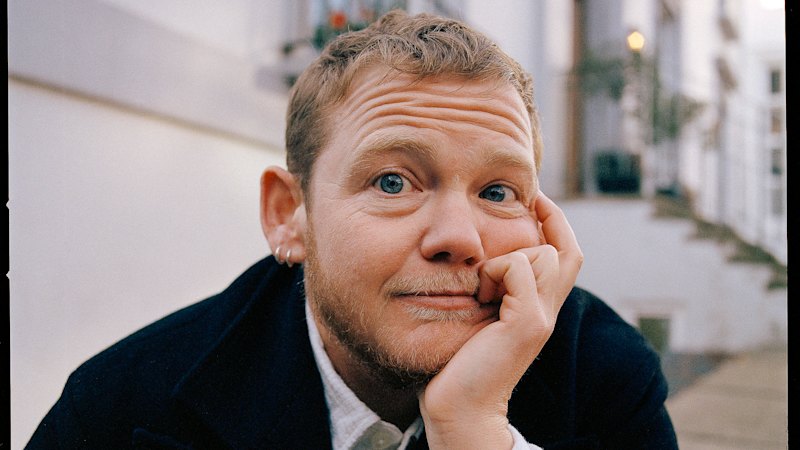
Dog Park co-creator and star Leon Ford.“We have a lot to learn from dogs,” says Ford, who grew up with pooches and now has a clever maltese shih tzu named Gidget.
“Dogs are mostly just living in the moment, and if there’s anything a grumpy middle-aged man can learn, it’s to be more like a dog: just enjoy the time with your friends at the park and relax a bit. Don’t worry about the future and don’t regret the past. Just live in the moment.”
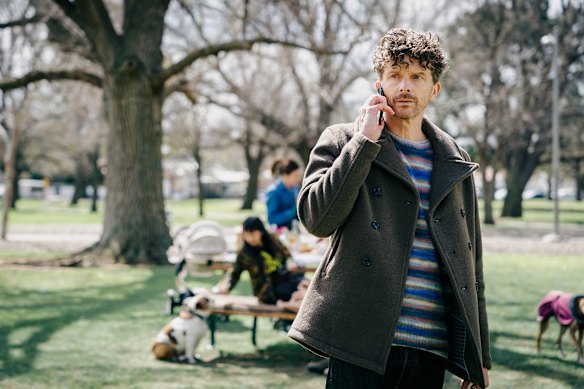
If anyone needs to be more like a dog, it’s Roland. Everything irritates Ford’s prickly character, whether it’s someone slowing down a check-out line or butter not being properly spread on toast. He’s also struggling in his home life, where his teenage daughter bristles at his advice and his wife toys with the idea of leaving him. The only family member who appears entirely loyal to Roland is Beattie, the energetic border collie-poodle cross.
With his wife overseas and daughter disconnected, Roland has little choice but to take Beattie to their local dog park – an activity that he, a lone wolf, shudders at the thought of. After all, there are people at the park and Roland “hates chat”.
Once there, he’s immediately swept up by the “Dog Park Divas”, a motley crew of endlessly positive dog owners. There’s Penny with farty Marty, a particularly gassy bulldog; Jonah with Spike, a whippet-kelpie stray rescued during an ultra-marathon in Chile; and Sam (played by Pacquola) with Muppet the Australian shepherd. They couldn’t be more different in age, temperament or socio-economic standing, but they meet in the park every day to bond over the one thing they have in common: dogs.
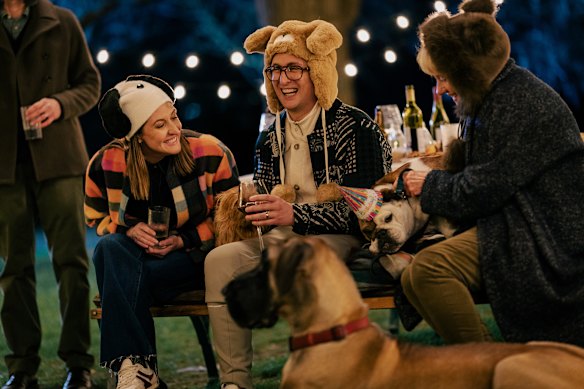
It’s something most dog owners will recognise. Formal groups may be less common, but many will recall times they’ve shared a funny dog anecdote with a passing dog-walker, or offered a poo bag – especially during the socially isolated lockdown days. Even those who don’t have a dog could relate. The first time I took care of my parents’ black labrador was also the first time I said more than four words to my neighbours.
“A dog park is like a level playing field where it doesn’t matter who you are,” Ford says. “So many of my friends go to dog parks, and they tell their fellow dog-owners the most intimate things, sometimes things they wouldn’t even tell their own partners.”
Why so many people open up in these spaces, Ford isn’t sure. Maybe, in the same way we confess parts of our lives to taxi drivers and hairdressers, it’s the belief that “what’s said in the park stays in the park”. Regardless, having dogs around certainly helps. They’re something to focus on if things get awkward, and a reason to be there in the first place.
A growing body of research already suggests that having a dog could improve heart health and lower blood pressure, but Ford and his fellow writers were more interested in the social impact of dog ownership.
Ford says Roland’s relationship with Beattie, which is essentially just Roland continuously begging Beattie to stop annoying him, is similar to his relationship with his own dog. This is epitomised in a scene where Roland lets Beattie outside, only to have her beg to come back in, then beg to go out again, and so on. Suffice to say, Roland has little patience for it.
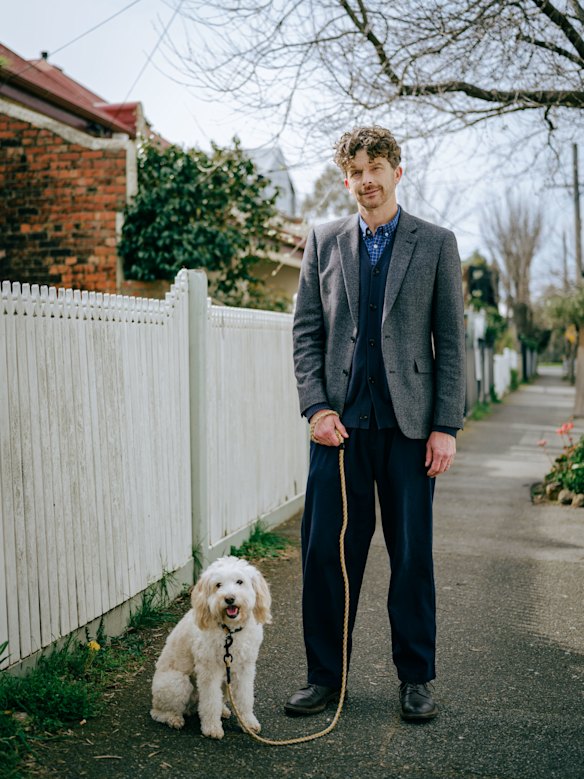
“He’s not realising what he’s got in front of him – that he’s got a lovely, loyal friend that just wants to love him. But he, for whatever reason, just can’t see that or go there,” Ford says. That is, until he visits the dog park.
Dog Park is packed with zingers (“this dog is the spitting image of John Farnham”, “you can’t force a dog to watch you shower – it can’t consent”), as well as Roland’s facetious wit. But it’s also a deeply emotional show, one that encourages reflection on broader themes like loneliness, both in a big city and within a small family.
The dogs are integral too. Each canine featured was highly trained, with some having been on television before, and there were coats and doggy tents on set to retire to during breaks. The production was not without challenges.
“There was one scene where I had to dramatically walk off purposefully in a straight line and a random dog stopped directly in front of me and proceeded to do a shit,” Pacquola says. “I just had to keep walking. The dog looked at me like, ‘Why are you walking towards me? I’m clearly doing a shit.’ It undercut the seriousness of my dramatic acting. But otherwise, I didn’t step in shit once.”
Still, Pacquola was right at home in this show. Her role as Sam, an eternal optimist and unofficial leader of the dog park group, is not dissimilar to her glass-half-full character in Rosehaven, the comedy she co-created with Luke McGregor about a real estate business in a small Tasmanian town. She’s naturally inclined to be more upbeat, she says, though she’s open to more dramatic roles – perhaps even a villain.
Dog Park, however, hasn’t quite filled the Bluey-shaped hole in her life. She famously missed the opportunity to play the mother in the popular children’s show, a story she shared in her stand-up. “I’ll let you know if [Dog Park] becomes the most popular show in the world, but until then, no.”
Dog Park premieres 8.30pm February 1 on the ABC and ABC iview.
Find out the next TV, streaming series and movies to add to your must-sees. Get The Watchlist delivered every Thursday.