3 months ago
49
3 months ago
49

John Kelleher struggles up the stairs of his house that he has climbed without effort thousands of times before, and is gasping for breath when he reaches the top. He has just had a chemotherapy session to slow the oesophageal cancer diagnosed eight months earlier.
We sit in his front room. It is a hot day and the bird feeder in the front garden is empty. His wife, Anne, says it is probably too hot for the abundant birds to be lured from the shade.
Inside, John sits on his couch with a blanket under him.
On the coffee table is a box with dozens of medications. “It is difficult to keep track of what to take,” he says.
His doctor says the evidence suggests his condition is work-related.
The bean counters at Victoria Police’s WorkSafe agent seem to know better, pointing out Kelleher was a smoker. “I gave up more than 30 years ago,” he says.
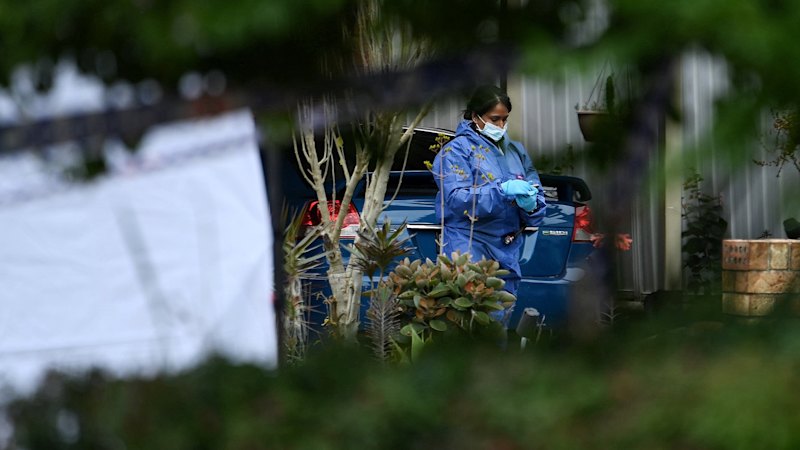
The decision, made from an air-conditioned, non-smoking office, seems not to have considered that over his career as a Victoria Police fire and explosives scientist, he investigated 7000 fires, often looking for body parts and clues as to how the blazes started.
“I started with Victoria Police on a three-month secondment, and 37 years later, here I am.”
For decades, Kelleher has been Victoria’s leading forensic fire and explosives expert. He is acknowledged as a world leader, and ran national training programs, which means every expert in Australia was mentored by him.
On the wall is a plaque with police badges given to him by the agencies he assisted. Every Australian law enforcement body is represented.
In 2014, he was awarded an Order Of Australia: “For significant service to the community, particularly as a forensic specialist in the field of fire and explosion investigation.”
When he started, he says, the protective gear issued consisted of “painter’s overalls and a pair of gumboots”.
For years, Kelleher planned to retire but felt compelled to stay as the Fire and Explosive Unit was chronically understaffed with only six of the 11 positions filled.
Then with the tobacco wars – where firebombings became the norm – he was attending 400 fires a year and sometimes three a day. “They [the inexperienced arsonists] usually have no idea what they are doing, can kill or injure themselves and often get the wrong shop.”
He worked closely with firefighters, who expertly screened blazes and would call him out only when there was something suspicious. “We had a great relationship,” Kelleher says.
If Kelleher had worked for Fire Rescue Victoria, it would be almost certain he would not be fighting for compensation.
Professional and volunteer firefighters, plus the staff who maintain the equipment, have been given access to presumptive rights compensation for 15 types of cancer considered to be highly likely to be triggered by work-related conditions.
This includes oesophageal cancer.
He also trained and taught at Fiskville, the CFA facility that was closed after it was found to be riddled with cancer-causing pollutants.
Last year, Kelleher had a medical without issue. Two months later, he was diagnosed with aggressive cancer. He then retired, aged 70.
Two ex-detectives, both retired, contacted me, angered by the way Kelleher has been treated. “He was one of the best in the world and a first-class investigator. He has been to more fire scenes than anyone in Australia and to deny him just compensation is just wicked,” one said.
Certainly, Victoria Police know his quality, recently publishing a glowing account of one of his cases.
“When you think of someone who is an expert in their field, you might think of Tiger Woods in golf or Novak Djokovic in tennis. Well, John Kelleher was at that level as an arson chemist for 20 years,” Detective Leading Senior Constable Glen Hatton said.
“There would be fire scenes where we would be scratching our heads, then John would turn up and in just 15 minutes, he would be able to tell you exactly what had happened.”
So what was his trick? At the beginning, he would seemingly do nothing. “You just stand there and look. The first thing is to make sure the building is safe, and the roof isn’t going to collapse.”
Once inside, “we look for a pattern, where has the fire burnt the most, then look for evidence such as the melted remains of a jerrycan”.
The most gruesome task is to look for human skin, as arsonists often manage to burn themselves, shedding burnt tissue.
In October 2002, Kelleher was about to head to Florida for a conference when two terrorist bombs detonated in Bali. “I asked if I was needed and was told the [Australian] Federal Police had it under control. When I landed, the message on the phone told me to turn around and fly back.”
The tourist centre of Kuta was a war zone with bombs placed in the popular Sari Club and Paddy’s Bar; the toll was 202 dead and 240 injured. Local services were overwhelmed.
Kelleher and a team of experts concluded Paddy’s Bar was blasted in a suicide attack with the terrorist wearing a backpack. This meant his torso would have been obliterated. “We were looking for a head and matching legs.”
In a macabre game of human Lego, the bomber’s remains were matched so he could be identified.
The February 2009 Black Saturday fires that cost 173 lives led to a year-long investigation for Kelleher and his team. He investigated 200 fire source areas, visiting most at least twice. “I hardly saw my family. We spent months in the bush.”
As an explosives expert, he has dealt with committed terrorists and dangerous eccentrics, such as Glenn Sanders – a troubled inventor with an appetite for smoking ice and stockpiling explosives.
He even built a cannon and would shoot projectiles at nearby Mount Elephant near Derrinallum.
In April 2014, “Colonel” Sanders was spotted wearing a suicide vest, and after a seven-hour siege, managed to detonate a carefully prepared set of booby-traps. His vest had three detonating points, including on the shoulders, so if he even shrugged his shoulders, it would explode.
What he knew, that police didn’t, was that the property had been seeded with secret bunkers, sensors and seven interconnected bombs linked to a timer. Sanders kept asking negotiators the time but when one of the bombs went off prematurely, he involuntarily jumped, activating the suicide device.
The series of explosions could be heard for 30 kilometres.
For three weeks, Special Operations bomb experts searched the property, setting off 22 counter charges.
By the time Kelleher was able to examine the property, the counter charges had compromised the crime scene, making it impossible to track all the explosives.
“It looked like he had spent years organising it. We know he ordered an explosives safe that was dropped into a hole. I reckon there is still stuff [explosives] buried down there,” Kelleher says.
At too many scenes, he has had to deal with self-trained bomb makers, some with sinister intentions and others who just like making big bangs – often with deadly consequences. “It is so easy to make your own.”
There was the survivalist who stockpiled so many explosives, it took three days to clear his house. “He was stealing Powergel from work and buying [deactivated] Claymore mines.”
An understanding of rudimentary chemistry does not guarantee brains. Kelleher recalls a man who built a pipe bomb that he carried on his lap with one of the two connectors attached to a battery on the front seat.
“When he went over a speed bump, he must have put his hand out to steady it, which managed to complete the circuit and cause the detonation.”
This did nothing for his mortality, nor the resale value of his car.
There was another country hideout where they found a cache of uranium.
United Firefighters Union Victorian secretary Peter Marshall has spent more than 10 years fighting for his members’ cancer risks to be recognised through the Presumptive Rights Compensation Scheme.
He says the research shows that up to 8000 carcinogens are released into the air during a house fire with the dangers greater after the blaze is controlled.
“When it is smouldering, it can be at its worst.
“He [Kelleher] would have been exposed to the same risk as firefighters,” Marshall says.
He offered to chat to Kelleher to see if he could provide information that could help the case.
In every similar case under the compensation scheme, liability has been accepted and compensation paid. Kelleher is the odd one out.
Which means firefighters, with whom Kelleher worked closely with for years, are reaching out while the police force that called him out in the middle of the night and expected him to do gruesome investigations in dangerous conditions, remains silent.
Kelleher sits on his couch, his body showing the signs of the disease that grips him. On the other side of the room sits some legal paperwork requesting him to testify over a fire scene he analysed before his forced retirement.
Right now, he has a bigger fight on his hands.
Start the day with a summary of the day’s most important and interesting stories, analysis and insights. Sign up for our Morning Edition newsletter.