3 months ago
23
3 months ago
23
The collaboration now unfolding inside Bangarra Dance Theatre’s rehearsal rooms involves much more than the interplay of bodies. In an old wooden wharf on Sydney Harbour, tradition steps side by side with contemporary choreography as dancers whose movements draw on a 65,000-year history interact with members of the Australian Ballet, the 64-year-old company steeped in a discipline created in the 15th century.
Fittingly, they have come together to create a work about renewal – about the stirring of new life beneath the soil of the Australian landscape. Flora begins beneath the clay, where the Mother Seed is unfurling, and grows into a narrative about the impact of colonisation.
It’s the first collaboration in 14 years between Australia’s premier First Nations performing arts company and the nation’s largest classical ballet company. The co-production has its world premiere on March 12 at Melbourne’s Regent Theatre.
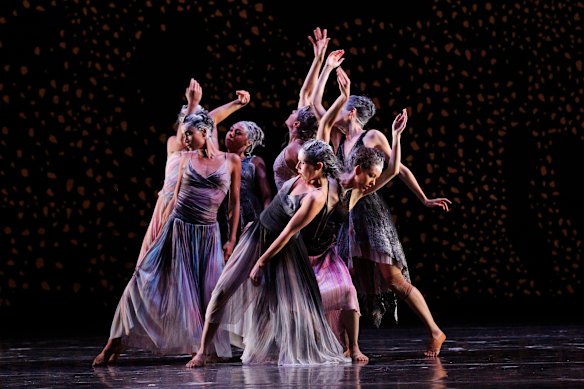
Inside the rehearsal rooms, 16 Bangarra dancers and 19 members of the Australian Ballet corps practise the different techniques of their ancient art forms. They watch and learn from each other as they twist and contort their bodies like vines.
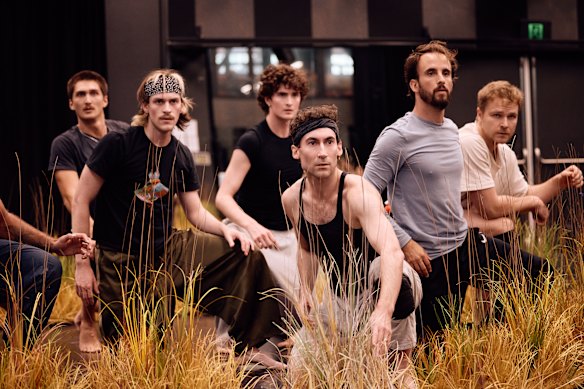
True to their name, which in the Wiradjuri language means “to make fire”, the Bangarra dancers turn up the temperature with some up-tempo moves, while their colleagues pirouette and plié with equal vigour.
A carpet of fake spinifex sits in a corner and Miriam Mer designer Grace Lilian Lee’s costume sketches line the wall. A copy of Sir Joseph Banks’ seminal book Florilegium, a collection of copperplate engravings of plants collected by the botanist as he accompanied Captain James Cook between 1768 and 1771, sits open on a table.
Flora is a loaded word for First Nations people, given the widely held but false belief that they were categorised under the flora and fauna act, not as human beings, before the 1967 referendum.

For Bangarra artistic director and co-chief executive Frances Rings, a descendant of her mother’s Mirning tribe from the west coast of South Australia, Flora began as her personal passion project. The 10-part tale starts with the Mother Seed and grows into a narrative involving sleeping yams, bush flowers, grass tree warriors and the impact of hooves from introduced animals.
In devising and choreographing the work with dancers from both companies, Rings was inspired by her bush childhood. She grew up in South Australia, and went on regular family drives from Port Augusta to the wildflower-rich Flinders Ranges in spring and camping trips in Western Australia after they moved to Kalgoorlie for her father’s work. She remembers fields of everlasting daisies, “as far as the eye could see”, and “the breathtaking vastness of the sky”.
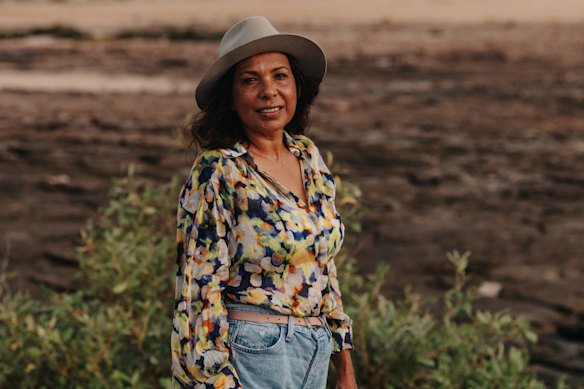
“I grew up in the country, and it was not until I was a young adult that I realised just how much that has impressed on who I am today and the work that inspires me and that I am inspired to do,” says Rings, a dancer who took over as Bangarra’s artistic director in 2023, when Stephen Page left after three decades.
“As a child the outdoors was my theatre, my expression, what I connected to … being able to see a tree and climb it and then that tree became part of this imaginative world … you could call it escapism, but we were just looking for ways to express our imaginings.”
It was, she says, pretty much the same work she does now, creating thoughtful dance works for audiences to escape into and see stories from a First Nations perspective.
“I chose flora as a subject because it does connect back to my past and to growing up on country and in those regional and remote areas. But also, for all of us here who share this country, there’s such a uniqueness to our flora, the power and beauty of it. I thought it was something that we can all connect with and all appreciate. It’s about beauty.
“The thing I find really inspiring is the resilience of our flora as it also mirrors that of our First Nations people. When we see country surviving, the return of native flora in areas that have been decimated by, say, fires or flood, that’s inspiring for us. That inspires our spirits. Flora, for us, is not separate from who we are as First Nations people, it’s so intrinsically connected to our identity, to our spirituality.”
During the creation of this floral-focused work, Rings has begun rewilding the backyard of her home on the central coast north of Sydney, where she lives with her husband and two sons. She’s been planting natives such as warrigal greens, saltbush, pandanus, finger limes, Lomandra, golden wattle, and Gymea lilies, some of the plants she seeks to recreate onstage in Flora. This has helped connect her more to the natural world, she says. It also helps her appreciate her father’s green thumb.
“We had vegetable gardens everywhere we lived,” she recalls. “He was a prolific gardener.”
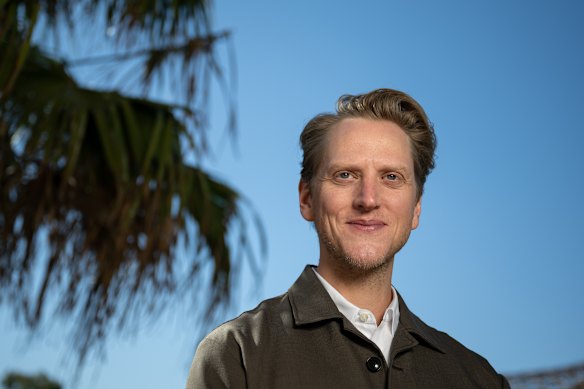
This couldn’t be further from the Arizona childhood of the Australian Ballet’s artistic director, David Hallberg, who confesses he knew little about Australian flora before this project, just as he knew little about Australia before he moved here.
“I grew up in Arizona, where the cacti bloom in the desert – often it is only one beautiful bloom and that’s it. But one thing I never tired of as a performer is receiving flowers after a performance. I remember receiving bouquets of Australian natives after shows here and thinking how much more striking they were than those I received in Moscow, Paris and New York,” he says.
“I have been on a five-year learning curve not just about Australian flora, but First Nations stories, how to do an acknowledgment of Country, and learning about Australia in general.”
Part of that education involved a tour of Sydney’s Royal Botanic Garden with dancers from both companies when they began rehearsals for Flora.
“I have walked through those gardens a lot but never really appreciated just how resilient the Australian native plants were until we learnt about them … being here in this country has given me such a new perspective on the world.”
Hallberg draws a connection between Flora’s themes and his own relationship with his adopted country.
“I am putting down roots like a plant, which feels right,” he says. “I am so happy living in Australia. I am seeking citizenship, I am in love with an Australian, too. When I came to Australia alone for this job, I never thought this would be the outcome.
“I was ready to leave New York, to take this role, to stop dancing. I was ready to go grocery shopping to have food in the fridge and settle in one place for a while, not always living out of a suitcase. This is home,” he says of Melbourne now.
When he took the reins at the Australian Ballet in 2021, Hallberg wanted to work on a co-production with Bangarra, a tradition that is now 30 years strong. The relationship between the companies began in 1996 with Stephen Page’s Alchemy. The following year, Rings danced alongside the Australian Ballet’s Steven Heathcote in Rites, which Page choreographed to Stravinsky’s The Rite of Spring and toured to the US and Europe until 2008. Warumuk, devised for the Australian Ballet’s 50th anniversary in 2012, was the last time the two troupes worked together.
“I was eager to continue that kind of lineage because it’s been so fruitful in the past,” Hallberg says. “But it was really important to forge a meaningful friendship and artistic partnership with Frances. She has a steadfastness, and a steely focus, topped with this real warmth. My role is not as choreographer, my role is developer, nurturer and guarder of Frances’ vision for this show.
“This journey with Frances and Bangarra has taken me and our dancers on a trajectory of discovery about flowers, the First Fleet, Sir Joseph Banks and just how fragile the Australian indigenous flora is and how we need to protect it.”
Hallberg says he has learnt patience from watching Rings work with the dancers, and an appreciation of how the different companies work.
During rehearsals, some of the dancers adjourn to a smaller room, and write up lists of what they’ve learnt after studying things such as the 1846 Pastoral Act, or the impact hooved animals had on the early colonial landscape.
“We don’t necessarily put as much effort into research and development as they do at Bangarra,” Hallberg says. “We work within the constraints of time and budget, often on shows created outside of Australia. The ballet world is very different from Bangarra. It’s rigorous but not in the same way. It’s no less meaningful, just different.”
Australian Ballet dancer Montana Rubin, from Sydney but now resident in Melbourne, agrees.
“This is such a departure from ballet in every way. We do Sleeping Beauty and The Nutcracker and classical contemporary works where generations of audiences often know the story. But here we have Mother Seed opening the performance, and we are creating the story and get to put the stamp on it ourselves while still using our traditional ballet forms. It could go anywhere with Frances each day, and it feels like we have the space to grow,” Rubin says.
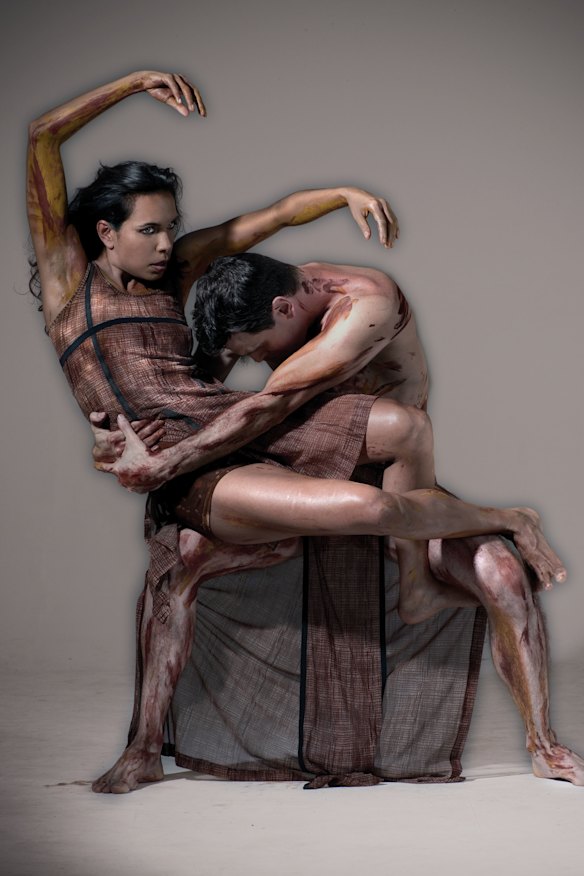
For Rings, that growth is a two-way street.
“Working in silos as separate companies can be limiting to expression and different perspectives. Watching the AB’s principal dancers and directors work helped elevate my practice – Steven Heathcote taught me tools around partnering when we did Rites together. When you take those tools back to Bangarra, that’s transformative.”
She wants audiences to heed the show’s serious message that we need to care for the environment.
“Plants are the architects of the natural world. But we’ve become so separate from the natural world, we must remember that they’re our ancestors who have sustained us. We’re not any more important than what they are, we are all connected.”
The show connects many threads of the arts world. Kalkadungu musician and didgeridoo virtuoso William Barton has composed the score, and will be accompanied by Orchestra Victoria in Melbourne and the Opera Australia Orchestra in Sydney. Designer Grace Lillian Lee, known for her woven sculptures and recent collaboration with Jean Paul Gaultier, has created the costumes, while Muruwari man Matthew Doyle has been a cultural adviser for the show.
“The meaningfulness of this collab is that we are two very different voices coming together,” Hallberg says. “Above all this is a piece of art that has been created by the companies, in their own cities, and it all comes from the seed of an idea created long ago. Everything from the design, the production, the costumes, the music is made here. Nothing is shipped in from overseas, every element is Australian. And there is a power in that. Like the flora itself.”
Flora is at Melbourne’s Regent Theatre, March 12-21, and the Sydney Opera House, April 7-18.