3 months ago
29
3 months ago
29
Chris Moss
January 4, 2026 — 5:00am
The world’s highest bridge recently opened in China. The Huajiang Grand Canyon Bridge stretches above a yawning gorge in the Guizhou province of southwest China.
It’s a vertigo-inducing 623 metres high, more than twice the height of Melbourne’s Eureka Tower. Prior to its completion, crossing the canyon took around one hour of driving along winding roads. The journey will now take about one minute.
Unsurprisingly, China already holds a number of records for big bridges, including the world’s longest (the 164.8-kilometre Danyang–Kunshan Grand Bridge in Jiangsu) and the world’s tallest (Changtai Yangtze River Bridge, at 352 metres, which also opened this year). Where it is not number one, it is often number two, three and four.
The world is full of great bridges, of course, and size isn’t everything. Just look at the Rialto in Venice – only 7.3 metres high at its arch and with a span of just under 32 metres. A beautiful landmark spoilt somewhat by overtourism, it doesn’t quite make my top 10. Don’t agree with my choices? Please leave your comments below.
Golden Gate Bridge, San Francisco
This is a masterpiece of construction, marrying super-hero strength and sublime grace. There are longer suspension bridges, but none is as familiar as this Art Deco portal to the Pacific.
Opened on May 27, 1937, it took four and a half years to build – signifying a huge vote of confidence so close to the Great Depression. Always photogenic, it’s especially arresting at sunset, when its two great orange-vermilion towers glow intensely, or when it’s rising majestically out of a blanket of fog or low clouds.
Cross it: You can walk, bike, or drive across it, visit the Welcome Centre, take photos from viewpoints like Battery Spencer or Crissy Field, or enjoy a Bay cruise to see it from the water.
Sydney Harbour Bridge
After the Opera House, Sydney Harbour Bridge is the city’s most loved landmark. Inaugurated in 1932, it connects suburbs on the northern side of the harbour with the rest of the city.
It has a span of about 503 metres, making it one of the world’s longest steel-arch bridges. It has four railway tracks, a highway, and two pedestrian walkways across its length.
The bridge was designed and constructed by Middlesbrough firm Dorman Long and Co Ltd, which had already shown off its engineering and aesthetic prowess with the Tyne Bridge in England’s Newcastle. About 80 per cent of the steel was imported from England, a welcome injection of cash in the north-east during the Depression. The rest was made in Newcastle, New South Wales, and six million rivets came from Melbourne.
Cross it: A major tourist attraction, the bridge attracts walkers and cyclists. There are ferry trips around the harbour as well as a range of bridge climbs.
Millau Viaduct, France
When it was opened in 2004 by then-French president Jacques Chirac, the Millau was the world’s tallest bridge. Surpassed only by the Changtai Yangtze River Bridge, it is now number two.
Spanning the Tarn Valley in the Occitanie region in the south-west of the country, it was built to relieve a bottleneck that slowed down tourist traffic from northern France to the Mediterranean coast. Motorists could take up to four hours to cross the valley when traffic was heavy; it takes a matter of minutes to cross the bridge.
With its highest pylon at 343 metres, a total length of 2.46 kilometres and a glorious natural setting, the Millau has been a tourist attraction since day one. The approaching motorway was modified so drivers coming from the north could enjoy a view of the bridge and valley before they arrived.
Cross it: Lord Foster, who designed the viaduct, has said: “Ideally passing over the bridge should allow one to ‘elevate oneself’. Looking at it should provoke an emotion.” He described driving over it as akin to flying by car. For those who want to see it up close and learn about its engineering, there are guided tours.
Forth Bridge, Scotland
The Forth Bridge has been carrying rail passengers over the Firth from Edinburgh to Fife since 1890. A magnificent feat of engineering, it’s one of Scotland’s most iconic structures and has been a UNESCO World Heritage Site since 2015.
On opening, it had, at 518 metres, the world’s single longest cantilever bridge span – two of them – a record that lasted until 1919, when the Quebec Bridge opened in Canada. The two structures still occupy the first and second spots in that particular ranking.
Cross it: Lucky passengers on the Royal Scotsman luxury train get to ride across the bridge sipping single malts on an open-air platform. Ten great viewpoints allow visitors to take in the awesome sweep of the Forth Rail bridge and there’s also a five-mile walking trail.
Pontcysyllte Aqueduct, Wales
Built during the frenzied “Canal Mania” of 1790-1810, the Pontcysyllte Aqueduct carries the Llangollen Canal across the valley of the River Dee, connecting North Wales’s abundant raw materials (coal, iron, lime, slate) to markets in England.
It was an engineering masterpiece involving two of the great innovators of the era: Thomas Telford and William Jessop.
Crossing difficult terrain, it provided a crucial link in the Ellesmere Canal system, and created a smooth and continuous waterway without recourse to time-wasting locks. Among the new techniques employed were hollow stone piers to reduce weight, a lighter, watertight cast-iron trough for the channel and ox-blood mortar, which gave added strength.
Cross it: Cruising across the aqueduct in a narrowboat is bliss. You can also canoe across it and walk on the towpath. A picnic in the surrounding Ty Mawr country park, which includes the Cefn Viaduct too, is also lovely.
Helix Bridge, Singapore
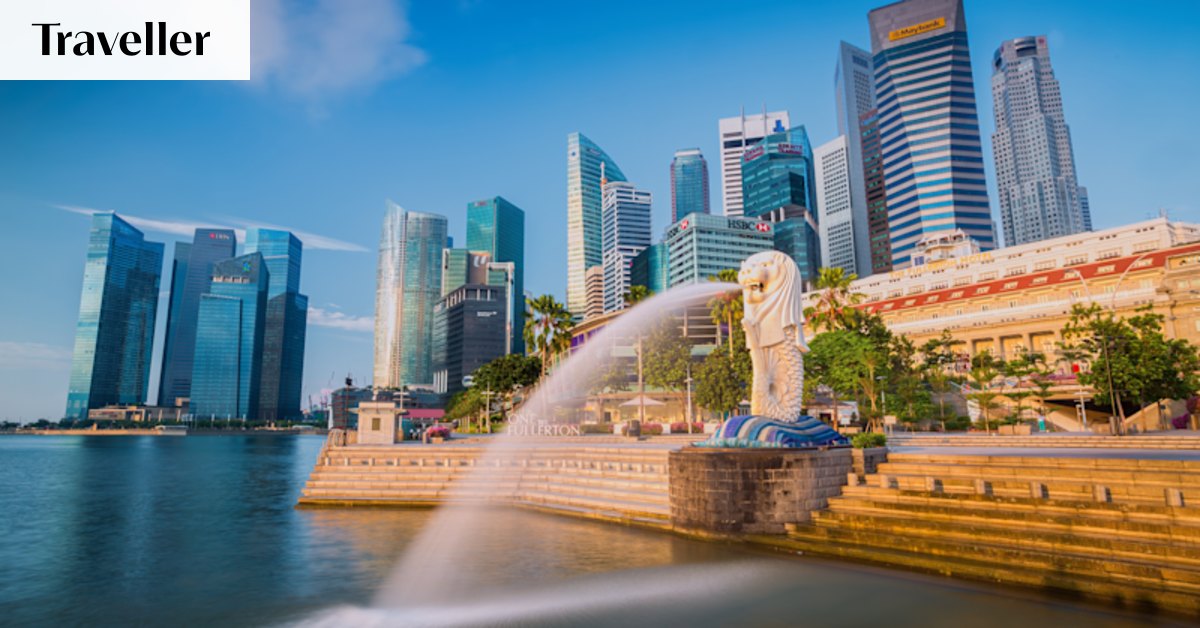
Singapore likes to impress visitors with flashy new structures, from indoor gardens to eccentric street art to soaring skyscrapers.
The Helix Bridge at Marina Bay was inspired by the geometric arrangement of a DNA strand, with the walkway passing through opposing double-helix structures of stainless steel.
Canopies made of fritted (porous) glass and perforated steel mesh offer shade from the tropical sun. At night, pairs of coloured letters – C, G, T and A, representing the four bases of DNA – are illuminated in red and green.
Spanning the Singapore River, between Marina Centre and Marina South, the 280-metre-long twisting bridge has four viewing platforms that cantilever out from the structure, affording pedestrians sweeping views of the bay and landmarks including the lotus-shaped ArtScience Museum, Singapore Flyer big wheel and three-towered Marina Bay Sands hotel.
Cross it: You can walk, ride a bike, or an electric scooter, across the bridge. There’s kayaking in the Marina Bay. The bridge is a crossing and a place of car-free retreat, with residents and visitors coming to simply stroll and slow down.
Arkadiko Bridge, Greece
Crossing old British packhorse bridges always feels like stepping back in time.
But the Arkadiko or Kazarma Bridge is a Mycenaean structure dating from the Greek Bronze Age: around 1300-1200BC. One of the oldest preserved bridges in Europe, it lies near a modern road in Argolis on the Peloponnese peninsula.
A corbel arch bridge, it’s 22 metres long, 5.6 metres wide and just four metres high, spanning a small, culverted stream. It was on a military highway between the two cities of Tiryns and Epidauros, part of a larger network built to support chariots.
Cross it: There’s a small parking area close by, and the bridge is open to pedestrians. For keen bridge-crossers, Argolis is special, with a further four Mycenaean corbel arch bridges near Arkadiko.
Alcantara Bridge, Spain
This magnificent Roman stone arch bridge across the Tagus was built between 104 and 106 AD under orders of the Roman emperor Trajan, to link Roman Merida and Caceres with Beira Alta in present-day Portugal, when the area was known as Lusitania.
The name – which is also used for Toledo’s Roman bridge – derives from the Arabic word al-Qantarah meaning “the arch”.
At the entrance to the bridge is a small temple honouring the builder: “The bridge will remain constant in the world forever, made by Lacer, famous for his divine art”. Despite suffering damage during the Reconquista, the War of Restoration between Spanish and Portuguese forces, the Peninsular War and the Carlist Wars, it has stood firm and still looks like a work of art.
Cross it: Earlier this year, a new road bridge opened to turn the Alcántara into a pedestrian bridge. It lies on several hiking trails. Nearby is the town of Alcantara, which has impressive convents.
Nine Arches Bridge (Sankey Viaduct), England
In 1826, the Act for the Liverpool & Manchester Railway (L&MR), the world’s first intercity railway, was passed by Parliament. George Stephenson, principal engineer for the 50-kilometre route, knew he faced a major hurdle at the half-way point: the Sankey Brook and Sankey Canal that ran along the Sankey Valley.
Stephenson’s solution was to construct an embankment on the western side of the valley, a mighty viaduct, and then a smaller embankment on the eastern side.
Stephenson designed the viaduct with Thomas Longridge Gooch, his chief draughtsman. The construction required 100,000 tonnes of marls – a mixture of fine-grained minerals – and moss, compacted with brushwood, to construct the embankment.
Some 200 piles were driven up to nine metres into the ground to provide firm foundations for 10 piers. Nine arches – each with a span of 15 metres and built of brick faced with stone – carry two rail tracks 21 metres above the valley floor.
Cross it: Riding on the trains between Manchester and Liverpool is wonderful, but to see the lofty arches, it’s best to walk along the towpath of the disused canal. A major refurb is underway, in preparation for the bicentenary of the opening of the L&MR in 2030.
Ponte Vecchio, Italy
One of Florence’s greatest landmarks – alongside Brunelleschi’s dome, the Uffizi Gallery and the Santa Croce church – the city’s “Old Bridge” is considered by many as the ultimate romantic hotspot, hence the thousands of “love locks” attached to the railings around the bust of Florentine sculptor and master goldsmith Benvenuto Cellini.
The first bridge crossing the Arno here was made of wood and replaced by a stone structure in 1333. That was destroyed by the river, but the one rebuilt in 1345 is the one we see now. The houses on either side were mainly butcher shops during the 15th and 16th centuries.
When the court moved to the Palazzo Pitti, Ferdinando I de’ Medici ordered the shops to be closed because of the rancid smells. Since then, goldsmiths and jewellers have been the principal tenants.
Cross it: On its eastern flank, the Ponte Vecchio houses a section of the Vasari Corridor, a secret passageway that connects the Palazzo Vecchio to the Palazzo Pitti. It was commissioned by Duke Cosimo I de’ Medici. The corridor can be visited with a special €43 Uffizi entrance ticket.
The Telegraph, London
Sign up for the Traveller Deals newsletter
Get exclusive travel deals delivered straight to your inbox. Sign up now.