3 months ago
19
3 months ago
19
By Paul Sonne
November 25, 2025 — 11.30am
Berlin: Ukrainian and European officials sprang into a frenzy at the weekend to alter US President Donald Trump’s 28-point peace plan to end the war in Ukraine, developed with input from Russia and heavily weighted towards the Kremlin.
Russian President Vladimir Putin, for his part, sat back and watched.
For the Russian leader, a Kremlin-friendly peace plan that enshrines Ukraine’s perpetual subordination and vulnerability would be a win. So would a failed process that leads Trump to pull remaining support for Ukraine and further antagonise European allies.
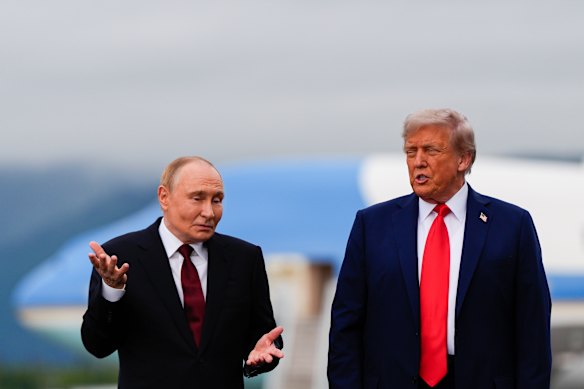
Vladimir Putin (left) could be aiming to cleave Donald Trump from the Ukrainians and the Europeans, analysts say.Credit: AP
US and Ukrainian officials reported progress on talks aimed at amending the proposal, saying they had made some unspecified changes. By late Monday (Tuesday AEDT), the officials had returned home.
It is unclear if Putin will accept those changes. On Friday, in a video conference with security officials, the Russian leader said the 28-point plan could be the foundation for a peace settlement, pending “substantive and meaningful discussion”, or Russia could keep pressing its case in Ukraine by force.
Loading
More Ukrainian cities would fall to Russian troops, “perhaps not as quickly as we would prefer, but inevitably”, Putin warned. He said such a path “also suits us” because Moscow was content to pursue its interests “through armed confrontation”.
His message: his authoritarian system can outlast the resources and will of its adversaries.
“The West has entered a pain contest with Vladimir Putin. Who can withstand more pain?” said Alexander Gabuev, director of the Carnegie Russia Eurasia Centre. “In this competition, Putin can be tough as nails, and his system can be tough as nails.”
The Ukrainians were just as tough, Gabuev noted, but “they are under-resourced”, suffering from a dearth of military personnel, weaponry and money, as well as a lack of unified Western support.
Putin’s ability to continue waging the war isn’t limitless. His economy is facing trouble, particularly after a significant decline in oil revenue, exacerbated by the Trump administration’s recent sanctions. Moscow is raising taxes to cover the war effort and has pruned next year’s military budget. Russia’s forces are on the front foot, but the advance has been slow and costly in lives and materiel.
Still, Putin believes, compared with Ukraine, that time is on his side. And while he appears satisfied to let the peace process either succeed or fail, Ukrainian President Volodymyr Zelensky is under immense pressure on multiple fronts, as Trump was pushing him to accept a settlement plan by Thursday.
The battlefield situation has been deteriorating for Ukraine. Zelensky has been weakened domestically by a ballooning corruption scandal. And Ukraine is running low on cash to sustain its defences and economy, with its European allies vacillating about using billions of dollars in frozen Russian money to fund Kyiv.
Trump has also begun aiming invective again at Ukraine, accusing Zelensky last weekend of expressing “ZERO GRATITUDE FOR OUR EFFORTS”.
Loading
Those efforts produced a 28-point plan that underscored Putin’s unwillingness to bend on the war, and that Ukraine and its European allies are now pushing to amend.
Yuri Ushakov, a Kremlin foreign policy aide, said on Monday that many “but not all” of the plan’s positions were acceptable to Russia, but they required detailed discussion. He said European counterproposals that had been circulating were not constructive.
Most of the provisions in the 28-point proposal reflected Putin’s long-standing demands, including a legally enshrined ban on NATO membership for Ukraine. Still, it is not clear that Putin would accept the plan even in its original form. Some smaller points represent a comedown from previous Kremlin proposals, such as a cap on Ukraine’s military strength at 600,000, versus the 100,000 that Moscow proposed in 2022 talks.
In his remarks on Friday, Putin spun it as if he had already made concessions. He said that when he met Trump in August in Alaska, the Americans had asked the Russians to show flexibility and that he was “ready” to do so.
By this, Putin was probably referring to the question of territory. Russia’s negotiators dropped their initial demand that Ukraine hand over the entirety of the four regions that Moscow “annexed” in 2022, even though Russia doesn’t control huge portions of that land, including two regional capitals.
In Alaska, Putin expressed a willingness to stop fighting if, in addition to accepting his other demands, Ukraine handed over just the part of the Donetsk region it still held. The 28-point plan calls for Ukraine to withdraw from that territory, which would become a “demilitarised zone” recognised as Russian land.
Because Putin has portrayed his war domestically as a rescue operation for the Russian-speaking people of Donetsk and neighbouring Luhansk, it would be difficult to sell a victory at home that does not result in the capture of the rest of Donetsk. Russia already controls Luhansk.
Stefan Meister, a Russia analyst at the German Council on Foreign Relations, said it remained to be seen whether Putin would be willing to compromise. Putin could be aiming, Meister said, to cleave Trump from the Ukrainians and the Europeans, leaving Russia with an easier path to subjugate Ukraine by force.
“Putin’s calculation is he hopes that Trump gets frustrated with Zelensky and backtracks with any kind of support, and if there is no intelligence sharing or long-range missiles, the Europeans can’t replace it,” Meister said.
Ultimately, Meister said, Putin “wants to break Ukraine”.
This article originally appeared in The New York Times.
Get a note directly from our foreign correspondents on what’s making headlines around the world. Sign up for our weekly What in the World newsletter.
Most Viewed in World
Loading