3 months ago
8
3 months ago
8
Australian Open with 4K on Stan Sport.
Every match, live & on demand.
At the pointiest end of sport, what separates the best athletes is wafer thin. What divides the world No.1 from No.3 can be tiny. What separates a grand slam winner from being runner-up yet again? A marginal line call? A skewed shot? Cramp at an inopportune moment?
What Alexander Zverev does not think separates them is his life-long management of type one diabetes.
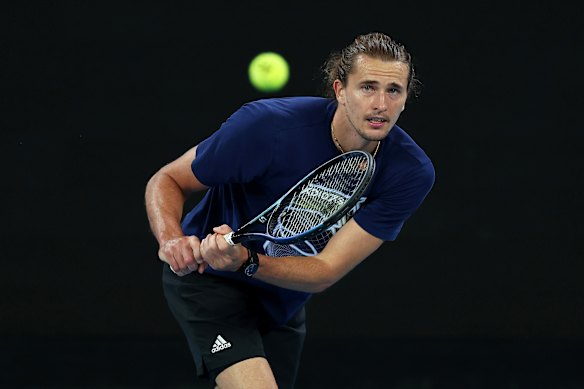
Alexander Zverev is still in search of his maiden grand slam title.Credit: Getty Images
Zverev is the current world No.3. He has been as high as No.2 in the rankings but never reached best in the world. He’s won an Olympic gold medal but never a grand slam title. Three times – at the US (2020), French (2024) and Australian (2025) Opens – he has made the final, but not got over the line.
This weekend, he will return to the Australian Open a year on from losing the final to Jannik Sinner. That final came after an earlier match when he was heckled by a crowd member about accusations of physical and emotional abuse from two former partners. He made an out-of-court payout to one woman who brought charges against him, while also continuing to deny the allegations.
Zverev remains a contentious figure. But he also remains one of the sport’s best, even if the break through grand slam win still awaits.
While margins are small between physically elite players, Zverev does not consider type 1 diabetes to have been a hurdle in his career (he was diagnosed at age four) or the difference between being the best player in the world and the third-best.
Loading
Of course, it’s academic. He cannot know what difference it might have made for him, physically, as a player. But he does understand the maturity it thrust upon him at a younger age than his peers and the discipline it demanded of him that perhaps gave him an edge.
“I think you have to grow up faster when you grow up with it. So, you have to know what is good and what is bad for you from an early age, where maybe you learn that a bit later in your life [without the condition],” Zverev said in Melbourne on Monday night.
“But I would say that I don’t necessarily know, or think, that I would be better without diabetes. I don’t think that.
“I think it is part of my life. It is who I am these days, and maybe it even helped me. As I said, I had to grow up faster. I had to know what is good for me, what is bad for me.
“I was kind of pushing my limits, also maybe a bit more because of the stubbornness that I also have. I’m not unhappy about anything.
“I got diagnosed more than 24 years ago, and I feel like diabetes 24 years ago and diabetes now are very, very different, right?
“A lot of doctors, a lot of specialists, were suggesting professional sports with diabetes back then was like an impossible thing. It was not something that was very, very common. But luckily for me, I had a very stubborn mother, and she was basically saying, ‘My son wants to do something, we’re going to do it’ and we won’t let … this illness limit ourselves.”
He pointed out that Nacho Fernandez, one of Spain’s best footballers, and other gold medal-winning Olympians also had type 1 diabetes.
“I always felt like you could do anything with diabetes, and if you’re managing it right, and if you have it under control, I don’t see why there should be a reason not to be professional.”
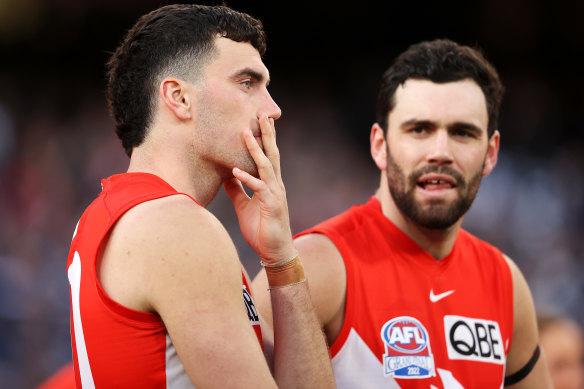
Paddy McCartin (right) and his brother Tom (left) after the Swans’ 2022 grand final loss to Geelong.Credit: Getty Images
A pump that can be worn on the body to regulate insulin levels has been advantageous in managing diabetes for Zverev and former AFL player Paddy McCartin. The Medtronic pumps – they cost $8000 and last four years – are helpful in training and life, but can’t be worn in matches.
McCartin, like Zverev, was diagnosed at a young age but not deterred by his diabetes.
McCartin’s career, which began at St Kilda as a No.1 draft pick and ended playing alongside his brother Tom at the Swans, was cut short by multiple concussions.
He doesn’t believe there is any correlation between the diabetes and the concussions he suffered.
“There was never any sort of signs for that. I think it was just a coincidence, and I was a bit unlucky,” he said.
“I’d definitely looked into it for sure. It would have been silly not to, with the amount of them I had.”
McCartin, like Zverev, was very private about the diabetes for a long period in his career but was encouraged when he arrived at the Swans to open up about it to the players. It helped that Tom was there with him when he did, but he felt it was cathartic.
Most Viewed in Sport
Loading