3 months ago
57
3 months ago
57
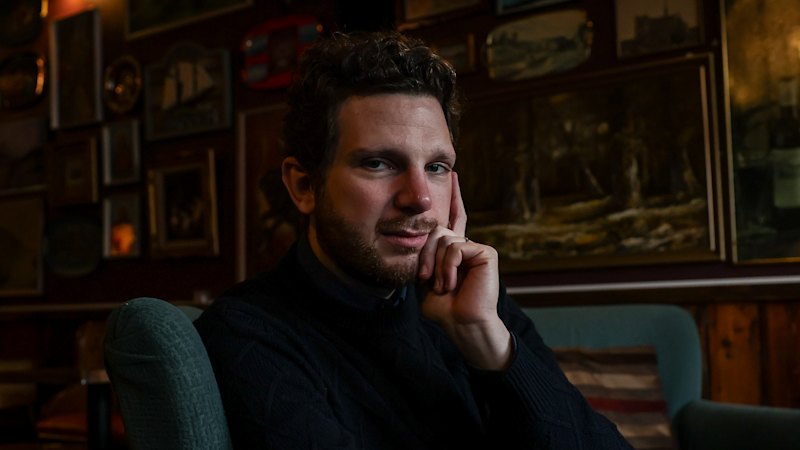
It’s those fleeting seconds before a show starts that Kai Ollmann, one half of emerging Sydney electronic pop duo Barley Passable, worries about. “That first note, the first play, the moment before playing – that’s the most nerve-racking,” he says. “Then you’re all good.”
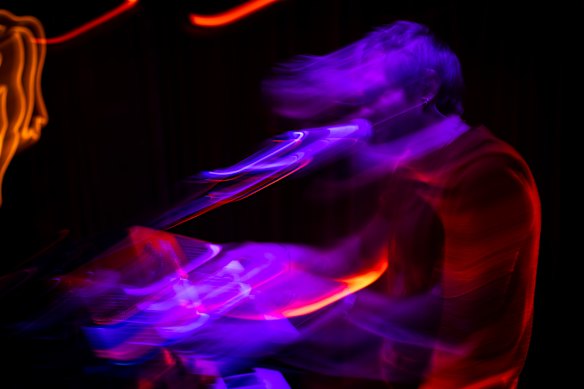
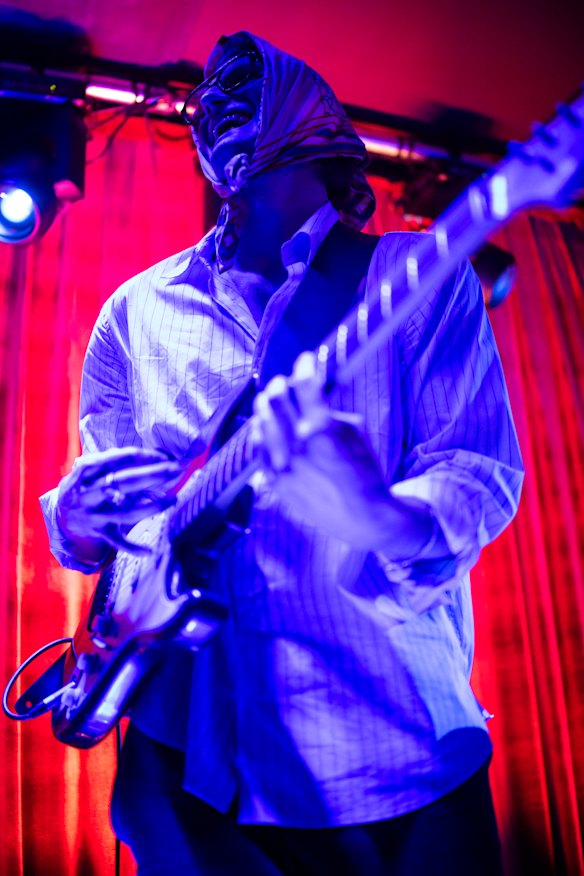
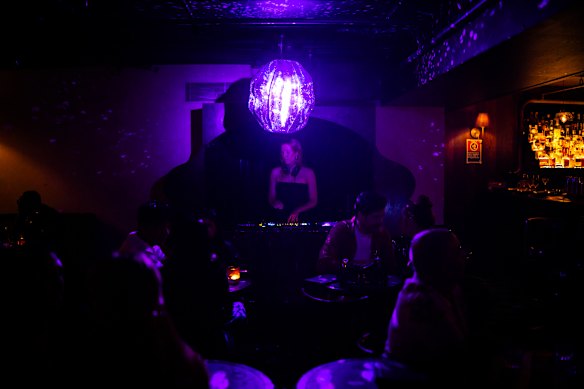
As the band begins their set at Newtown’s Pleasure Club, a 200-person crowd bathed in neon lights grinds, twists and shuffles listlessly.
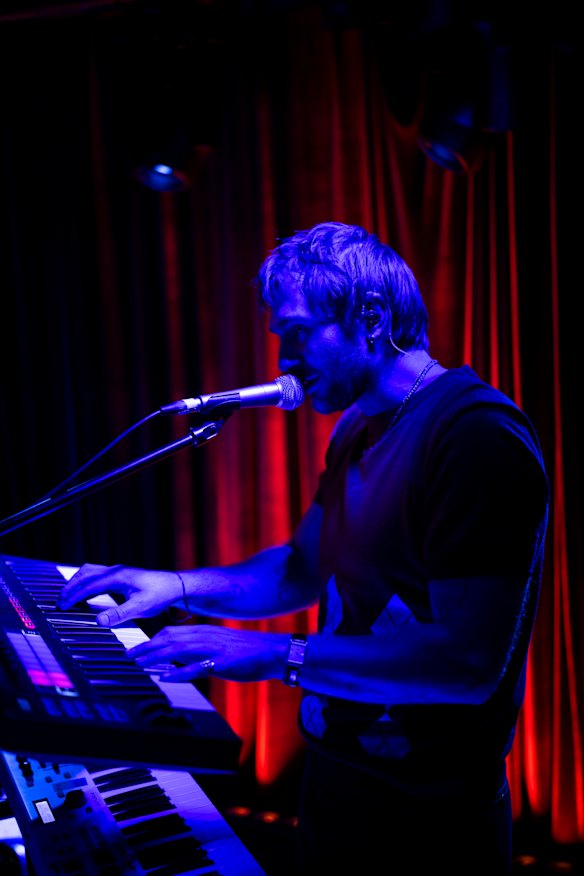
Beads of sweat flicker off the forehead of Davy Brown – the band’s other half – as the set warms up. “That’s when you’re locked in,” the 27-year-old says. “Everything’s hopefully running smoothly. I look over to Kai, and I think, ‘This is pretty cool.’ I’m in the middle of it, the thick of it.”
Barley Passable is a little-known band hoping to make their mark at a time when Sydney’s live music scene has struggled to compete with streaming while also recovering from the effects of lock-out laws and pandemic-era lockdowns.
Ollmann, 27, believes live shows are just part of an emerging band’s success. “You release so much more music now because it’s cheaper to make, and shows have high ticket prices.”
“I don’t think there’s a specific ticket to success,” Brown says. “Otherwise we’d be taking that train one way.”
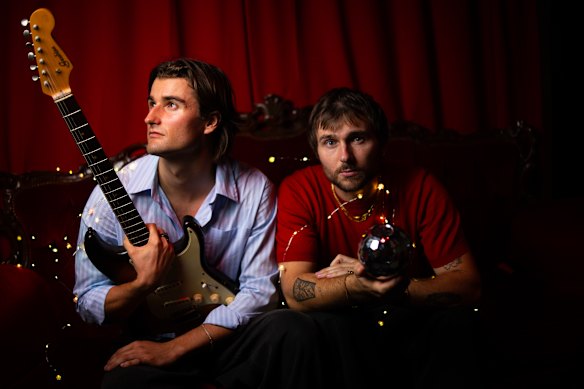
The duo, who met while training at the Sydney Conservatorium of Music, have heard how the now-defunct Surry Hill’s Hopetoun and Newtown’s Sandringham Hotels were once great cradles for the city’s future bands. They closed in 2009 and 2017 respectively, both citing red tape.
The Landsdowne Hotel in Chippendale survives and continues to foster local bands, but it does so in a new ecosystem: one where fans can stream music cheaply, but pay far more to experience it live.
Inner west and inner-city venues are leading the push in locations where bands are clamouring to establish themselves, Ollmann and Brown say. Some popular venues include the Oxford Art Factory in Darlinghurst (whose founder, Mark Gerber, recently acquired the Lansdowne), Mary’s Underground in Circular Quay and Newtown’s Pleasure Club.

Musicians once lived and died by selling records and CDs. Now, Spotify pays artists between $0.003 and $0.005 per stream on average, meaning if a tune hits 1 million listens, the artist – depending on royalties – will earn between $3000 and $5000.
“The more people listen to us, great, but we get no money out of it,” Ollmann says. “If someone likes it, then presses ‘follow’, then finds out we have a gig, and then comes to our gig, buys a T-shirt and signs up to our mailing list, that’s the tier [to start generating money from fans]. Streaming is like the lowest tier of entry.”
Brown estimates that 10,000 streams on Spotify is worth the equivalent of selling a band T-shirt.
While streaming has taken a cut of musicians’ revenue, it has not decimated the city’s live music scene as much as the lockout laws did when they were established in 2014.
Operating for over a decade in response to alcohol-fuelled violence, the laws applied a 1.30am lockout and 3.00am last drinks in the CBD and Kings Cross. Alcohol related night-time assaults followed a downward trend in former lockout areas; however, the era left a generation without nightlife and caused major disruption to the city’s night-time economy. The restrictions were lifted in January.
The state government’s vibrancy reforms, first introduced in 2020 by the Liberal government and continued by Labor in three tranches, are reversing this damage.
Since March 2023, there has been a 320 per cent surge in venues accessing live music incentives, according to data provided to the Herald from NSW Music and the Night-time Economy.
The incentive affords eligible venues an 80 per cent discount on liquor licensing fees and an additional two hours of trade on nights they host live music, with 564 venues across NSW accessing the Minns government scheme in 2025, compared to 133 in March 2023.
Brookvale’s 7th Day Brewery has increased its number of annual gigs from 80 to 300 under the incentive. Of the 564 live music venues registered with Liquor and Gaming NSW, 406 are in metropolitan areas, and 158 are in regional NSW.
Outside the inner west and the inner city, Parramatta, Manly and Cronulla are emerging as Sydney live music hotspots, boasting six, eight and nine venues respectively.
In the hundreds of new and revived bars and pubs across Sydney, artists radiate music from their souls into crowds. From afro-beats to techno, jazz, heavy metal, hip-hop, electronic-pop, indie-rock and reggaeton, artists are commanding younger audiences with bold sounds. They’re also forging the city’s musical identity.
The introduction of poker machines in pubs in 1997 contributed to the decline of the first wave of Australian pub-rock that produced household names such as AC/DC, Midnight Oil, Cold Chisel and INXS, from venues such as Selina’s in Coogee, the Royal Antler in Narrabeen and the metropolitan Civic Underground, among many others.
The second wave of electronic music was cut off by lockout laws, but not before talents such as Flume, Flight Facilities, and Alison Wonderland took off.
NSW Minister for Music and the Night-time Economy John Graham says the lockout laws stalled Sydney’s third wave of musicians – one he believes might take another decade to produce.
“[Young musicians] could produce a third wave of Australian music. A Sydney sound, that will probably take 10 or 15 years,” Graham says. “We don’t know which of these bands will go on to tour the globe and really explode onto the music scene, but you can almost feel there will be some, and that’s really exciting – as a music fan.”
Graham – whose favourite Australian artists include Nooky in the First Nations supergroup 3%, Kobie Dee and Max Jackson – says Sydney’s night-time economy stands out during international policy discussions at a time when most global cities are losing music venues.
“It’s quite an active discussion between New York, London, Berlin, Rome, Tokyo, Barcelona, all these cities competing to reach their potential, sharing tips about what’s working and what’s not,” he says.
“This is really unusual for us to be heading the other way, and to head the other way in such big numbers – it’s really encouraging.”
Sabrina Medcalf, operations manager for hospitality group Odd Culture (which owns Pleasure Club), says more venues should host free gigs, pay artists fairly and have nights to encourage local talent for the city’s live music scene to keep thriving.
Because live music isn’t a revenue stream for venues, Medcalf says, it is often treated as a “necessary evil” rather than a way to “secure recurrence, to show the precinct is vibing, and to keep hospitality evolving”.
“Sydney’s music scene is breathing with CPR from venues and government bodies … new bands are starting every week, and it’s important for venues to get greener artists in to give them not only the money to help them tour and stay afloat, but to give them a chance to see how it is to be treated properly in a venue.”
Graham agrees. “Especially with interest rates on the way up, [hospitality] is still a tenuous business, and that’s what we’re really watching, what we’re concerned about. [The data] is a good sign that things are coming back, but we are not there yet.”
Meanwhile, for the Barley Passable duo, balancing their passion for making music with tracking their social media and Spotify popularity creates conflicting emotions.
“The experience of expressing ourselves through music is the whole reason why we play,” Ollmann says. “It’s not for clicking release and watching numbers.”
Brown adds that performing music live, of having “people sing back your song to you”, feels amazing.
After a gig, Ollmann says it feels like everything was worth the struggle to break through. “We just destroyed ourselves trying to make this set and finish all this music,” he says. “We’re so tired, and you get to the end, you’re like, ‘That felt incredible.’ ”
Must-see movies, interviews and all the latest from the world of film delivered to your inbox. Sign up for our Screening Room newsletter.