3 months ago
11
3 months ago
11
What’s in a name? If you are the celebrated Professor Jagnoor Jagnoor, it adds up to a legacy of defying racist, religious and sexist stereotypes.
A question about her name is one that Jagnoor, an epidemiologist and the head of injury prevention at the George Institute for Global Health, anticipates when we arrange lunch at Mediterranean-influenced restaurant St Siandra, near the Spit Bridge in Sydney.
It is often the first thing others ask the global drowning prevention expert or quietly ask people who know her before they meet.
Despite knowing Jagnoor for a decade while reporting on water safety, I have never questioned her about it. (Maybe it is because my full name is Julie Anne Julie Power, a weird family story.)
Jagnoor’s name was a snub to convention by her mother, Dr Manmeet Kaur, a health promotion educator. Called a tautonym, it is a bit like being called Thomas Thomas. Unusual for India, it was her mother’s way of rejecting the practice of naming a child in a way that immediately pigeonholes religion and caste.
“[My mother] was progressive for her time,” says Jagnoor, who moved to Australia more than 20 years ago to do a master’s degree in public health (and ended up staying, marrying and having two children).
Between delays caused by roadworks, Mosman Council’s temperamental parking meters, the arrival of photographer Edwina Pickles, and me getting lost, it takes us time to settle into St Siandra and order.
Jagnoor chose the restaurant because it is near water, the foundation of civilisation, a source of joy to many, and sorrow to the families of the 300,000 around the world who fatally drown every year.
She has been instrumental in reducing drowning rates in parts of the world where the equivalent of a kindy class of children aged one to five from the poorest of families fatally drowns every week. That compares with one kindy class a year in Australia.
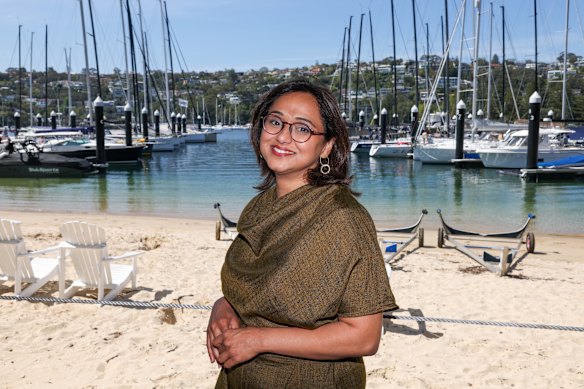
Jagnoor chose a restuarant near water, a source of life but also heartache.Credit: Edwina Pickles
The fix? Jagnoor worked with local communities to establish small free crèches that provide supervision and preschool education to care for children who live near ponds and other water bodies while their mothers work.
It lifts all boats. Described by Jagnoor as the “least glamorous fix for the biggest ripple effect”, these crèches reduce the risk of drowning by more than 80 per cent, improve the employment of women, and kickstart the education of young children.
But more on that later.
To start with, Jagnoor recommends the flat bread, something she makes three times a day. “Food is a love language,” she says. Everything in her home is made with ginger and garlic, she confides, a precursor to a delightful discussion about the joys of Indian lime pickle.
Over the potato flatbread with smoked garlic and some roasted cauliflower, both as good as she promised, Jagnoor sums up her backstory.
An only child, she was born in Chandigarh in northwestern India to two progressive academics in an era when India appeared to be embracing the Chinese one-child policy that also favoured boys over girls.
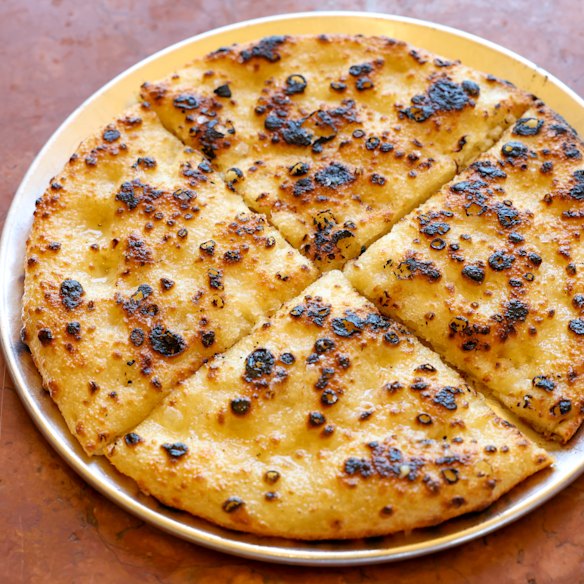
Potato flatbread at St Siandra.Credit: Edwina Pickles
If her parents had followed Sikh convention, her surname would’ve been Kaur. “My mother thought: ‘I have one child. I have a daughter, and I’m not going to give her a surname. It represents your religion and your caste. And if you want to have equity in society, you don’t want to have those hierarchies’.”
“She always said, ‘I never want you to be boxed in, I would like you to be a global citizen’.”
“You were born a human,” her mother told Jagnoor. “We all are, and then we are tagged and labelled in different ways. I would like you to die a human.”
“I hold that dear to my heart,” Jagnoor says.
Jagnoor – a vegetarian – orders the eggplant katsu, and I order the hanger skewers, and a salad. We both drink tap water.
When her main course arrives, I have FOMO. The eggplant is crunchy and crisp, and when she cracks it open, it oozes with creaminess. She gives me a taste. Then another. My skewers are good, but not quite as delicious.
Over lunch and follow-up chats, Jagnoor talks about prejudice towards people with brown skin in global research, and a bias that results in academics from the Global North being deferred to and given first credit rather than local experts.
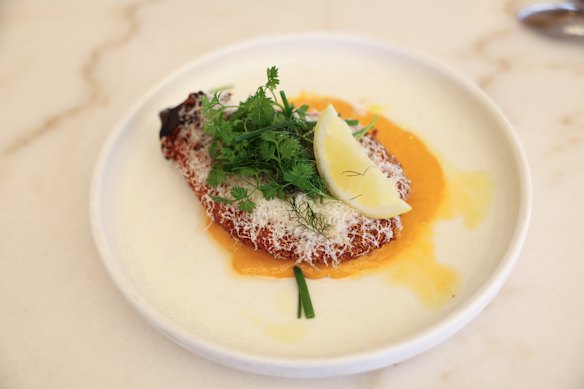
The eggplant is crisp on the outside but creamy inside.Credit: Edwina Pickles
As someone who lives in Castle Hill but was born in India, who works in Sydney (at the George Institute and UNSW) but travels to the subcontinent for work and family, Jagnoor sees herself as a kind of “double agent” able to navigate both worlds.
Australia is home to more than 900,000 people born in India, the most recent Census found, and Indians are one of the nation’s fastest-growing population groups.
Jagnoor, voted one of the 40 most influential Asian-Australians under 40 a few years ago, says they are underrepresented in leadership roles like hers.
Originally graduating as a dental surgeon in India, hearing an interview about an undertaker who worked in Delhi’s slums changed her life. The undertaker said he had found a little girl cuddling her dead father’s body, seeking warmth in Delhi’s bitter winter. “Because there was no clothing, no blankets,” Jagnoor explains. “It was that level of poverty and inequity in a city that has so much affluence.”
Raised to believe that health and education are great equalisers, she switched to studying a master’s in public health at Sydney University, intending to devote herself to overcoming inequality.
While undertaking a doctorate and coming across a chart relating to the so-called Million-Death Study, which identifies the causes of death in India, she found her calling.
“I realised that ... drowning is the leading cause of death for children aged one to three,” she says.
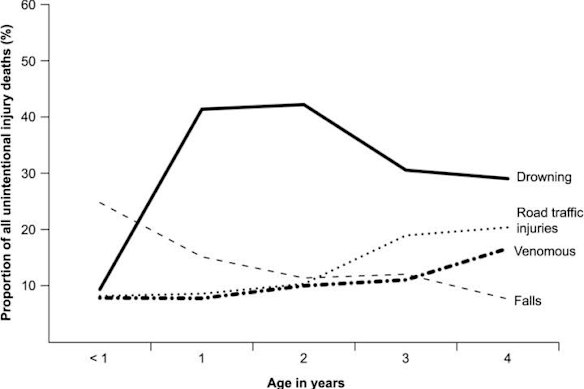
The chart that opened Jagnoor Jagnoor’s eyes, showing the steep rise of children who died from drowning from one to five in IndiaCredit: Jagnoor Jagnoor
“I was looking at a line diagram – I still have that figure right in front of my eyes – where on your X axis, you have your age groups, and you’re looking at zero to one, one to two, etc. and you see this steep line going up.
“And you look at that variable, and the cause of death is drowning. That number, having that evidence, was definitely the triggering thing.”
“You have to stop and say, ‘Oh, man, we are doing so good with immunisations, so much effort, so much resources, we put so much effort into nutrition and now something as preventable as drowning [is killing children]’.
“You start considering how much investment goes into everything else versus how much goes into drowning. We often call it a silent epidemic. I think it is silent in many ways.”
Experts say drowning, like road safety, falls in the canyons between disciplines. It is not quite health, not quite infrastructure, nor is it swimming and sport. And it is something that disproportionately kills the poorest people in the world, with 92 per cent of deaths in low to middle-income countries. In Australia, drowning deaths are two to three times higher in disadvantaged communities.
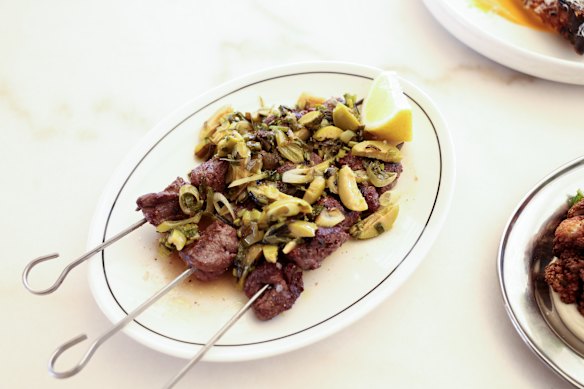
St Siandra’s skewers.Credit: Edwina Pickles
“I have had high-level bureaucrats and policymakers sit across me and say, ‘What is the solution? If you talk to us about malaria and tuberculosis … the solution is clear. ’ With drowning, it is not like you can give one shot of a vaccine, and you have prevented it; it is very much a Swiss cheese approach. You need multiple layers at multiple levels.”
In much the same way that policy for women is often created by men, she discovered that knowledge and research were often shaped by outsiders, Western academics. “It was a kind of ‘colonial love’,” she says, that stood in the way of progress.
“I remember my own distance vividly: flying from Sydney to Kolkata, then to rural West Bengal, speaking of global drowning statistics to people for whom water was life, not ‘risk’.
“Their initial silence was not indifference but resistance to a foreign frame.”
The key was listening to those whose voices were often least heard. Whenever she asked a community head to provide the number of children who drowned, they would say, “Drowning is not our problem. We have a problem with water salinity. We have a problem with access to clean drinking water, we don’t have a public health community centre.”
But when she talked directly to the people in the community, there was silence, “then heads nodded, and stories emerged”, she said. “Then you sit with the community members, and you ask, in the last 12 months, did anyone in your household drown? And then there’s not a single household that won’t have lost a child.”
“Every family carried loss.”
Those conversations led to a local survey in West Bengal of 800,000 people, which later expanded to 18 million with Bloomberg Philanthropies’ support.
The research by Jagnoor and others found the drowning mortality rate for children aged 1 to 4 years was 243.8 per 100 000 children, five times the rate of children five to nine. Most had drowned in ponds within 50 metres of their homes while a carer was working in the home.
“The numbers revealed what silence had long held – a kindergarten of young children drowning every month in the state West Bengal, most of them less than 100 metres from their household.”
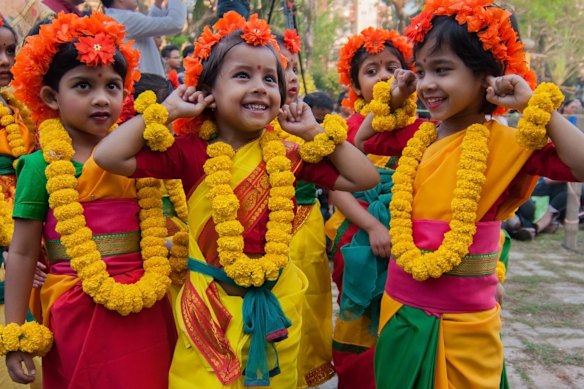
Community crèches are being rolled out in West Bengal to save the lives of children under five.Credit: Getty Images
Funded by UNICEF and the Australian government, the crèche program was first implemented in Bangladesh in 2010. With support from the World Health Organisation, it was expanded in 2012 and 2014, with multiple funders coming on board over the next decade. From 2012 onwards, it gained national recognition and became government policy in 2024, with further support from Bloomberg Philanthropies facilitating its expansion into West Bengal, India.

The bill.Credit: Nine
The Centre for Injury Prevention and Research in Bangladesh found that the small, free crèches were more than 80 per cent protective of death by drowning. As a result, another 700 community-owned crèche centres that provide safe supervision for children aged one to six years are being rolled out across the Indian subcontinent.
There are other benefits too. Families are often delighted by the head start the crèche gives children. Jagnoor says children learn how to say hello in English, count and read. (Children who go to the crèches are more likely to attend primary school.)
They also free older sisters, who are otherwise stuck minding their siblings, to work and study.
These crèches aren’t charity but a kind of justice for women.
“Feminist thinking helps name what this feels like: a shift from ‘speaking for’ to ‘working with’, from distant expertise to collective meaning-making,” Jagnoor said.
Asked what achievement makes her proud, Jagnoor surprises. It was a recent safety conference she organised in India that her colleagues said was a masterclass in diversity, equity and inclusion. Local experts took to the stage to talk about their experiences. Western academics sat in the audience.
Loading
We don’t have dessert. But it is nice to linger and chat over coffee, before ducking off to discover that we paid the price. We both cop parking fines of $140 – my meter didn’t work. Jagnoor was a minute over time.
Start the day with a summary of the day’s most important and interesting stories, analysis and insights. Sign up for our Morning Edition newsletter.