
There's a moment each morning, just after the cleaners and the waiting in line, when visitors to the Sagrada Família in Barcelona get their first glimpse. Nearly everyone gazes up.
"You'd have to have a soul made of stone not to kind of, when you step over the threshold, for your spirit just to lift up with that light," said writer Gijs van Hensbergen.
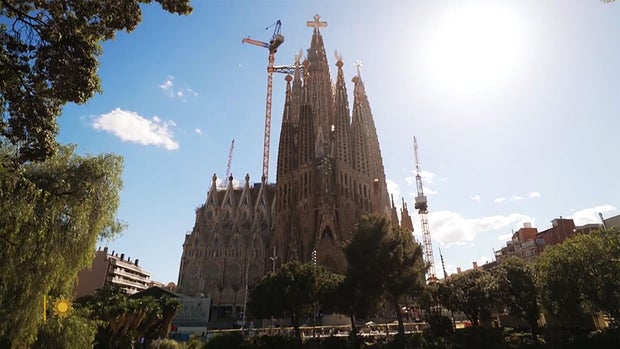 The Sagrada Família in Barcelona.
CBS News
The Sagrada Família in Barcelona.
CBS News
The Sagrada Família soars 50 stories. It's imposing and intriguing, a fantasy of forms. It has been redefining Barcelona's skyline for nearly a century and a half, and it is still under construction.
At 566 feet, it's taller than the Washington Monument in D.C., but lower than nearby Montjuïc. Asked why, architect Mauricio Cortes replied, "Out of respect; Gaudí didn't want to surpass the work of the Creation."
The Basilica's architect Antoni Gaudí wanted to build a "Bible out of stone." In February, the newest of 18 towers (this one dedicated to Jesus) was crowned with a cross, making the Sagrada Família the tallest church in the world.
"It culminates more than a decade of work," said Cortes. "It's like a dream come true."
"Your dream? Gaudí's dream first?"
"Yeah, Gaudí's dream, and five generations, really," he replied.
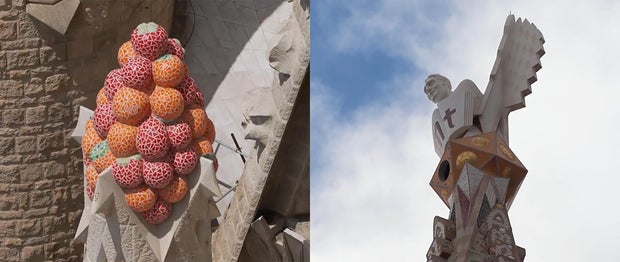 Exterior decorations at the Sagrada Família.
CBS News
Exterior decorations at the Sagrada Família.
CBS News
Gijs van Bensbergen wrote a biography of the visionary architect, whose buildings across Barcelona can seem shaped by hand. "He was an extraordinarily ambitious architect, probably the most ambitious architect in history," he said.
Gaudí's basilica could be described like a sand castle on a beach. "Absolutely, however serious and profoundly Catholic he was, I think he always had this wonderful capacity for joy, for playfulness," van Bensbergen said.
The basilica's chief architect, Jordi Faulí, began working here in 1990. "Gaudí was an extraordinary architect," he said. "He created beauty."
According to Fauli, Gaudí wanted the interior columns to appear like a forest: "He designed this structure, columns, that are divided in different branches to support all the weight of the church only with these internal trees."
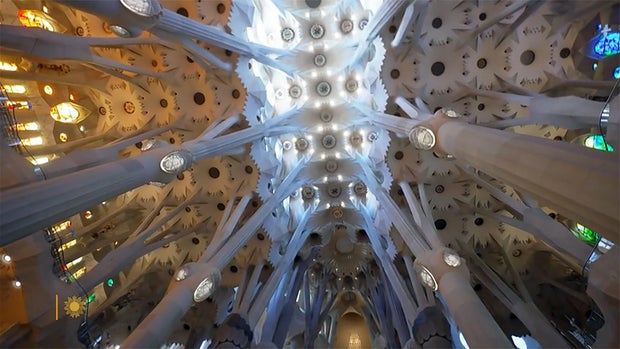 The interior of the Sagrada Família.
CBS News
The interior of the Sagrada Família.
CBS News
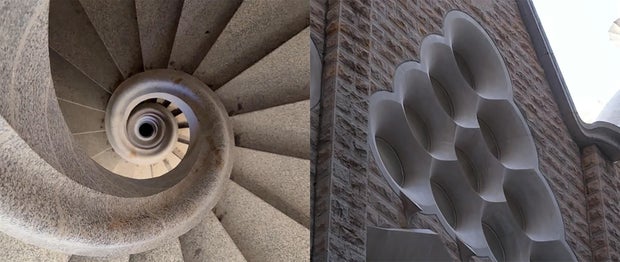
Nature figures throughout the basilica: there's a staircase resembling a snail shell, and honeycomb-like hexagons.
 CBS News
Antoni Gaudì was commissioned, in 1883 at just 31, not by a Catholic diocese, but a local bookdealer. He worked on the church for 43 years, in the end, living on the construction site. Exactly one hundred years ago, on June 7, 1926, Gaudí was crossing the street when he was struck by a tram. He was so disheveled that no one recognized him. Ultimately, he was taken to a hospital, where he died of his injuries three days later.
"It's almost a state funeral when he dies," said van Hensbergen, "because by that time the Catalan identity had become enshrined in Gaudí's personality."
But when he died at age 73, only about 10 to 15 percent of the structure was complete.
Fauli says, while Gaudí knew he wouldn't live long enough to finish the Sagrada Família, "He left a lot of information in order to make possible that in the future his successors will build following his ideas, his project."
Those ideas were mostly in the form of models. But divining Gaudí's intentions has required detective work, because during the Spanish Civil War, anarchists protesting the Catholic Church set fire to parts of the structure, and smashed Gaudí's models into 8,000 pieces. Using photographs as guides, models containing some of the surviving pieces could be reconstructed, filling in what was missing.
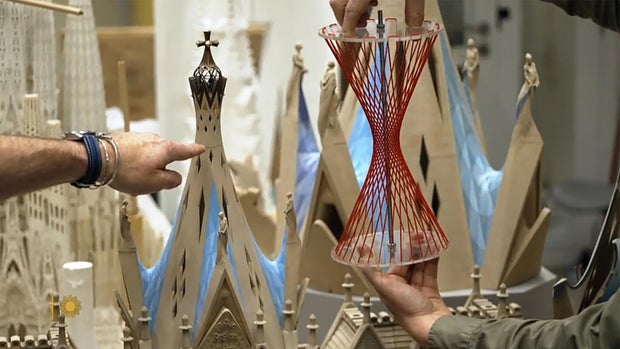
According to Esteve Umbert, one of the architects, Guadì also left geometric clues to help with construction, such as a hyperbolic paraboloid used to divine the shape of a church spire.
 CBS News
Sophisticated software and modular construction have sped up building. It's all paid for by ticket sales - over $150 million collected last year from nearly five million visitors. It is Spain's top tourist destination. Walk around here and you'll likely see more selfie sticks than rosary beads. Protesters decrying overtourism have shot water pistols at tour buses.
The Basilica has also endured aesthetic critiques. Asked to respond to critics of Gaudí's design, Fauli said, "The people could have his opinion, it's normal, no? But all we build, it's according to Gaudí's ideas."
Does he ever disagree with what Gaudí had decided? "No. Never," he replied.
Significant work still lies ahead on what the Guinness Book of World Records already says is the oldest active construction site in the world. A staircase Gaudí envisioned would require demolishing nearby homes and businesses.
How many years will it take to finish? "We don't know," said Fauli. "10, 15, 20, we don't know."
Asked if he think he will live to see it completed, he replied, "I don't know. Perhaps? I don't know."
Fauli may appreciate the approach of his predecessor, for whom time was but an earthly concern. Guadí said his client was God and, quote, "God is not in a hurry."
For more info:
- The Sagrada Família, Barcelona
- "The Sagrada Família: Gaudí's Heaven on Earth" by Gijs van Hensbergen (Bloomsbury USA), in Hardcover and eBook, available via Amazon, Barnes & Noble and Bookshop.org
Story produced by Robert Marston. Editor: Ed Givnish.
The Sagrada Família
The Sagrada Família
(08:08)

















































