3 months ago
15
3 months ago
15
The British Museum once held an exhibition called A History of the World in 100 Objects. The idea was that these objects – sometimes humble, sometimes priceless – told the story of humanity. I’d like to mount a more modest display. I’d call it The Australian Beach Holiday in 20 Things.
First up, as you entered my special museum, would be a glass cabinet featuring a set of Kellogg’s Variety Pack cereals. The purchase of these, in most families, marked the start of an Australian summer holiday. Sibling rivalry finally found its proper battlefield – squabbling over which child snaffled the Coco Pops and who got lumbered with the Sultana Bran. Best of all, the tiny box turned into a bowl, introducing a touch of magic to the humblest of holidays.
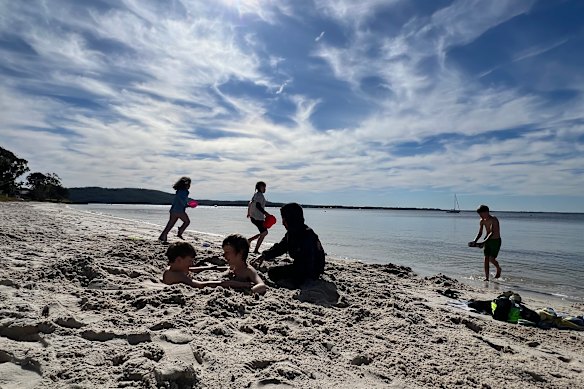
There a few key markers of the classic Australian beach holiday. Credit: Delyse Phillips
Next, inside the first display area in my museum, there’d be a display of thongs. No, not the ones that show off your bum. I mean the type that goes on your feet, one rubbery edge worn down to almost nothing, to facilitate the tight turn into the takeaway shop when you need some hot chips in a hurry. The pair of thongs we’d feature would be double-pluggers, of course, a nod to the fact that Australians have the need to traverse some rough terrain. Who wants a thong blow-out when you’re making your way to the nearest slice of heaven?
A pair of Speedos will be featured in an adjacent glass case, with photographs of the garment being worn in the wild. Museum visitors will be able to witness one of the stranger paradoxes of Australian masculinity: the more aged and decrepit the body, the briefer the swimwear. I speak, of course, of myself.
The braver among our visitors will then enter a curtained-off vestibule, with a warning sign about the sensitive nature of the artefacts within. There’ll be display cases revealing the perils of an Australian summer. On one wall: a lurid medical photograph of a foot ravaged by tinea – the infection caused by simply walking past the caravan park shower block. On the wall opposite: a citronella candle and a mossie coil, with a sign explaining their curious ability to attract, rather than repel, any passing swarms of mosquitoes. There’s a picture of a pie left too long in a pie-warming machine at the local municipal pool – along with a video of the shocking medical aftermath. Then, in this chamber of horrors, a diorama of children in the 1960s – those from the era before “Slip, Slip, Slap”. Visitors will be invited to pull a strip of Velcro from its backing so that they might hear a sunburnt child who, after a long day at the beach, was being removed from the vinyl seat of a 1969 Holden.
And finally, in this curtained room, there’d be a horrific photo of a bluebottle sting, with a note explaining how the medical advice changed every year. Suggested treatments included hot water, cold water, vinegar, booze, and – weirdest of all – weeing on yourself. A museum guard would be on hand in case any visitors were tempted to try out the remedies, particularly the last.
The Irish may be good at making music, the Brazilians may be adept at barbeques, but my God we Australians know how to pack an Esky.
Visitors, shaking off the horrors they had experienced, would then encounter our main display space. In the centre of the room: a large Esky, packed with considerable precision. The bottom layer is constructed from cans of beer, with the food sitting on top. Thus does the melting ice drain into the gaps between the cans, leaving the tucker cold but dry.
The Irish may be good at making music, the Brazilians may be adept at barbecues, but my God, we Australians know how to pack an Esky.
A Hills Hoist is also featured in this central space, its arms outstretched. Colourful beach towels hang like bunting. Rash vests and cossies, some stained by sun cream, flutter. A sweet summer breeze has, of course, been created by our museum’s clever engineers. Visitors will note that no socks are drying on the line, since no one here has worn shoes all week.
Loading
We’re nearing the end of our exhibition, but we end with a special treat: an exit tunnel filled with the sounds of summer. There’d be the sharp giggles of little kids as the first waves of the day splash against them. Next, a kookaburra’s laugh, followed by the sound of a helicopter overhead, checking for sharks. The ch-ch-ch of a backyard sprinkler, set up not to water the lawn, but to entertain more squealing kids. And, finally, the hypnotic murmur of a TV tuned to the cricket, half-watched by a bloke who is half-asleep on the couch.
We’d have a gift shop, of course, like all cash-strapped museums. We’d sell ashtrays modelled on the one your parents once stole from a Gold Coast motel. There’d be small packets of sand which you could deposit in your bed once you got home. A barbecue apron would be on offer, with various “humorous” slogans, mostly claiming the wearer was an Emperor of the Tong dynasty.
My exhibition may not have all the majesty and grandeur of the British Museum’s 100 Objects, but at least it tells a small – and glorious – part of our own Australian story.
Most Viewed in Lifestyle
Loading