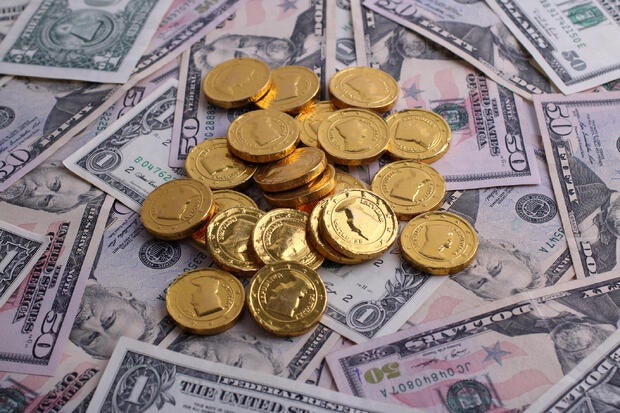
 The relationship between gold and the U.S. dollar is a relatively straightforward one.
Getty Images
The relationship between gold and the U.S. dollar is a relatively straightforward one.
Getty Images
Investors have long viewed gold as a steady hedge during periods of economic uncertainty, but its role in today's markets is evolving rapidly. Recent shifts in monetary policy, stubborn inflation risks and rising geopolitical tensions have all reshaped how investors think about safety, value and long-term protection, and have pushed traditional market relationships to their limits.
Against that backdrop, gold's recent price behavior has been anything but ordinary. After breaking through key price thresholds in 2024 and 2025 — first $3,000 per ounce, then $4,000 — the price of the precious metal has continued climbing in 2026, recently surpassing $4,600 per ounce and setting a string of new all-time highs. What once looked like a cyclical upswing now resembles a sustained re-rating of gold's place in the global financial system.
A combination of persistent central-bank buying, shifting rate expectations and changing investor attitudes toward risk has helped keep gold's momentum intact. Perhaps most surprising, though, is how the metal has behaved alongside a relatively strong U.S. dollar, challenging long-held assumptions and leaving many investors wondering what comes next. Below, we'll break down what investors should know now.
Wanted to invest in gold now that the price is climbing? Get started here now.
The relationship between gold prices and the dollar
Below, experts break down why the price of gold keeps climbing and the precious metal's complex relationship with the dollar.
Why gold prices have been climbing
"Gold can be a valuable asset in a portfolio precisely because it has [a] low correlation with other asset classes," emphasizes Ben Nadelstein, head of content at Monetary Metals.
This independence from traditional market patterns has caught investors' attention, especially as the economy faces increasing uncertainty. The appeal of gold's unique behavior has helped drive its impressive price climb, but it's not the only factor at work. Industry professionals highlight other forces that have pushed gold prices higher:
- Central bank buying: Central banks have dramatically increased their gold reserves in recent years and continue to do so.
- Investor sentiment: More investors are adding gold to diversify their portfolios amid inflationary and financial stability concerns.
- De-dollarization: The BRICS+ nations are reducing their dependence on the U.S. dollar.
- Market evolution: Gold prices now respond to a broader range of global economic factors.
How gold prices typically move with the dollar
Henry Yoshida, co-founder of Rocket Dollar, highlights that gold prices and the U.S. dollar traditionally move in opposite directions.
"A stronger U.S. dollar will suppress the price of gold, while a weaker U.S. dollar will likely drive the price of gold higher through increased demand," Yoshida says.
But Michael Petch, co-founder and president of Argo Digital Gold, points out that this relationship isn't absolute.
"[When there's] financial instability, gold and the dollar may [go up as people] seek safe-haven assets," Petch says.
The complex interplay between gold and the dollar
"Large-scale government accumulation has added a demand-side force that can push [gold] prices higher, even in a strong-dollar environment," Petch says.
Beyond this influence, Kevin Bryan, director of customer experience at The Alloy Market, points to several often-overlooked factors that create a more nuanced dynamic:
- Supply limits: Mining strikes and environmental regulations can restrict gold production. As a result, gold prices may go up, even if the dollar is strong.
- Geopolitical risks: Rising global tensions and trade disputes create uncertainty. Naturally, this drives people to invest in safe-haven assets such as gold.
- Inflation concerns: Investors may turn to precious metals, including gold and silver, to hedge against inflation, regardless of current dollar strength.
- Digital gold investment vehicles: Investment products such as exchange-traded funds (ETFs) have made gold more accessible but also more sensitive to market sentiment. This creates new patterns in the gold-dollar relationship.
- Foreign policy changes: More countries are reducing dollar holdings in favor of gold, creating steady demand.
Gold's price trajectory and key indicators to watch
Several market indicators can help you track gold's price trajectory. Petch suggests looking beyond the usual metrics, such as inflation rates and the Federal Reserve policy. Here are the signals experts recommend keeping a close eye on:
- Central bank buying: Continued purchases by major national banks signal strong long-term demand.
- Real yields: Gold tends to shine when inflation-adjusted interest rates decline.
- U.S. fiscal policy and Treasury market: Growing concerns about U.S. debt levels could drive more investors to gold.
- Supply and demand: Gold lease rates and mining production levels help gauge market strength.
- Geopolitical tensions: Trade wars, tariffs and global instability often increase gold prices.
The bottom line
Understanding gold's relationship with the U.S. dollar can help you make smarter investment decisions. Today's gold market offers plenty of ways to invest. For example, you might choose gold bars and coins to hold tangible assets long-term or buy gold ETFs if you prefer easier buying and selling. Opening a gold IRA could be smart if you're thinking about retirement planning.
But before jumping into gold investing, consult your financial advisor about which approach best fits your goals and portfolio strategy. They can help you weigh your options and create a personalized plan.
Edited by Matt Richardson